Synchronizing Structural Takedown with Adjacent Operations
The Complexity of Shared-Site Operations
Demolition doesn't happen in isolation—it typically occurs adjacent to active construction, ongoing business operations, or other concurrent projects. Synchronizing demolition with adjacent activities is one of the most complex aspects of modern construction management. A missed coordination between a demolition crew and adjacent operations creates safety hazards, schedule delays, and cost overruns.
The fundamental challenge is that demolition has inherent properties that conflict with parallel operations: vibration, dust, noise, equipment movement, and unpredictable sequences. Meanwhile, adjacent operations require stability, clean conditions, defined schedules, and safe working environments. Managing the intersection of these conflicting needs demands explicit coordination protocols and architectural understanding of how operations truly affect each other.
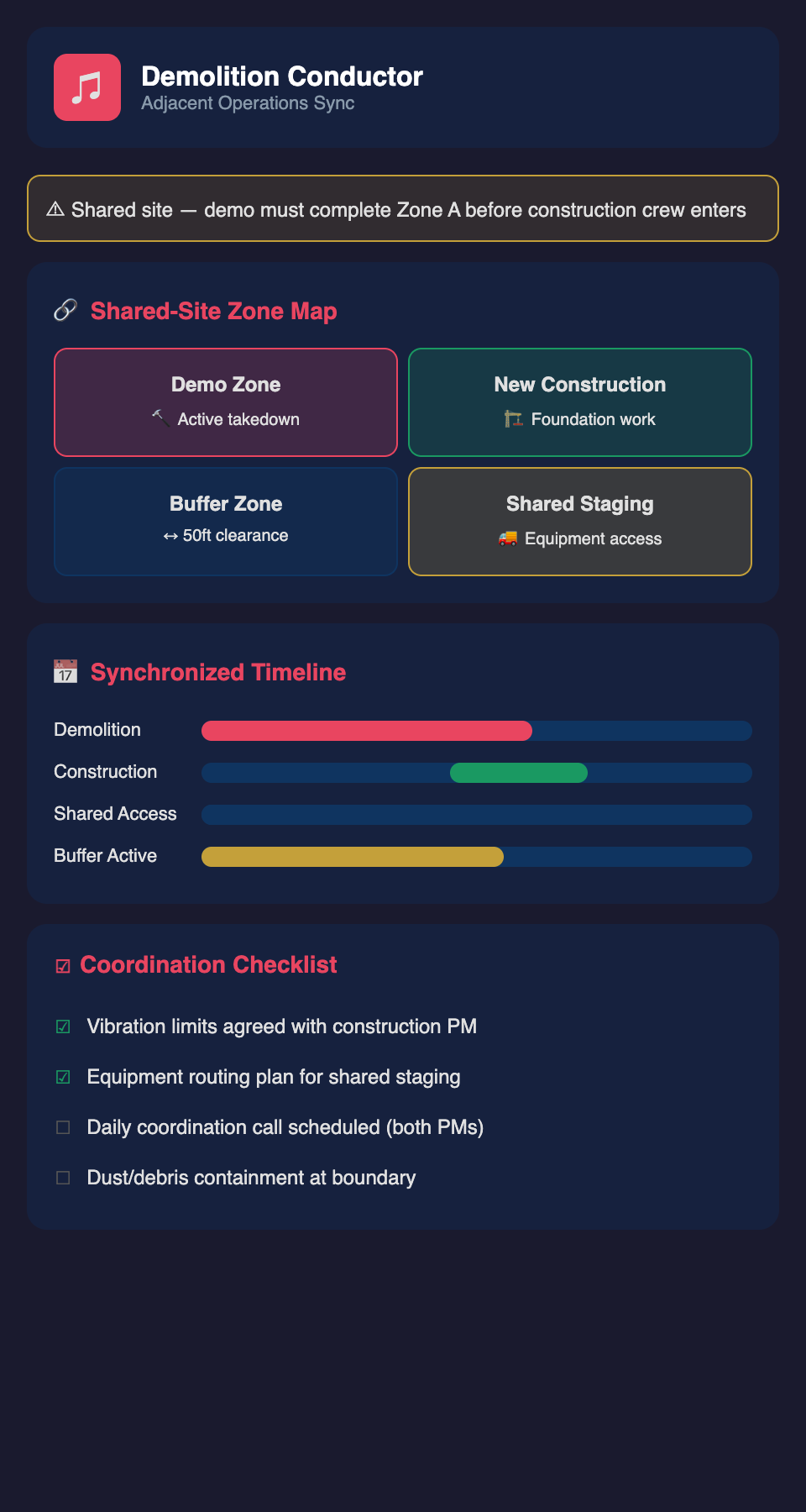
Identifying True Adjacency Hazards
Not all adjacent activities create coordination requirements. A demolition project in Building A and a construction project in Building B across the street have minimal adjacency issues. But when these projects share site infrastructure—utilities, access roads, equipment staging areas, or property lines—they require active coordination.
Map your adjacency hazards:
Shared utilities: If demolition requires temporary utilities or utility modifications that affect adjacent operations, you need coordination. A project demolishing the south wing of a building that shares electrical feeds with the north wing requires utility sequencing that keeps north-wing operations functional.
Shared access and staging: If both the demolition and adjacent project need the same access route or staging area, you need a sharing agreement that prevents conflicts. Two projects using the same entrance creates traffic management requirements and scheduling conflicts.
Vibration transmission: Demolition activities like jackhammering, blasting, or heavy equipment movement create vibration that transmits through soil and structure. If adjacent work involves precision activities (surveying, setting sensitive equipment, medical/laboratory operations), you need vibration monitoring and activity coordination.
Dust and atmospheric impact: Demolition creates dust. If adjacent operations require clean environments (pharmaceuticals, electronics manufacturing, surgical facilities), you need dust control coordination.
Noise impact: Demolition is loud. If adjacent operations are noise-sensitive (clinical facilities, sound recording, teaching institutions), you need noise monitoring and activity scheduling that minimizes impact.
Load path concerns: Structural demolition can affect load-bearing systems of adjacent structures. If you're demolishing a wall and the adjacent building leans on that wall for lateral support, you need structural engineering coordination for temporary bracing.
Equipment interference: Cranes and large equipment need clearance. If a crane boom will swing over adjacent work, you need coordination protocols that prevent accidents.
Developing Coordination Agreements
Formal coordination agreements replace ad-hoc decision-making and prevent conflicts from becoming disputes.
Your coordination agreement should address:
Activity scheduling: Define hours when adjacent-disruptive activities can occur. If adjacent operations have critical daytime requirements, you schedule demolition activities for evening hours. If noise-sensitive operations run 24/7, you need continuous monitoring.
Vibration monitoring: If vibration is an issue, establish trigger points. If vibration exceeds a defined threshold, that activity stops until you implement additional vibration control. Specify which party monitors and who makes decisions.
Dust control requirements: Define what dust control is necessary. Is standard watering sufficient? Do you need temporary barriers, negative pressure systems, or air filtration? Who verifies compliance?
Access and staging: Define which access routes each project uses, what staging areas are shared, and what traffic management protocols apply. Define conflicts resolution—if both projects need the same crane access on the same day, how is that decided?
Equipment coordination: Define clearance requirements for cranes, haul trucks, and large equipment. Specify who's responsible for spotting and confirming clearance.
Emergency response: Define how activities stop if unsafe conditions develop. If adjacent operations detect vibration exceeding limits, can they demand immediate work stoppage? Who's authorized to make that decision?
Insurance and liability: Clarify which party bears responsibility for damage, injuries, or delays resulting from coordination failures.
Communication protocols: Define who talks to whom, how often, and through what channels. Designate specific points of contact for daily coordination and an escalation path for disagreements.
Sequencing Demolition to Support Adjacent Work
Smart sequencing often resolves coordination challenges more efficiently than elaborate control measures. Rather than demolishing the entire building simultaneously while managing impact on adjacent operations, sequence demolition to minimize impact during critical adjacent phases.
For example:
-
Demolition contractor A needs 12 weeks to demolish the south wing
-
Construction contractor B needs to operate on the north wing, with 4 weeks of foundation work requiring precise vibration control
-
Rather than demoing simultaneously, sequence it: spend the first 4 weeks removing non-structural interior elements with minimal vibration, complete contractor B's critical foundation work during those low-vibration weeks, then proceed to structural demolition for the remaining 8 weeks
This sequencing often requires different demolition method selection (interior first versus structural first) or crew rotation (smaller crew for early phases, larger crew for later phases), but it simplifies adjacency management.
Implementing Vibration and Noise Monitoring
If vibration or noise is an adjacency issue, monitoring is essential. This isn't optional—it's the difference between successful coordination and disputes.
Set up protocols:
-
Baseline measurement: Before work begins, measure ambient vibration and noise in the adjacent space. This becomes your baseline for detecting change.
-
Continuous monitoring: Install permanent monitors in the adjacent space. Modern systems provide real-time alerts when thresholds are exceeded.
-
Threshold triggers: Define vibration and noise limits that trigger activity modification. These should be based on the adjacent operation's actual sensitivity—not conservative assumptions.
-
Real-time decision protocols: When monitors detect threshold exceedance, define how quickly you respond. Does the demolition activity stop immediately? Does the adjacent operation pause? Who makes that decision?
-
Data logging and review: Keep records of all monitoring data. After activities complete, review what actually happened, compare to predictions, and use this data to inform future coordination.
Well-implemented monitoring protects adjacent operations, builds confidence in your coordination, and often reveals that predicted impacts are less severe than feared—allowing activities to proceed with justified confidence.
Utility Coordination for Shared Infrastructure
Shared utilities are often the most critical adjacency issue. If you're working on infrastructure that serves both the demolition area and adjacent operations, errors create cascading failures.
For shared utilities:
-
Complete mapping: Map every utility serving both the demolition area and adjacent operations. Understand exactly what each utility does and what it serves.
-
Isolation planning: Plan utility isolation in phases that maintain service to adjacent operations throughout. Never isolate a utility until temporary service is established and verified functional.
-
Testing under load: When you activate temporary utilities serving adjacent operations, test them under full operational load before shutting down the permanent system. This catches problems before they become crises.
-
Redundancy requirements: Critical utilities to adjacent operations should have redundancy built in—two feeds, backup power systems, or parallel distribution routes.
-
Emergency response procedures: If a shared utility fails unexpectedly, define immediate response protocols that restore service to adjacent operations within minutes, not hours.
The cost of detailed utility coordination is minimal compared to the cost of disrupting adjacent operations.
Change Management When Adjacency Impacts Emerge
Despite careful planning, adjacency impacts sometimes emerge during demolition. A jackhammer that was expected to cause minor vibration creates more significant impact than predicted. Dust control measures prove insufficient. Noise levels exceed expectations.
When this happens, you need a change management process:
-
Stop work immediately in the affected activity
-
Measure the actual impact to confirm it exceeds defined limits
-
Implement additional controls (vibration damping, dust barriers, noise suppression)
-
Test modified approach before resuming full-scale activity
-
Document what changed and why, for learning on future projects
-
Communicate with adjacent operations about the modification and timeline
This process prevents escalation of minor issues into project conflicts. Early acknowledgment and correction shows good faith and prevents the resentment that develops when impacts are minimized or ignored.
Successful coordination isn't a single protocol—it's a collaborative relationship where both parties understand each other's constraints and work actively to prevent conflicts. The project manager who treats adjacent operations as partners rather than obstacles invariably achieves better outcomes.
Join our waitlist to access coordination tools that help you manage complex multi-project sites with clarity and confidence.