Coordinating Concurrent Demolition Projects Efficiently
Understanding the Multi-Project Coordination Challenge
Enterprise demolition firms routinely manage 5-15 concurrent projects across different geographic locations. The complexity increases exponentially with each additional project. Crews must be allocated strategically, equipment rotated efficiently, and schedules synchronized to avoid bottlenecks. Traditional spreadsheet-based tracking systems break down when managing this volume—critical dependencies get overlooked, resource conflicts emerge unexpectedly, and timeline slippages cascade through multiple projects.
The financial impact is substantial. A single scheduling conflict that causes a crew to sit idle for one day costs $3,000-$8,000 in wages alone, not counting equipment rental fees. When you're juggling 10 projects simultaneously, these conflicts multiply quickly.
Visualizing Project Dependencies as a Network
The most effective demolition firms treat concurrent projects as an interconnected network rather than isolated tasks. Each project has internal dependencies (structural columns must be removed before walls collapse), and projects share dependencies (both need the same excavation crew during overlapping windows).
Creating a Dependency Map
Start by documenting hard dependencies:
-
Sequential dependencies: Task B cannot start until Task A completes
-
Resource dependencies: Crew A cannot work on two projects simultaneously
-
Equipment dependencies: The large crawler crane must be available before interior demolition can begin
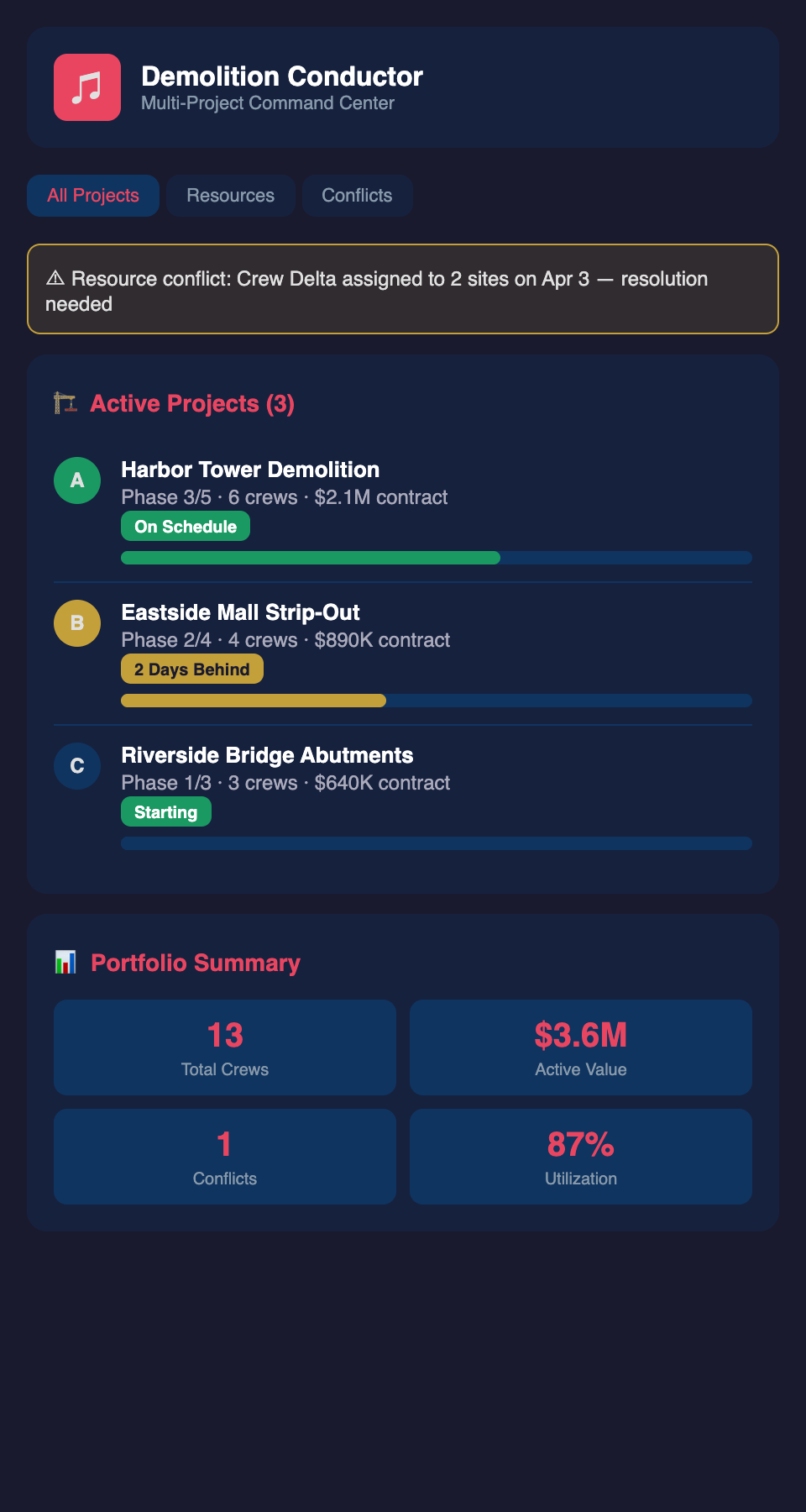
Visualization is critical. When you can see that Project Alpha needs the excavation crew from March 24-28, and Project Beta needs the same crew March 26-30, you immediately spot the 2-day conflict. Without visualization, this conflict might not surface until crews show up on-site and discover the problem.
Allocating Shared Resources
With 10 concurrent projects and limited specialized crews (master riggers, hazmat specialists), allocation becomes a complex optimization problem. The visual approach works best: represent each project as a timeline, overlay crew availability, and adjust start dates until conflicts resolve.
Key principles:
-
Front-load availability planning — determine crew needs 6-8 weeks before execution
-
Create buffer zones — allocate 1-2 extra days between major project handoffs
-
Cross-train backup crews — reduce dependency on single specialists
-
Batch similar tasks — group all concrete cutting across projects to reduce equipment setup time
Synchronizing Crew Schedules Across Locations
Geographic dispersion adds another layer of complexity. A crew in downtown Detroit cannot instantly shift to a project 45 minutes away in the suburbs. Travel time, setup, permit inspections—these create hidden dependencies.
Travel Time Buffers
When scheduling concurrent projects in the same metro area:
-
Add 30 minutes minimum travel buffer between projects
-
Account for permit inspections (typically 1-2 hours, unscheduled)
-
Include 1-hour setup/teardown time at each site
-
Schedule coordinated work for Tuesdays-Thursdays (avoid Monday chaos, Friday fatigue)
A demolition firm managing 5 projects in the same city can significantly reduce idle time by clustering related work. All concrete cutting might happen Tuesdays and Thursdays; all structural steel removal on Mondays and Wednesdays. This rhythm reduces context-switching costs and lets crews develop momentum.
Communication Across Site Teams
Without real-time coordination, field teams work with outdated information. A crew arrives at 7 AM expecting to begin interior demolition, only to discover that structural support removal is running 3 days behind. They either sit idle or tackle low-priority tasks, losing productivity either way.
Establish daily synchronization rituals:
-
6 AM standup — 10-minute call with all project managers reviewing status
-
Hourly status updates — from site supervisors to central coordination (via mobile app or radio)
-
Weekly resource planning — dedicated meeting to adjust next week's crew allocations based on actual progress
Preventing Cascading Delays
When one project falls behind, it impacts dependent projects downstream. Project Alpha runs 4 days late, which pushes back the crew needed for Project Beta, which delays Project Gamma's concrete cutting phase.
To prevent cascades:
1. Identify critical path items — the tasks that have zero float (no buffer time). These are your vulnerability points.
2. Assign accountability — each critical-path task needs a primary and backup person responsible. When the primary encounters obstacles, responsibility explicitly transfers to the backup, preventing communication gaps.
3. Implement escalation triggers — if a critical-path task is tracking more than 1 day behind, escalate immediately to leadership. Don't wait until the end of the week.
4. Maintain 10% schedule contingency — on concurrent projects with tight scheduling, reserve 10% of your total timeline as a buffer. This absorbs minor delays without cascading.
Real-World Example: Manufacturing Plant Demolition
A Midwest demolition firm managed the simultaneous decommissioning of three 1980s manufacturing plants in the same industrial park. The complexity: Plant 1 required hazmat remediation (PCBs in electrical systems), Plant 2 had active environmental cleanup, and Plant 3 proceeded normally.
By visualizing dependencies, they discovered that:
-
The hazmat crew (2 specialists) was needed for 6 weeks across both plants 1 and 2
-
Equipment staging area overlapped—they needed to adjust access routes to avoid congestion
-
Plant 2's environmental remediation could run in parallel with Plant 3's preparation work
The visual coordination saved 3 weeks of timeline and prevented $400,000+ in crew idle time by clearly showing how to sequence work and allocate specialists efficiently.
The Power of Real-Time Project Visibility
Modern demolition firms are moving beyond spreadsheet coordination toward systems that provide real-time visibility into project status, crew location, equipment allocation, and upcoming dependencies. When supervisors can see at a glance where every crew is, which equipment is available, and which projects are at risk, decision-making improves dramatically.
The benefit compounds with scale. Managing 2-3 projects with spreadsheets is barely functional. Managing 10-15 projects becomes nearly impossible without structured visibility. Firms that invest in coordination systems quickly outcompete those relying on manual methods—delivering projects faster, maintaining higher margins, and building stronger client relationships through predictable timelines.
Ready to eliminate scheduling conflicts across your demolition portfolio? Join leading demolition firms managing complex multi-project coordination with unprecedented precision. Join the waitlist today.