Demolition Crew Communication Best Practices Guide
Why Communication Fails in Demolition Operations
Poor communication is the root cause of most demolition incidents. A supervisor doesn't relay that temporary support is compromised, so crews proceed with demolition and create a structural failure. A hazmat team doesn't confirm that abatement is complete, so general crews begin work in a contaminated area. A project manager doesn't communicate a schedule change, so crews show up to find the site unexpectedly inaccessible.
These incidents are often characterized as "safety violations" or "operator error," but the real root cause is communication breakdown. When information is clear, crew intentions are aligned, and accountabilities are defined, incidents drop dramatically.
Yet most demolition firms have no formal communication systems. Information flows through ad-hoc phone calls, text messages, and informal conversations. In a 50-person organization with 10 concurrent projects, this approach guarantees miscommunication and incident risk.
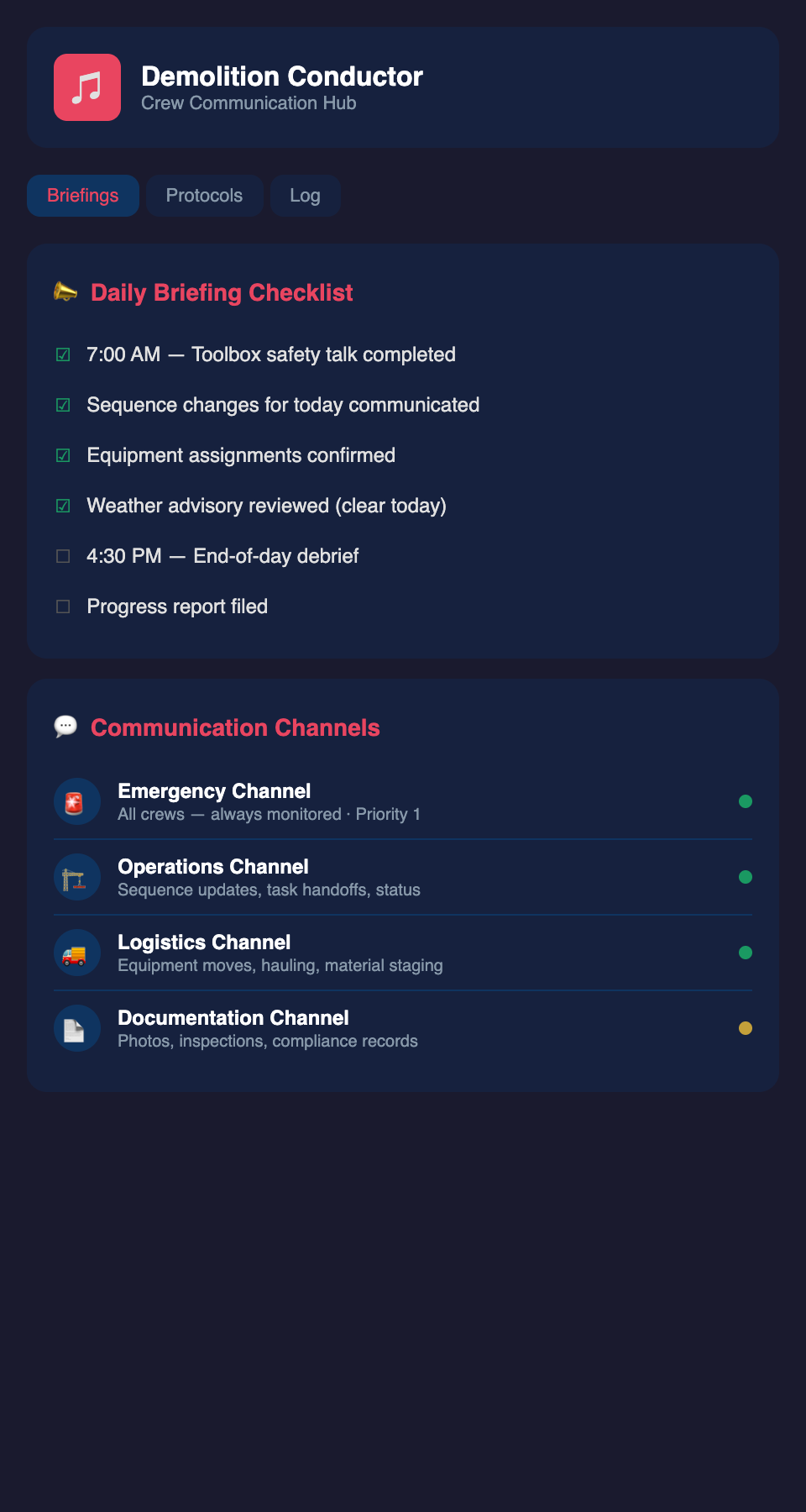
The Four Levels of Demolition Communication
Effective communication must happen at four levels: strategic, tactical, operational, and incident response.
Strategic Communication (Monthly)
Leadership communicates overall direction, resource constraints, and portfolio priorities.
Forum: Leadership briefing (quarterly)
-
Executive team reviews all projects
-
Identifies conflicts or resource constraints across portfolio
-
Makes decisions about project sequencing, resource allocation
-
Communicates decisions to project managers
Objective: Align entire organization on priorities. Prevent lower levels from making decisions contrary to leadership direction.
Format: 60-minute in-person or video meeting
-
5 min: Executive summary of portfolio status
-
20 min: Problem solving on portfolio-level conflicts
-
15 min: Resource allocation decisions
-
15 min: Cascading decisions to project level
-
5 min: Clear action items and owners
Tactical Communication (Weekly)
Project managers synchronize across projects to identify emerging conflicts and coordinate resource sharing.
Forum: Weekly project synchronization (every Monday morning)
-
All project managers plus key coordinators attend (30-45 minutes)
-
Focus: next 2-3 weeks of work
Agenda:
-
Review current week's actual progress vs. plan (2 min per project)
-
Flag any emerging conflicts or delays (1 min per project)
-
Coordinate resources for next 2 weeks (10 minutes discussion)
-
Identify which projects need escalation to leadership (5 minutes)
Objective: Catch emerging problems early (1-2 weeks in advance) while solutions are still available. Coordinate crew and equipment sharing.
Required output:
-
Master schedule updated with any plan changes
-
Resource conflicts identified and resolution assigned to owner
-
Escalations documented for leadership
Operational Communication (Daily)
Site supervisors and project managers communicate about current operations: what's happening today, what's expected tomorrow, any immediate changes.
Forum: Daily standup (15 minutes, 6-7 AM)
-
All site supervisors, project managers call into central dial-in
-
Each site reports: crew on-site, progress yesterday, planned work today, any blockers
Structure:
-
"Project A: 12 people on-site, completed interior demo of floors 2-3 per plan, starting floor 4 today, no blockers"
-
"Project B: 8 people on-site, behind 1 day on hazmat abatement, requesting hazmat specialist to assist with remediation acceleration"
-
etc.
Objective: Central coordination knows what's happening at every site in real-time. Can reallocate crews or resources if unexpected issues emerge.
Output:
-
Real-time status visibility
-
Rapid identification of blockers or resource needs
-
Coordination of crew movements during the day
Incident Response Communication
When safety concerns, injuries, or serious deviations from plan occur, communication must be immediate and escalate quickly.
Incident Communication Protocol:
-
Immediate notification (verbal, within 1 minute of discovery)
-
Site supervisor calls central coordinator with incident description
-
Coordinator notifies project manager and safety officer immediately
-
-
Initial response (within 30 minutes)
-
Safety officer or project manager is on-site or on phone
-
Determine immediate mitigation (halt work, evacuate, stabilize)
-
Medical response if injury is involved
-
-
Incident documentation (within 2 hours)
-
Formal incident report captured
-
Witness statements gathered
-
Photos/video taken
-
Root cause preliminary assessment
-
-
Leadership notification (within 4 hours)
-
Executive leadership informed
-
Decision on whether to escalate to authorities
-
Client notification if required
-
This is non-negotiable. Incidents are the one area where every organization takes communication seriously.
Communication Tools and Technology
Different communication methods work for different purposes.
Real-Time Coordination
-
Radio/walkie-talkie — Site-based instant communication
-
WhatsApp or Slack — Quick async messages for crew coordination
-
Voice calls — For complex discussions requiring real-time back-and-forth
Scheduled Meetings
-
In-person meetings — Strategic and tactical discussions (retain most detail and context)
-
Video calls — When in-person is geographically impossible
-
Phone calls — Emergency or time-sensitive issues
Documentation
-
Email — Formal confirmations and decisions (creates written record)
-
Project management software — Centralized task tracking and documentation
-
Site notebooks — Daily logs captured by site supervisors (physical backup)
The best organizations use multiple channels strategically rather than defaulting to one method for everything.
Case Study: Transforming Communication Culture
A 40-person demolition firm was experiencing frequent safety incidents, schedule conflicts, and crew frustration. Root cause analysis showed poor communication:
-
Site supervisors didn't know what other projects needed
-
Project managers discovered conflicts only when crises occurred
-
Field crews received updates via text messages with no formal confirmation
-
Incidents were reported verbally with no written documentation
By implementing the four-level communication system:
Week 1-2: Established daily standups (7 AM sharp, 15 minutes)
-
Attendance requirement: all project managers, site supervisors
-
Format: standardized status report per project
-
Immediate result: central coordination discovered they had 2 crews scheduled for the same site on the same day
Week 3-4: Implemented weekly sync meetings (Monday 8:30 AM, 45 minutes)
-
Focus: 2-3 week resource planning
-
First meeting identified 5 brewing conflicts that could have caused disasters
Month 2: Created incident response protocol
-
Mandatory incident reporting within 2 hours
-
All incidents reviewed in weekly safety meeting
-
Trend analysis identified pattern: hazmat crew communication was poor
Month 3: Implemented discipline in communication
-
Formal agenda for all meetings
-
Written decisions captured and distributed
-
Project managers required to confirm plans with site supervisors in writing
Results after 3 months:
-
Safety incidents down 60% (fewer miscommunications = fewer safety failures)
-
Scheduling conflicts down from ~3 per month to ~1 per quarter
-
Crew satisfaction improved (better information = less frustration)
-
Timeline adherence improved 15% (better coordination = fewer unexpected delays)
The transformation wasn't difficult—just disciplined, structured communication replacing ad-hoc chaos.
Communication Roles and Accountabilities
Clear roles reduce miscommunication.
Site Supervisor responsibility:
-
Daily safety briefing with crew (what's the plan, where are the hazards?)
-
Daily report to project manager (status, blockers, changes)
-
Immediate incident escalation
-
Enforce safety protocols
Project Manager responsibility:
-
Weekly status to leadership
-
Coordination with other project managers (resource conflicts)
-
Daily communication with site supervisor
-
Client communication (progress updates, changes)
Central Coordinator responsibility:
-
Maintain master schedule and resource allocation
-
Facilitate daily standup
-
Identify conflicts early
-
Escalate issues to leadership
Leadership responsibility:
-
Make resource allocation decisions
-
Strategic direction on project priorities
-
Incident review and learning
-
Culture accountability
When these roles are clear and accountabilities are explicit, communication improves dramatically. When roles overlap or unclear, miscommunication increases.
Building Communication Discipline
Communication systems don't work unless they're reinforced. The best firms make communication culture explicit:
-
Make communication mandatory — Not "call in if you can," but "attendance is required" for coordination meetings
-
Make communication timely — Daily standups at 6:30 AM means 6:30 AM, not 6:45 AM. Consistency matters.
-
Make communication documented — Important decisions get captured in writing so there's no ambiguity later
-
Make communication specific — "Project is on track" is too vague. "Completed 65% of interior demolition, 2 days ahead of plan, starting roof structural removal tomorrow" is specific and actionable
-
Make communication safe — Supervisors who report problems aren't punished; that's how you learn about and prevent issues
Ready to establish a communication culture where every crew member knows what's happening, why it matters, and what they're accountable for? Join the waitlist today.