Managing Interdependent Demolition Sequences Safely
The Critical Role of Sequencing in Demolition Safety
Demolition sequencing isn't just a scheduling problem—it's fundamentally a safety issue. Demolish a load-bearing column before temporary support is installed, and you risk catastrophic structural failure. Begin interior work before hazardous materials are properly sealed, and you expose workers to toxic exposure. The consequences of incorrect sequencing are measured in deaths, injuries, and legal liability.
This is why experienced demolition firms treat sequencing as a science, not an afterthought. Every task has predecessors and successors, and these relationships must be mapped, communicated, and enforced on-site.
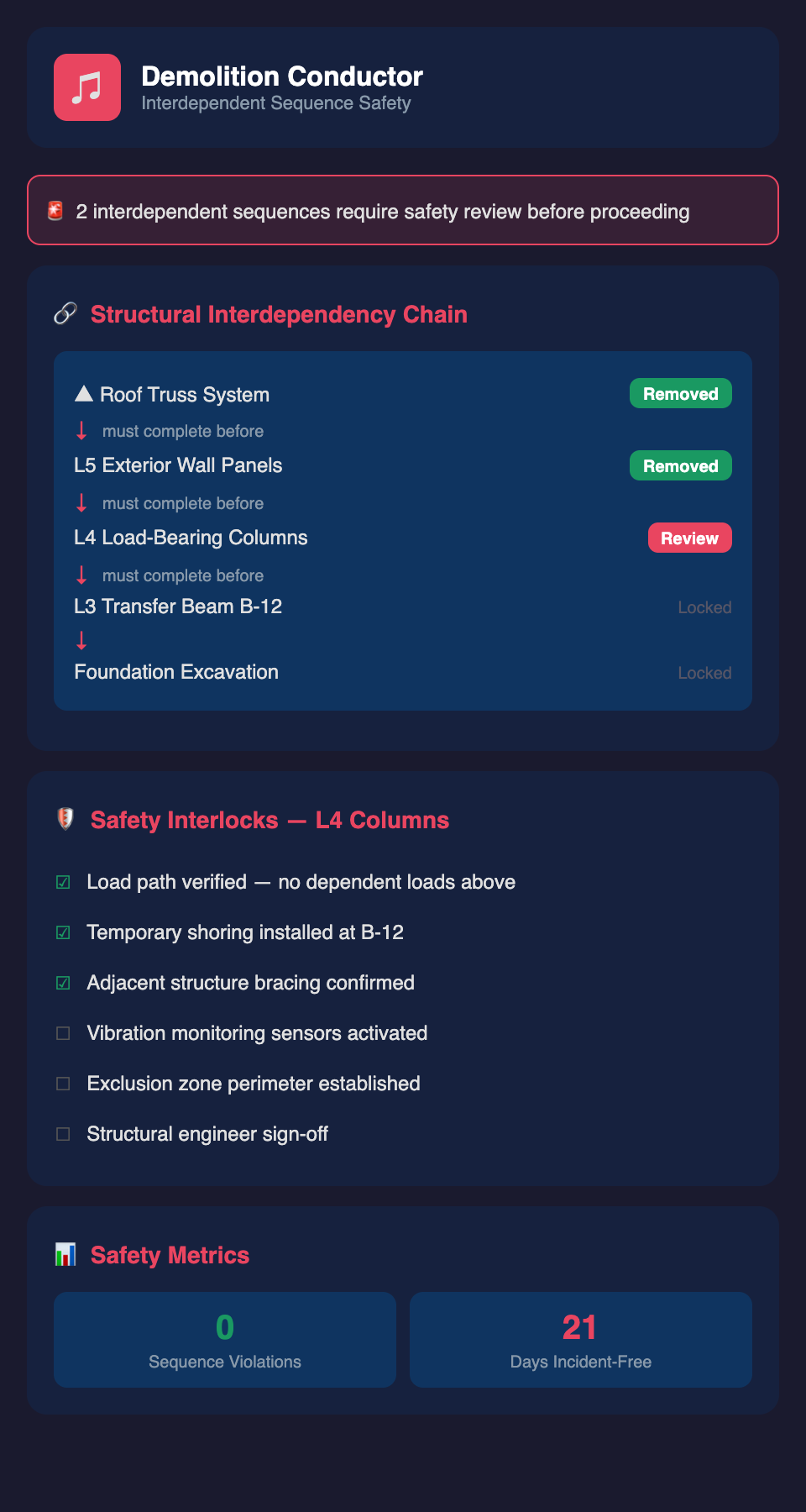
Structural Dependency Sequencing
In structural demolition, the building itself dictates sequence requirements. Load-bearing systems operate as interconnected networks—removing one element affects stress distribution throughout the structure.
Understanding Load Paths
Before demolition begins, structural engineers must trace load paths: how loads transfer from roof to foundation. A typical three-story commercial building might transfer roof loads → primary beams → columns → footings. If you attempt to remove a column before its load has been safely transferred (via temporary bracing or load-path rerouting), catastrophic failure occurs.
Safe demolition sequence for structural elements:
-
Phase 1: Load transfer — Install temporary support systems and load-bearing braces to redirect loads away from elements you'll be removing
-
Phase 2: Non-structural removal — Remove non-load-bearing walls, fixtures, and mechanical systems
-
Phase 3: Structural deconstruction — With loads safely transferred, remove structural elements in reverse order from how they were installed
-
Phase 4: Foundation removal — Only after the superstructure is completely removed
Most contractors fail by skipping Phase 1 or rushing it. They see exposed structural steel and think "that's ready to cut," without confirming that temporary support is actually bearing the load. Site supervisors must verify temporary support installation before authorizing crew to proceed.
Hazmat and Environmental Dependencies
Hazardous materials create hard sequencing requirements. Asbestos, lead paint, PCBs, mold—each requires specific removal protocols before structure can be disturbed.
Layered Hazmat Removal
A building with multiple hazards requires layered removal:
Week 1-2: Pre-demolition assessment
-
Detailed hazmat survey identifying all contaminated materials
-
Environmental remediation plan with regulatory agency sign-off
-
Crew training on containment procedures
Week 3-4: Hazmat abatement
-
Isolation of contaminated areas using negative pressure enclosures
-
Careful removal of ACM (asbestos-containing materials), lead paint, PCBs
-
Proper disposal and waste documentation
-
Post-abatement air testing and clearance certification
Week 5+: Structural demolition
-
Only after hazmat clearance can general demolition crews proceed safely
-
Remaining structure is free from known hazardous materials
Attempting to demolish while hazmat abatement is underway creates worker exposure risks, regulatory violations, and potential liability. The sequence is non-negotiable.
Crew Skill Dependencies
Not all crews can perform all demolition tasks. Master riggers are required for complex rigging operations. Hazmat specialists handle contaminated materials. Heavy equipment operators remove structural steel. These specialized crews often work sequentially—one phase requires riggers, the next requires operators.
Planning for Skill-Based Sequences
When scheduling crews with different specializations:
Rigorous dependency documentation:
-
Identify which tasks require which skills
-
Determine which tasks can overlap vs. which must be sequential
-
Allocate specialized crews to highest-value work
-
Schedule lower-skilled crews for parallel, independent work
Example sequence for a 20-story office tower:
-
Weeks 1-3: Hazmat team isolates and removes ACM (other crews cannot work)
-
Weeks 4-6: Rigging crew installs temporary support and begins selective deconstruction (general crews clear non-structural areas)
-
Weeks 7-12: Heavy equipment operators remove structural steel (rigging crew moves to next project)
-
Weeks 13-15: Excavation crews remove foundations and site debris
Without this sequencing, you'd have expensive specialists sitting idle while waiting for prerequisite work to complete.
Real-Time Dependency Tracking
In large demolition projects with 50-100+ interdependent tasks, tracking dependencies manually is error-prone. Critical relationships get overlooked, and on-site crews lose visibility into prerequisite status.
Establishing Clear Prerequisite Communication
Every task should have a documented prerequisite checklist:
-
Hazmat clearance obtained (checkbox)
-
Temporary support installed (checkbox)
-
Structural assessment completed (checkbox)
-
Required equipment available on-site (checkbox)
-
Previous phase tasks 85%+ complete (checkbox)
Site supervisors review this checklist daily. A task cannot begin until all prerequisites are verified. This simple system prevents costly mistakes and keeps work flowing.
Visual Dependency Networks
The most effective demolition firms visualize their sequencing as network diagrams—showing how tasks connect, which are on the critical path, and which have float (flexibility). When a task falls behind, the network immediately shows which downstream tasks are at risk.
Case Study: High-Rise Office Building
A demolition firm was contracted to demolish a 28-story office tower in a dense urban area. The complexity: the building sat above an active subway station. Any vibration from heavy demolition could damage the transit infrastructure.
Required sequence:
-
Structural assessment — Determine how to minimize vibration (selective deconstruction vs. demolition)
-
Hazmat survey — Identify asbestos and lead paint
-
Environmental remediation — Remove contaminants in sealed containment
-
Vibration mitigation installation — Deploy shock-absorption systems and monitoring equipment
-
Phased selective deconstruction — Carefully remove structural elements with minimal vibration
-
Late-stage structural demolition — After subway risk is mitigated
-
Foundation removal — Final phase after structure is cleared
By sequencing correctly and communicating prerequisites clearly, the firm completed the project on schedule, avoided all structural damage to the transit system, and maintained perfect safety record. Without proper sequencing, this project would have been extremely high-risk.
Preventing Sequence Violations
The biggest risk isn't planning poor sequences—it's crews ignoring documented sequences on-site. A foreman sees an opportunity to get ahead and begins work on a task before prerequisites are complete. This is how accidents happen.
Strategies to enforce sequencing:
-
Daily briefings — Review today's scheduled work and required prerequisites with all crews
-
Task sign-offs — Site supervisor must formally authorize a task to begin, confirming prerequisites
-
Real-time communication — Crews can radio questions about prerequisites immediately, rather than assuming
-
Safety culture — Crews that question sequence are rewarded, not penalized. "I'm not sure we're ready for this" should be praised.
The firms with the best safety records treat sequencing as sacred. Supervisors will delay work rather than risk sequence violations. This conservative approach costs slightly more in the short term but saves catastrophically on accidents, lawsuits, and regulatory fines.
Ready to lock down your demolition sequences with crystal-clear dependencies and real-time safety oversight? Join the waitlist to experience precision coordination that eliminates sequence violations and keeps crews safe.