Preventing Costly Scheduling Conflicts in Demolition
The Cost of Scheduling Conflicts
A scheduling conflict in demolition isn't a minor inconvenience—it's a financial and operational crisis. When two projects compete for the same specialized crew, one project must delay. That delay costs:
-
Crew idle time — $3,000-$5,000/day for 5-person specialized crew
-
Equipment rental during delay — $1,000-$3,000/day for heavy equipment
-
Site management overhead — $500-$1,000/day for supervisors and safety personnel
-
Ripple effects — Delayed project blocks downstream clients, damages relationships, creates liability
A single week-long scheduling conflict costs $25,000-$50,000+ and can trigger contract penalties, client disputes, and timeline cascades.
Yet most demolition firms don't systematically identify conflicts until they occur. Then they scramble to resolve them with expensive, reactive solutions (overnight crew travel, premium equipment rental, inefficient workarounds).
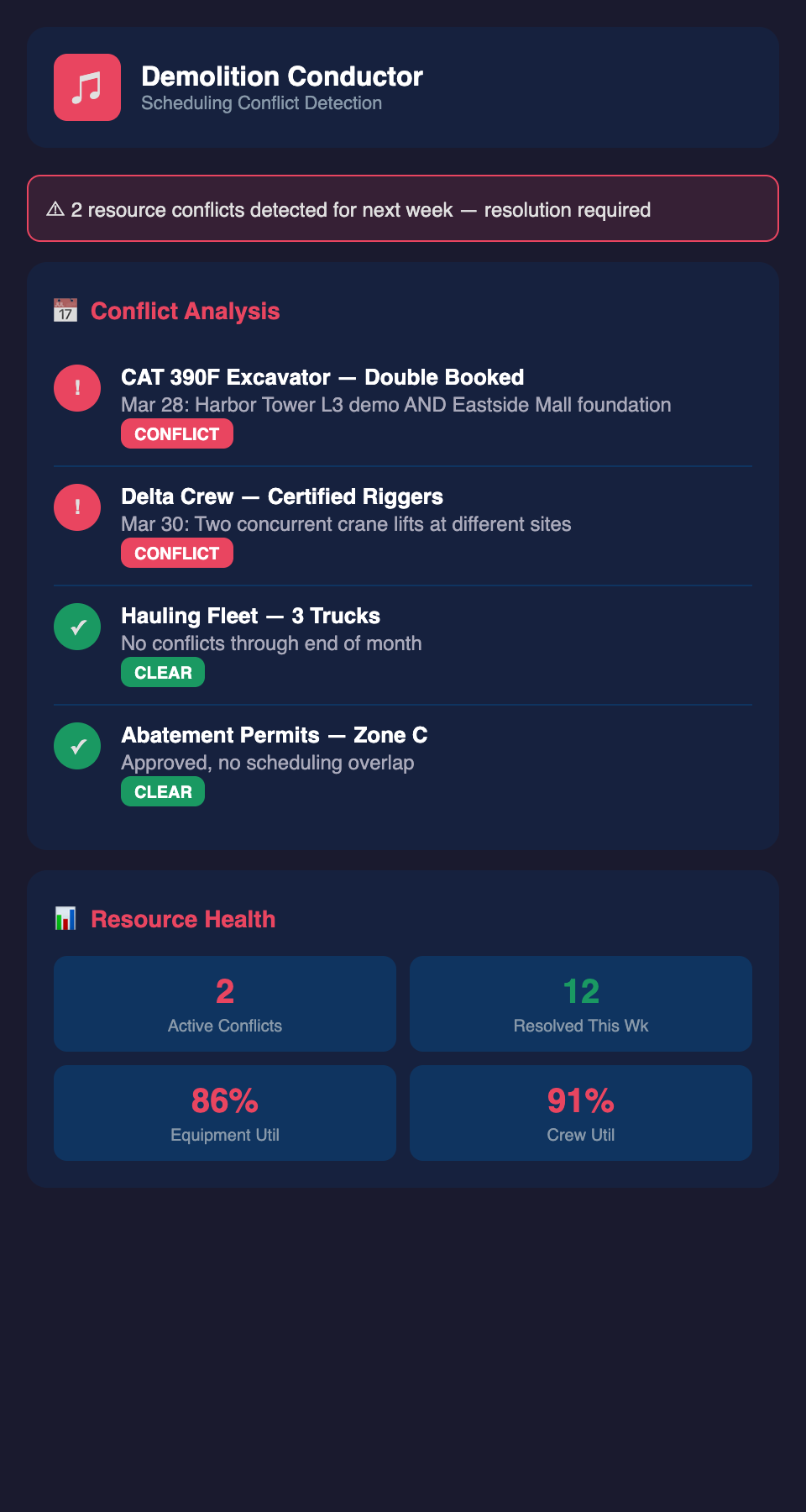
Systematic Conflict Identification
The key is early identification. Conflicts that surface 8-12 weeks before project start are manageable. Conflicts discovered 2 weeks before start are emergencies.
Creating a Master Resource Schedule
Maintain a forward-looking resource schedule (12 months ahead) showing:
-
All projects (active and committed)
-
Required resources for each project (crew types, equipment, duration, timing)
-
Resource availability (how many master riggers do we have? How many weeks available per year?)
-
Conflicts (flagged when two projects need the same resource in the same time window)
This master schedule is the foundation for conflict detection.
Resource Types and Their Bottlenecks
Different resources create different constraints:
Specialized crews (usually the bottleneck):
-
Master riggers (often only 2-3 per firm)
-
Hazmat specialists (highly certified, limited supply)
-
Structural engineers on-site
-
Heavy equipment operators
Equipment (sometimes a constraint):
-
Large cranes (150+ ton capacity)
-
Specialized shears or breakers
-
Hazmat containment systems
Permits and approvals (often overlooked):
-
Environmental permits (shared pool across projects)
-
City demolition permits (competing for inspector time)
-
Equipment permits (over-weight vehicles, street use)
The first to conflict are usually specialized crews. You can usually find equipment rental on short notice, but you can't hire a new master rigger overnight.
Conflict Resolution Strategies
Once conflicts are identified, you have options. Choose the right strategy based on the specific situation.
Strategy 1: Reschedule One Project (Most Common)
Delay Project B's start date by 4 weeks, freeing up the specialized crew that Project A needs.
Pros:
-
Simple to execute
-
Predictable and reliable
-
Minimal additional costs
Cons:
-
Requires renegotiating client contract and timeline
-
Delays revenue recognition
-
Might trigger penalties if client has time-sensitive needs
When to use: Early identification (8+ weeks advance). If you have time to shift the schedule without client impact.
Strategy 2: Split the Specialized Crew Across Projects
Allocate the master rigger 3 days/week to Project A, 2 days/week to Project B, reducing conflict.
Pros:
-
Avoids delaying either project
-
Maximizes crew utilization
Cons:
-
Reduces efficiency (crew context-switching, travel time)
-
Can feel like compromising on both projects
-
Only works if projects are geographically close
When to use: Projects are geographically adjacent. Crew work is parallel rather than sequential.
Strategy 3: Bring in External Crew or Equipment
Contract an external specialized crew or equipment to handle one project, freeing your internal resource for the other.
Pros:
-
Both projects proceed on schedule
-
Projects get dedicated resources
Cons:
-
Significant additional cost ($15,000-$40,000+ for external crew)
-
Quality/reliability risk with external contractors
-
Reduces margin on affected project
When to use: Client premium or urgent timeline justifies the cost. Late-stage conflict discovered close to project start when rescheduling isn't possible.
Strategy 4: Restructure Project Scope or Sequencing
Modify how a project is executed to reduce resource requirements during the conflict window. Instead of sequential phases, run them in parallel. Instead of using specialized crew, train internal crew on a simpler approach.
Pros:
-
Creative solution that avoids delay and external cost
-
Opportunity to improve efficiency
Cons:
-
Requires engineering/operational reimagining
-
Might affect project quality or safety
-
Time-consuming to evaluate
When to use: Multiple conflicts exist or recurring patterns suggest process redesign is needed.
Case Study: Identifying and Preventing Conflicts
A demolition firm with 8 concurrent projects discovered conflicts using their new resource master schedule:
Discovered conflicts:
-
Hazmat team needed for Projects A (Feb 10-Mar 10) and B (Feb 28-Mar 28) — 10-day overlap
-
Crane 1 (200-ton) booked for Projects C (Mar 1-15) and D (Mar 10-25) — 6-day overlap
-
Master rigger needed for Projects E (Apr 1-20), F (Apr 15-May 5), G (May 1-15) — cascading conflicts
Resolutions implemented:
-
Conflict 1: Contracted external hazmat crew for 10 days ($22,000 cost) — Project B couldn't shift due to client deadline
-
Conflict 2: Rescheduled Project D to March 26-April 10 — Project D client was flexible, negotiated 2-week timeline adjustment
-
Conflict 3: Brought in external master rigger for Project F ($35,000 cost) — Projects E and G were back-to-back, couldn't compress
Total cost to resolve conflicts: $57,000 (additional cost)
Projects delivered on time, no client disputes
Without early identification, the firm would have discovered these conflicts 2-3 weeks before project start, forcing emergency solutions (premium external crews, express equipment rental, rushed scheduling) costing $100,000+. Early identification saved $43,000+ even after accounting for external crew costs.
Tools for Conflict Detection
Simple approaches work best:
Spreadsheet-based master schedule:
-
Rows = all projects (active and committed)
-
Columns = weeks for next 12 months
-
Color-code each project
-
At a glance, see which weeks have multiple projects competing for the same resource
Dedicated PM software:
-
Monday.com, Asana, Microsoft Project all have resource conflict detection
-
Automated warnings when resources are over-allocated
-
Requires disciplined data entry but saves analysis time
Regular review meetings:
-
Monthly resource planning meeting with all project managers
-
Review: upcoming conflicts in next 90 days
-
Decide: which conflicts need immediate action?
Creating a Conflict Prevention Culture
The most effective firms don't just detect conflicts—they actively prevent them through scheduling discipline.
Principles:
-
Never commit to a client timeline without checking resource availability (Master schedule is the source of truth)
-
Default to 2-week buffer between similar projects (Reduces conflicts from planning uncertainties)
-
Front-load specialized crew allocation (Book crews 16-20 weeks before need, not 8 weeks)
-
Communicate conflicts transparently (Tell clients about potential scheduling challenges early, not mid-project)
Firms that follow these principles rarely experience scheduling crises. The ones that ignore them are constantly firefighting.
Ready to identify and eliminate scheduling conflicts 8-12 weeks before they impact your projects? Join the waitlist to prevent costly resource clashes.