Reducing Rework and Delays Through Better Demolition Sequencing
The Rework Cost Reality
A demolition crew removes environmental hazards from a building zone. Weeks later, structural engineers discover that the approach to structural removal violates safety assumptions in the hazmat removal work. The structural phase requires additional environmental abatement that should have been done earlier.
The original environmental work needs to be redone. Crews return to completed zones. Time is wasted. Equipment is consumed. Cost increases.
This scenario repeats across demolition projects constantly. Poor sequencing forces rework that good sequencing would prevent. The cost compounds: not just the rework labor, but also schedule delay, equipment carrying costs, and crew redeployment time.
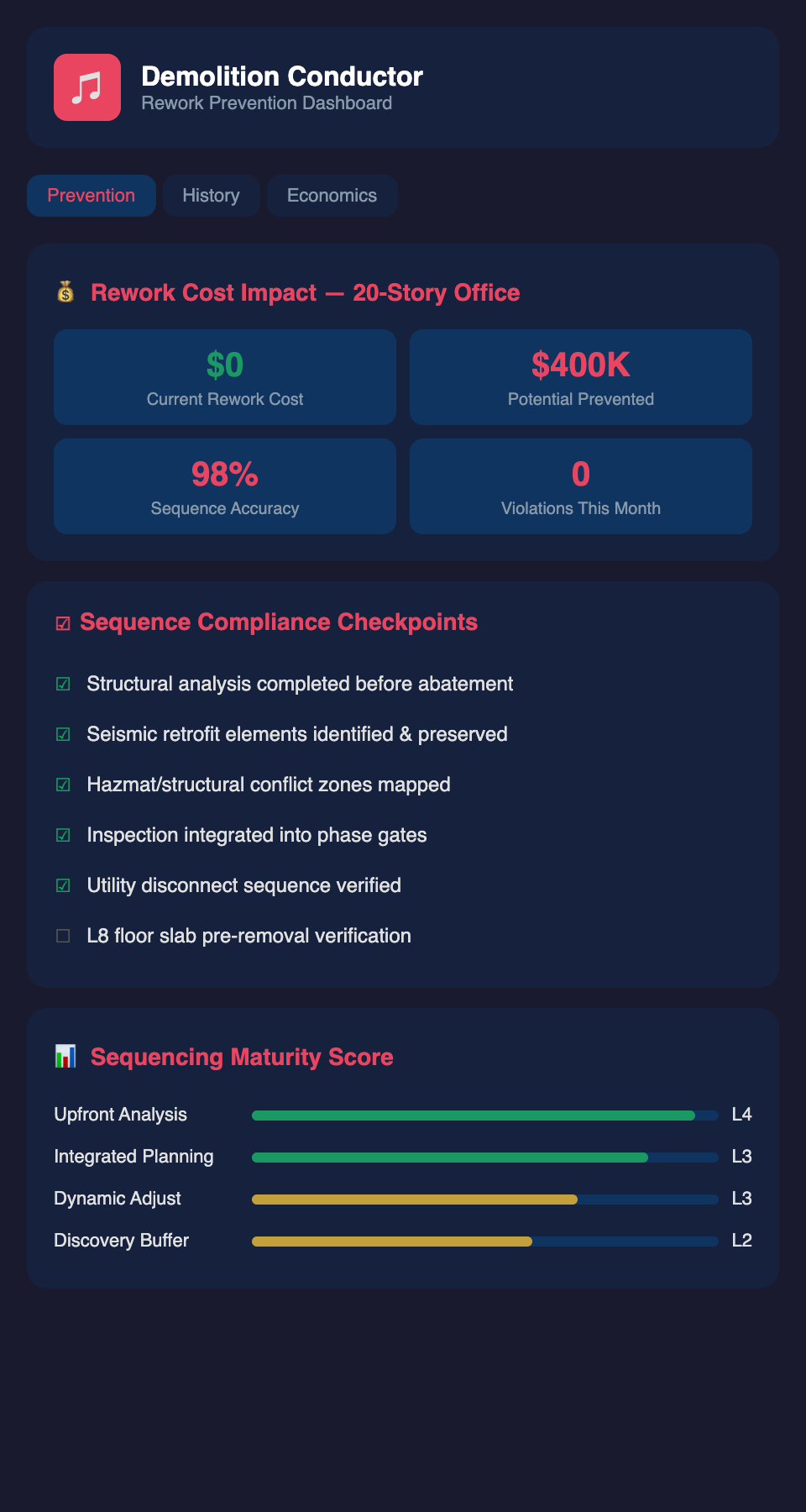
For a 200-person project, rework elimination can mean 10-15 percent schedule compression—equivalent to weeks of time and hundreds of thousands of dollars.
Where Rework Originates in Demolition
Incomplete understanding of structural interdependencies: Environmental abatement proceeds without structural analysis that reveals those zones will be under load during a later structural phase. Later, structural engineers require additional environmental work before structural removal is safe.
Sequence changes mid-project: Plans change due to permit delays, owner requests, or discoveries. If sequence changes don't account for work already completed, rework is required.
Inspection failures: Work proceeds through a phase, then inspection discovers non-compliance or inadequacy. The work must be redone before the next phase can proceed.
Utility disconnection errors: Utilities are disconnected in the wrong sequence, requiring reconnection and redisconnection.
Equipment damage requiring remediation: Equipment is damaged or left in an unsafe state, requiring cleanup or repair before it can be reused.
Scope clarification failures: Work is completed based on one interpretation of scope, then client clarifies that different scope was intended. Work is redone.
The commonality: These rework scenarios are mostly preventable with better sequencing and planning upfront.
How Sequencing Prevents Rework
Comprehensive structural and hazmat analysis first: Before any demolition begins, complete structural analysis and environmental assessment. Understand what must happen in what order to respect both structural safety and hazmat requirements. This analysis prevents the scenario where later structural analysis contradicts earlier environmental work.
Sequence with inspection integration: Don't plan phases that end in non-inspection state. If a phase must be inspected, sequence work so inspection can happen. If inspection reveals issues, the phase is still in active work, not completed. Minor adjustments are made before the phase closes.
Utility work sequencing: Plan utility disconnection to avoid "we disconnected this but need to use this utility later" scenarios. Sequence disconnection to the phase where utilities are truly no longer needed.
Contingency in sequence: Build flexibility into sequences for discoveries. If structural analysis reveals unexpected bracing, the sequence has buffer to accommodate additional work without cascading delays. Plans that are rigidly tight create rework when discoveries happen.
Scope clarity before execution: Invest time in requirements gathering and client agreement before sequencing is final. Changes mid-project require re-sequencing, which is expensive.
Rework Prevention Through Visualization
Visual planning tools prevent rework by making sequence implications visible:
Load path visualization prevents hazmat/structural conflicts: When hazmat teams see structural loads visualized on their zones, they understand what structural constraints exist. Environmental work accounts for those constraints. Structural work won't later require redoing environmental work.
Inspection points visible before execution: The sequence shows inspection checkpoints. Teams understand they're not truly done until inspection passes. This changes how carefully they execute—they anticipate inspection requirements rather than discovering them after completion.
Utility dependencies explicit: Visual utilities mapping shows when utilities must be present for later phases. Disconnection sequencing is planned to preserve needed utilities through phases that require them.
Parallel work verified as non-conflicting: Before two crews work in parallel, visual analysis confirms their work doesn't create rework requirements for each other. Structural crew and environmental crew's parallel work is verified as compatible.
Real-World Scenario: Office Building Demolition
A 20-story office building demolition uses a naive sequence:
-
Environmental abatement (all floors)
-
Structural core removal (top-to-bottom)
-
Structural frame removal (top-to-bottom)
-
Utilities final removal
-
Foundation extraction
But discovery during structural core removal reveals that the building had a seismic retrofit that created load-bearing elements in areas where environmental abatement had removed bracing. Now structural work is unsafe.
The project must halt. Environmental crews return to re-abate those zones, being careful to preserve the bracing. This triggers rework that cost an additional $400,000 and delays the project four weeks.
A better sequence would have been:
-
Complete structural analysis (including seismic retrofit documentation)
-
Environmental abatement with structural engineer consultation (preserving critical structural elements)
-
Structural core removal (with confidence about what load-bearing elements exist)
-
Continue as planned...
This sequence costs more upfront (structural engineer involvement in abatement phase) but prevents the rework cost and delay downstream.
Rework Risk Assessment
Different demolition projects carry different rework risks:
High rework risk:
-
Older buildings (unknown structural modifications, obsolete documentation)
-
Buildings with complex seismic or wind retrofits
-
Buildings that have been heavily remodeled
-
Projects with scope ambiguity or owner uncertainty
For these projects, upfront analysis to prevent rework is worth the investment.
Lower rework risk:
-
Newer buildings (clear documentation)
-
Straightforward structures (no complex retrofits)
-
Well-defined scope from the start
For these, less upfront analysis is needed.
Smart project managers assess rework risk and invest in upfront sequencing and analysis proportionally. High-risk projects get detailed analysis. Low-risk projects get simpler planning.
The Economics of Rework Prevention
Calculate the cost of rework:
-
10 crew members return to redo environmental work: 40 hours × 10 = 400 hours
-
At $50/hour cost (burdened): $20,000 in labor
-
Equipment carrying costs for 4-week delay: $30,000
-
Client delay costs/liquidated damages: potentially substantial
-
Total: $50,000-100,000+ in rework costs
Compare to the cost of upfront analysis:
-
Structural engineer for 2-week analysis: $30,000
-
Environmental consultant for coordination: $10,000
-
Total: $40,000 in prevention cost
This analysis is conservative—many rework scenarios cost much more. The ROI on prevention is obvious.
Sequencing Maturity in Enterprise Firms
The strongest demolition firms have moved through sequencing maturity levels:
Level 1: Reactive sequencing: Plan the sequence after general work phases are identified. Rework is common when conflicts are discovered.
Level 2: Upfront analysis: Conduct structural and environmental analysis before finalizing sequence. Catches many conflicts upfront.
Level 3: Integrated planning: Structural engineers, environmental consultants, and project managers plan sequence together. Conflicts are minimized.
Level 4: Dynamic adjustment: Initial sequence is solid. As actual conditions are encountered, dynamic adjustments are made within the sequence framework, preventing rework.
Most enterprise demolition firms operate at Level 2. The strongest operate at Level 3-4.
Moving to Rework Prevention
Reducing rework through better sequencing isn't revolutionary. It's straightforward project management discipline:
-
Invest in upfront analysis proportional to complexity and rework risk
-
Involve relevant disciplines (structural, environmental, logistics) in sequencing
-
Make sequence assumptions and constraints visible to all teams
-
Build contingency for discoveries
-
Verify sequences prevent conflicts before execution
-
Track actual performance to inform future project planning
The Competitive Impact
Demolition firms that consistently avoid rework have meaningful competitive advantages:
-
Faster completion (no rework delay)
-
Better margins (rework eliminated)
-
More reliable scheduling (fewer surprise delays)
-
Stronger client relationships (delivery confidence)
These advantages compound across multiple projects.
The Path Forward
Enterprise demolition firms that haven't systematically addressed rework have a quick, high-impact opportunity: Better sequencing that prevents rework.
Ready to eliminate costly rework on your demolition projects? Join our waitlist to see how strategic sequencing transforms your operational efficiency and margins.