Synchronizing Demolition Crews Across Multiple Sites
The Complexity of Multi-Site Crew Management
Enterprise demolition firms often manage 5-15 concurrent projects across different geographic locations. A master rigger might be needed in Downtown Detroit on Monday, shift to Dearborn on Wednesday, and move to Ann Arbor on Friday. Coordinate this across 10-15 specialized crew members, and the logistics become extraordinarily complex.
The financial impact is severe. Idle crew time—waiting between assignments, traveling longer than expected, or sitting on-site for delayed projects—costs $2,000-$5,000 per crew per day. With a 30-person organization, one week of poor crew synchronization easily costs $300,000+ in wasted labor.
Yet most demolition firms manage crew allocation using email, spreadsheets, and informal conversations. This approach works for 2-3 projects but breaks down at scale.
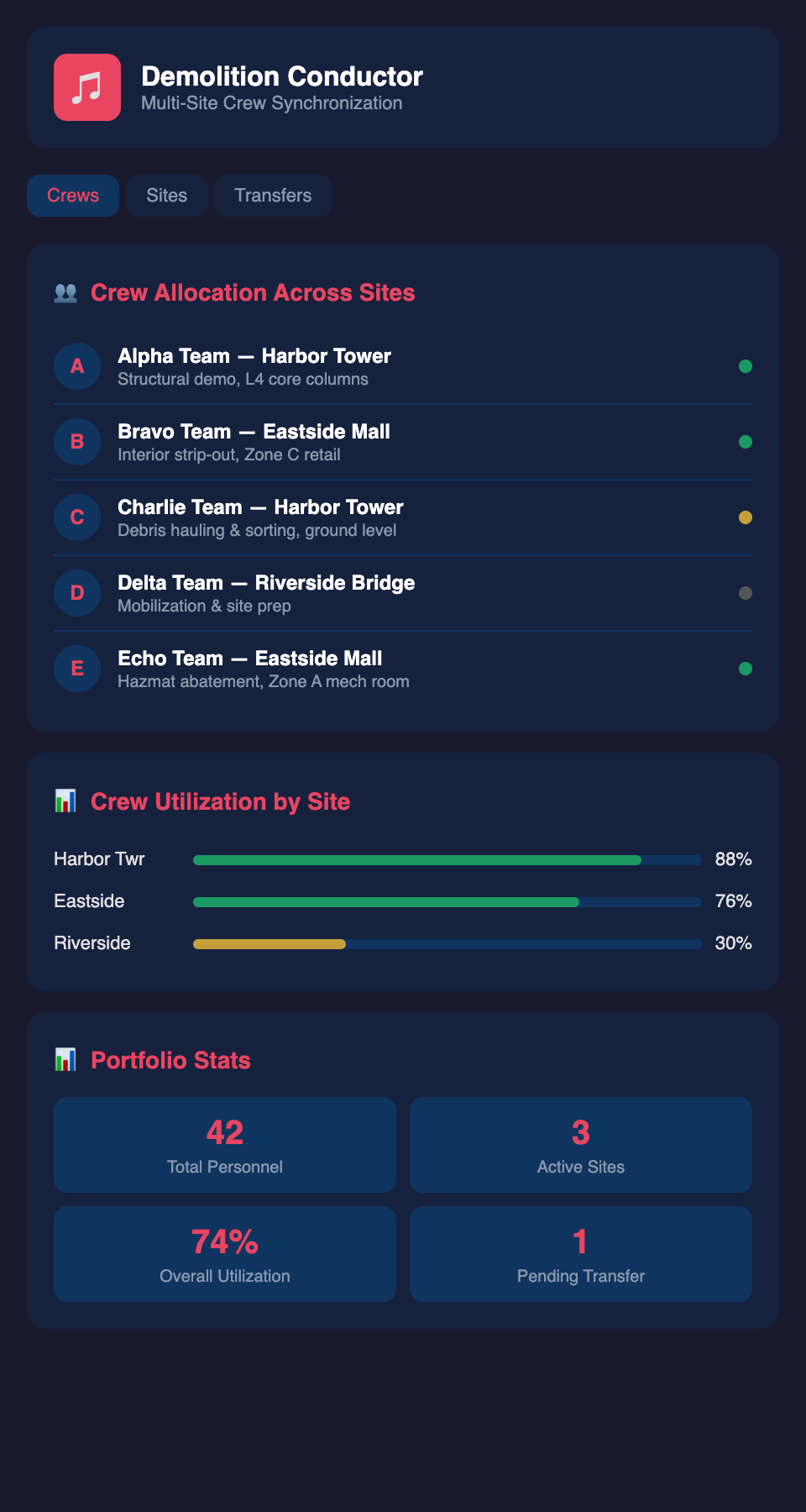
Understanding Crew Dependencies
Before synchronizing crews across multiple sites, you must understand what each project actually needs.
Crew Types and Their Constraints
Specialized crews (limited availability):
-
Master riggers (2-4 per firm, highly skilled)
-
Hazmat specialists (certified, expensive, limited supply)
-
Structural engineers on-site (oversight role)
-
Heavy equipment operators (qualified on specific machinery)
General crews (more available):
-
Laborers for material handling
-
Deconstruction crews
-
Debris management
-
Site cleanup
The challenge: specialized crews are the bottleneck. You can always find general laborers, but you can't easily find a fourth master rigger. Therefore, scheduling must optimize specialized crew utilization while keeping general crews efficiently occupied.
Calculating Crew Duration Per Project
Many firms underestimate how long specialized crews need on a project. A hazmat abatement might require 3 weeks of steady work, not 2 weeks. A rigging phase might need 5 weeks with the master rigger on-site 3-4 days per week.
For each project, document:
-
Phase duration (how many weeks)
-
Crew intensity (how many days/week is the specialized crew needed)
-
Overlap tolerance (can this crew move to next project while work continues on current)
Example: Master rigger work on Project A runs 6 weeks, but the rigger is only needed 3-4 days per week. This means Project B can begin rigging work 2-3 weeks into Project A, with the rigger splitting time.
Geographic Coordination Considerations
Proximity affects crew efficiency significantly. Moving a crew 15 minutes to a nearby site costs $300 in travel, setup, and lost productivity. Moving a crew 90 minutes away costs $1,500-$2,000.
Clustering Projects by Geography
The most efficient approach: cluster projects geographically and batch similar work.
Example geographic clustering for metro Detroit:
-
Downtown cluster (Projects A, B, C within 15-20 minutes of each other)
-
Suburban cluster (Projects D, E, F in nearby suburbs)
-
Outlying cluster (Projects G, H in exurban areas)
Dedicate crew teams to each cluster. Crews move within their cluster 1-2 times per week (manageable travel). Cross-cluster moves happen less frequently and are reserved for specialized crew only.
Travel Scheduling Rhythms
Rather than random travel, establish predictable rhythms:
-
Tuesdays: All master riggers are in Downtown cluster
-
Wednesdays: All master riggers are in Suburban cluster
-
Thursdays: Hazmat team works in assigned locations
-
Mondays, Fridays: Projects where travel isn't required (already-staffed sites)
This rhythm lets crews know their schedule weeks in advance. They plan commutes, child care, and personal schedules accordingly. Predictability reduces stress and improves retention.
Real-Time Crew Tracking and Allocation
Without real-time visibility, a project manager can't quickly reassign crews when unexpected situations arise.
Mobile-First Crew Management
Every crew member should have access to:
-
Current assignment and work location
-
Expected travel time
-
Site contact and site supervisor name
-
Parking and access information
-
Daily task list for today's work
Site supervisors should have visibility into:
-
Who is currently on-site vs. traveling
-
When next crew arrival is expected
-
Any crew reassignments from the morning
-
Current staffing vs. planned staffing
With this visibility, you can:
-
Quickly respond to unexpected delays by reassigning nearby crews
-
Avoid unnecessary travel by consolidating work
-
Make informed decisions about whether to proceed with reduced crew vs. wait for planned crew
Case Study: Managing 12 Concurrent Projects
A large demolition firm managed 12 concurrent demolition projects across a 5-county area with 35 crew members. The original approach used a spreadsheet updated weekly. Key problems:
-
Master riggers were frequently idle (2-3 days per month) while waiting for next assignment
-
Hazmat team couldn't coordinate across projects, leading to equipment conflicts
-
Travel time was rarely optimized (crews took inefficient routes)
-
Project delays weren't communicated to other project managers until it was too late to reassign crews
By implementing a real-time crew coordination system, they:
-
Reduced master rigger idle time from 10-15% to 2-3%
-
Consolidated travel so crews rarely moved between projects more than once per week
-
Synchronized hazmat team work so they could run parallel contamination removal on two projects
-
Improved communication so crew reassignments happened within hours of delays
Result: The same 35-person crew could now handle 12 projects instead of 8-9. Labor productivity increased 35-40%, translating to $800,000+ annual savings on wages and equipment.
Preventing Over-Scheduling
A common mistake: scheduling crews on too many projects simultaneously, assuming they can split time. In reality, split focus creates inefficiency. A crew split between three projects is fully productive on none.
Limiting Concurrent Assignments
Best practice: limit specialized crews to 2 concurrent project assignments maximum, and only when:
-
Projects are geographically close (minimal travel)
-
Work phases don't conflict (e.g., rigging on Project A doesn't overlap with rigging on Project B)
-
The crew has explicit daily direction (days 1-3 on Project A, days 4-5 on Project B)
When a specialized crew needs to juggle three projects, productivity drops 20-30%. Better to have the crew fully focused on one project and keep the other project waiting slightly longer.
Communication Rituals for Crew Synchronization
Without structured communication, information silos form. Project managers on different projects don't talk to each other, so they don't realize they're competing for the same crew.
Weekly crew synchronization meeting:
-
30 minutes every Monday morning
-
All project managers plus crew coordinators attend
-
Review: which crews are where this week, next week's planned assignments, any conflicts
-
Resolve conflicts: if two projects need the same crew, discuss options (delay one project, bring in external crew, split time)
This single meeting prevents endless one-off coordination conversations and keeps the resource plan visible to all stakeholders.
Daily crew status update:
-
15-minute standup each morning (can be via app/radio)
-
Field supervisors report: actual crew on-site, crew arriving, any planned changes
-
Allows project managers to adjust expectations and communicate changes to clients
Weekly cross-project coordination:
-
Project managers from related projects (geographically close or dependent) meet 1x/week
-
Discuss: schedule alignment, potential crew conflicts 2-3 weeks out, travel optimization
These three rituals—strategic, tactical, and operational—create the communication infrastructure needed for smooth crew synchronization.
Ready to synchronize specialized crews across your entire portfolio without idle time, travel inefficiency, or scheduling conflicts? Join the waitlist to master multi-site crew management at scale.