Tracking Hazardous Materials During Demolition Operations
The Hazmat Tracking Challenge
A demolition crew discovers asbestos in an unexpected location during interior work. The project manager must immediately:
-
Confirm the discovery and document its location
-
Notify the hazmat contractor
-
Halt work in the affected area
-
Initiate containment procedures
-
Arrange for sampling and analysis
-
Adjust project timeline and budget
-
Document all actions for regulatory compliance
-
Track remediation from removal through disposal
Without a systematic tracking system, any of these steps can go wrong. Information gets lost. Crews begin work in areas marked for remediation. Disposal documentation is incomplete, creating liability. Timeline impacts ripple unexpectedly.
Large demolition firms managing 5-15 concurrent projects can easily have 100+ hazmat discoveries in progress simultaneously. Without systematic tracking, chaos is inevitable.
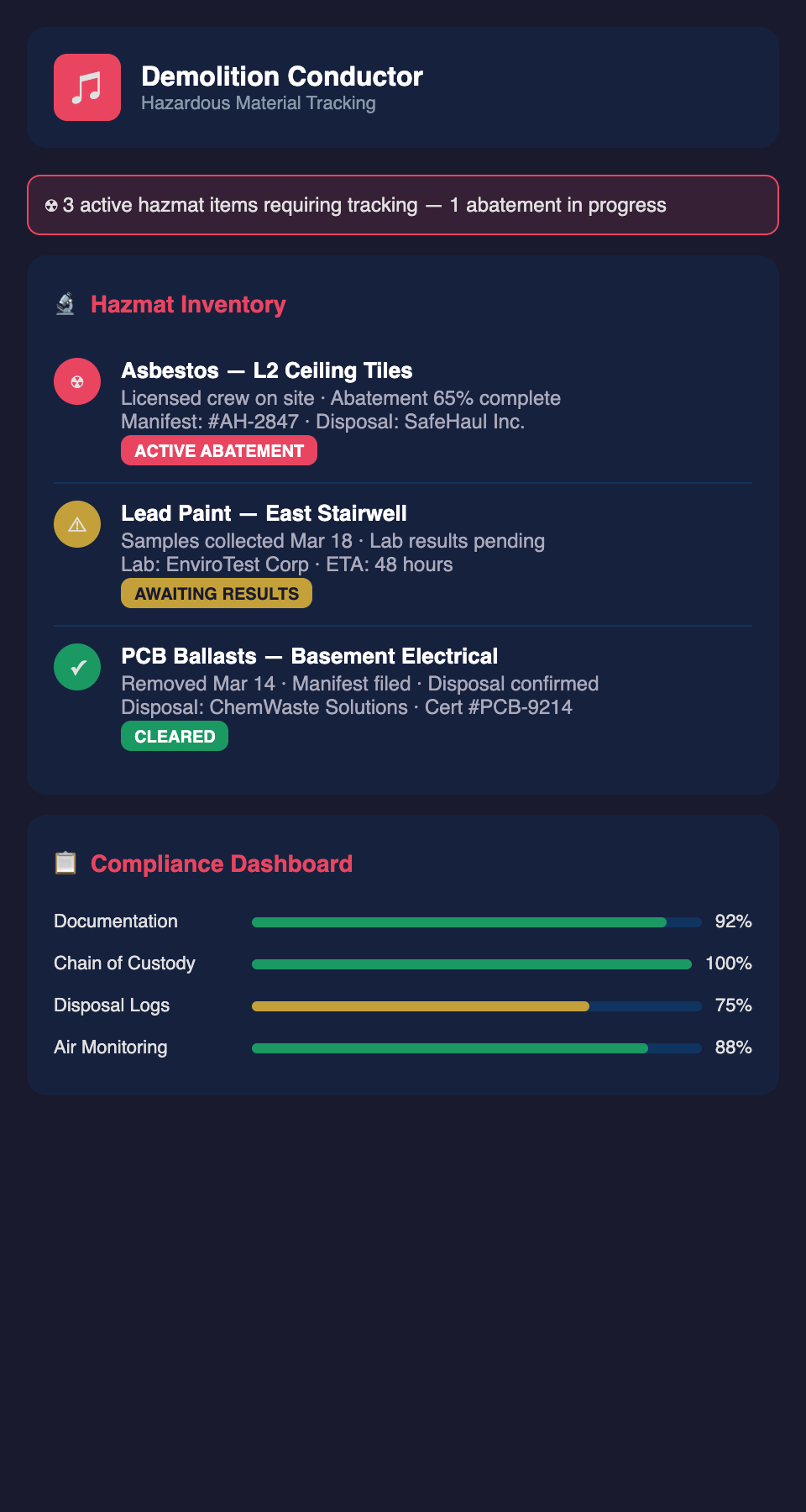
Hazmat Categories and Tracking Requirements
Different hazards require different tracking and documentation:
Category 1: Regulated Hazardous Materials
-
Asbestos (ACM — asbestos-containing materials)
-
Lead (lead paint, lead-based coatings)
-
PCBs (polychlorinated biphenyls in electrical systems)
-
Mold (extensive contamination)
Tracking requirements:
-
Regulatory notifications (EPA, state environmental agencies)
-
Licensed contractor involvement
-
Detailed documentation of removal, transport, disposal
-
Air testing and clearance before re-occupancy
-
Potentially 6+ month timeline for complete remediation
Category 2: Environmental Hazards
-
Underground storage tanks (USTs)
-
Soil contamination (petroleum, heavy metals)
-
Wastewater contamination
-
Groundwater contamination
Tracking requirements:
-
Environmental assessor involvement
-
Site characterization (sampling and analysis)
-
Remediation plan approval by environmental agencies
-
Post-remediation environmental clearance
-
Potentially 3-12 month timeline
Category 3: Operational Hazards
-
Pressurized systems (HVAC, refrigeration)
-
Electrical systems (high-voltage equipment, battery banks)
-
Flammable materials (stored chemicals, fuel)
-
Biological hazards (bird guano, bat infestations)
Tracking requirements:
-
Safe decommissioning procedures
-
Proper disposal arrangements
-
Documentation for regulatory compliance
-
Shorter timeline (weeks, not months)
Creating a Hazmat Tracking System
A functional system tracks discovery, remediation, and closure for every hazmat item.
Discovery Tracking
When a hazmat item is discovered:
Immediate action (day 0):
-
Site supervisor documents discovery:
-
Location (building, floor, room, specific area)
-
Material description (asbestos in ceiling tiles, lead paint on exterior, etc.)
-
Estimated quantity (square feet, cubic feet, weight)
-
Photos of location
-
Any immediate exposure risk
-
-
Project manager is notified immediately
-
Affected work areas are flagged (no crew entry)
-
Hazmat contractor is contacted (24-hour response)
Documentation:
-
Hazmat discovery form (standardized template)
-
Location marked on floor plan
-
Work blockage communicated to affected crews
Assessment Phase
Within 2-5 days:
-
Licensed hazmat contractor visits site
-
Samples collected for laboratory analysis (if uncertain about material)
-
Assessment report generated:
-
Material type confirmed
-
Quantity confirmed
-
Remediation approach recommended
-
Timeline and cost estimate
-
Regulatory notifications required
-
-
Regulatory agencies notified (if required)
-
Project timeline adjusted to accommodate remediation
Documentation:
-
Assessment report
-
Lab analysis results
-
Regulatory notifications (certified mail, returned receipt)
-
Revised project timeline
-
Budget impact assessment
Remediation Phase
During remediation (days/weeks/months depending on material):
-
Hazmat contractor executes remediation plan:
-
Containment systems installed (negative pressure, barriers)
-
Material removed and bagged/containerized
-
Removal progress documented
-
All waste properly containerized and labeled
-
-
Site supervisor monitors progress:
-
Daily status reports
-
Photo documentation of progress
-
Any obstacles or scope changes communicated immediately
-
-
Environmental monitoring (if required):
-
Air quality sampling during removal
-
Clearance testing after completion
-
Documentation:
-
Daily removal logs
-
Waste manifests (tracking waste from removal through final disposal)
-
Air quality reports
-
Safety incident reports (if any)
-
Cost tracking (comparing actual to estimate)
Disposal Tracking
Each container of hazmat waste must be tracked from removal through final disposal.
Waste manifest system:
-
Unique identifier for each waste container (barcode or number)
-
Contents description (ACM tiles, lead paint chips, etc.)
-
Quantity and weight
-
Date removed from site
-
Licensed contractor info
-
Transportation documentation
-
Disposal facility documentation (where it went, confirmation of disposal)
All manifests must be retained for 5-10 years depending on material type and jurisdiction.
Post-Remediation Closure
After remediation is complete:
-
Final air quality testing (if required)
-
Environmental clearance obtained
-
All remediation documentation compiled
-
Regulatory closure obtained (formal sign-off)
-
Affected work areas cleared for re-entry by general demolition crews
Documentation:
-
Final clearance report
-
Regulatory closure documentation
-
Summary for project file
Case Study: Multi-Hazmat Remediation Tracking
A demolition firm was contracted to demolish a 5-building former manufacturing complex. Pre-demolition environmental assessment identified:
-
Building 1: Extensive ACM (asbestos) in mechanical systems and insulation
-
Building 2: Heavy lead paint contamination + 6 PCB transformers
-
Building 3: Historical soil contamination from manufacturing process
-
Building 4: Underground storage tank (fuel oil) requiring removal
-
Building 5: Minimal hazmat (standard demolition)
Without systematic tracking, this project would have been chaotic. With their hazmat tracking system:
Tracked items:
-
187 ACM locations (asbestos)
-
42 lead paint areas
-
6 PCB transformers
-
1 underground storage tank
-
8 soil contamination zones
Tracking discipline:
-
Each item had unique identifier and dedicated tracking file
-
Item status tracked through discovery → assessment → remediation → disposal → closure
-
Regulatory notifications documented with date stamps
-
Manifests tracked each waste container through entire disposal chain
-
Project timeline adjusted based on documented hazmat requirements
Results:
-
Zero regulatory violations or citations
-
Perfect waste documentation compliance
-
No crew exposure incidents
-
Project completed within adjusted timeline (timeline was realistic because hazmat was accounted for)
-
Post-project audit showed all 244 hazmat items properly remediated and documented
Without tracking discipline, the firm would have faced:
-
Unrealistic original timeline (hazmat scope not understood)
-
Potential regulatory fines ($10,000-$50,000+)
-
Litigation risk from waste disposal documentation gaps
-
Crew exposure risks if remediation status wasn't clearly communicated
Technology for Hazmat Tracking
Simple spreadsheets work, but digital systems are more reliable.
Effective options:
-
Dedicated hazmat tracking software — Purpose-built for demolition/environmental industry
-
Digital forms + database — Google Forms → Sheets, Microsoft Forms → Excel
-
Project management software — Monday.com, Asana (with custom fields for hazmat tracking)
-
Mobile apps — Site supervisors capture photos and data on mobile device, synced to central database
Key features needed:
-
Photo attachment capability (document discovery and remediation)
-
Location mapping (where is each hazmat item?)
-
Status workflow (discovery → assessment → remediation → disposal → closure)
-
Regulatory notification tracking (what agencies must be notified?)
-
Waste manifest tracking (each container tracked separately)
-
Document archival (store all supporting docs)
Preventing Hazmat Surprises
The best time to address hazmat is before demolition begins.
Pre-demolition assessment:
-
Commission detailed environmental assessment 8-12 weeks before demolition
-
Go beyond standard Phase I ESA (Environmental Site Assessment)
-
Include aggressive intrusive sampling (drilling, cutting, sampling)
-
If uncertainty remains, perform targeted remediation pre-demolition rather than discovering during demolition
Budget planning:
-
Never assume "minimal hazmat" without assessment
-
Add 20-30% contingency for hazmat surprises on older buildings
-
Establish contingency budget for unplanned remediation
Timeline planning:
-
Allocate minimum 4-6 weeks for hazmat remediation on any building >40 years old
-
Front-load hazmat remediation before general demolition begins
-
Plan for regulatory agency review and closure timeline
The difference between firms that are surprised by hazmat and firms that manage it proactively is simply: do the detailed assessment before demolition starts, not during.
Ready to track every hazmat item from discovery through final disposal with zero regulatory violations and complete audit compliance? Join the waitlist today.