Avoiding Cascade Failures in Partial Demolition
What Causes Cascade Failures?
A cascade failure occurs when removing one element creates unexpected stresses that another element can't handle, causing it to fail. That failure creates additional stress, triggering more failures—a domino effect that cascades beyond the intended demolition zone.
These disasters occur most often in partial demolition projects where portions of the building remain standing. The remaining structure must absorb loads it wasn't originally designed to handle.
Real-World Cascade Scenario
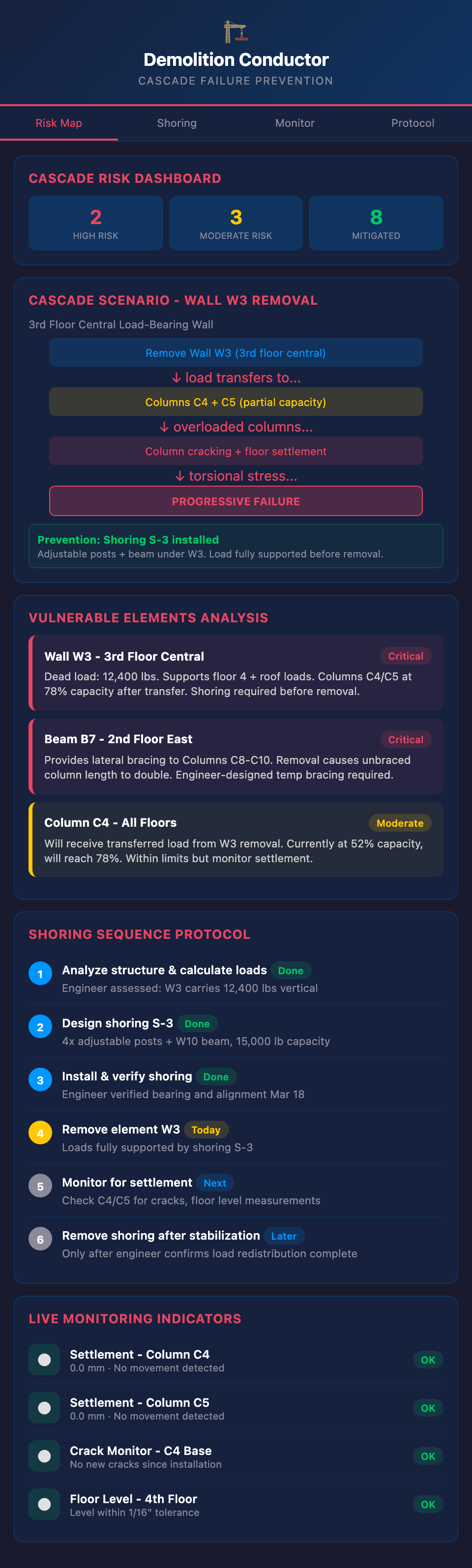
Imagine a building with a central load-bearing wall running the entire height. The structure above this wall depends entirely on it. You plan to remove the wall on the third floor to open the space for a tenant renovation.
Without proper planning, removing that wall section transfers its load to columns on either side. But those columns were only partially engaged with that load—the wall carried the main share. Now the columns must handle loads exceeding their capacity. They crack.
The cracks spread. Stress redistributes further. A section of the floor above settles unevenly. The uneven settlement creates torsional stress in the remaining wall sections. What started as opening one wall becomes a failing building.
This cascade could have been prevented with proper temporary shoring and load-path engineering.
Identifying Vulnerable Elements
Before removing any structural element, identify which remaining elements will receive its loads. Then verify those elements can handle the transferred loads.
Ask these critical questions:
What loads does this element carry?
-
Dead load (the element's own weight)
-
Live loads (occupant weight, temporary loads)
-
Environmental loads (wind, snow, seismic forces)
Which elements depend on this one?
-
Elements directly supported by it
-
Elements that share lateral bracing with it
-
Elements connected by critical connections
Can remaining elements handle the transferred loads?
-
Compare the transferred load to the element's capacity
-
Account for reduced capacity if elements are damaged or deteriorated
-
Consider concentrated loads at connection points
How will the load path change?
-
Loads that traveled through the removed element must travel through other paths
-
Ensure alternate paths exist and are adequate
-
Identify any new concentration points
The Temporary Shoring Strategy
Temporary shoring prevents cascades by assuming the loads of removed elements until the building structure permanently adjusts.
Install shoring before removal, not after. Shoring goes under the element you're removing, supporting the loads it carries. When the element is removed, shoring assumes that load. After the building stabilizes and remaining elements adjust, you can remove shoring.
Shoring specifications depend on:
-
Load magnitude calculated from structural drawings or engineer assessment
-
Load duration how long shoring must support the load
-
Shoring method beams on adjustable posts, temporary walls, or hydraulic shores
-
Connection details how shoring connects to bearing points
For load-bearing walls, you might install adjustable posts with beams spanning to columns on either side. For floor systems, you might install shoring towers beneath joists. For large open areas, you might build temporary bearing walls.
Sequencing Shoring Installation
Never remove an element and then install shoring. The building may collapse in the interim. Instead:
-
Analyze the structure and identify all loads to be supported
-
Design shoring adequate for those loads
-
Install and verify shoring before removing any element
-
Remove the element with loads fully supported by shoring
-
Monitor for settlement as remaining structure adjusts
-
Remove shoring once the structure stabilizes and loads redistribute safely
This sequence prevents the vulnerability window where the building is unsupported.
Monitoring for Cascade Indicators
Even with shoring, monitor for signs that cascades are beginning:
-
Unexpected settlement in areas that shouldn't move
-
New cracks appearing in remaining elements
-
Gaps opening at connections
-
Sounds of stress creaking or popping from the structure
-
Water leaks from cracks, indicating structural movement
-
Equipment misalignment if you have attached systems
If you observe any of these, stop work immediately. Contact your structural engineer to assess what's happening before proceeding.
When You Need an Engineer
Cascade risks exceed DIY assessment on:
-
Multi-story structures
-
Buildings with unusual or asymmetrical framing
-
Structures showing signs of prior damage or deterioration
-
Renovation projects where loads shift significantly
-
Projects where partial demolition affects structural integrity
Engineer consultation costs less than insurance deductibles and far less than building failures.
Build Safety Into Your Project Planning
Every demolition project can be planned to eliminate cascade risks. The key is thinking through how the remaining structure will handle the departure of each element before that element comes down.
Join contractors using intelligent orchestration to plan safer, more predictable projects. Our platform helps you map load paths, identify dependencies, and prevent the domino effects that catch unprepared contractors off guard.
Sign up for our waitlist and receive a structural planning checklist designed specifically for contractors like you.