Coordinating Multi-Crew Demolition Sites Efficiently
The Challenge of Managing Multiple Crews
When you scale from single-crew to multi-crew operations, coordination becomes exponentially more complex. One crew removing a support element while another works in the load path below creates lethal conditions. Yet most small contractors manage crews using whiteboards, phone calls, and hope.
This approach fails. Every year, preventable incidents occur because crews didn't communicate timing, dependencies, and hazards accurately.
Understanding Crew Dependencies
Before deploying multiple crews, identify what work depends on what. Some tasks happen in parallel. Some must sequence strictly.
Tasks that can run simultaneously safely:
-
Multiple crews on different buildings or separate structures
-
Interior non-structural demolition in different zones
-
Material sorting and recycling operations
-
Debris removal from earlier phases
Tasks requiring strict sequencing:
-
Removing shoring after load paths stabilize
-
Removing support elements that multiple work areas depend upon
-
Removing connections that hold multiple systems in place
Creating the Crew Coordination Matrix
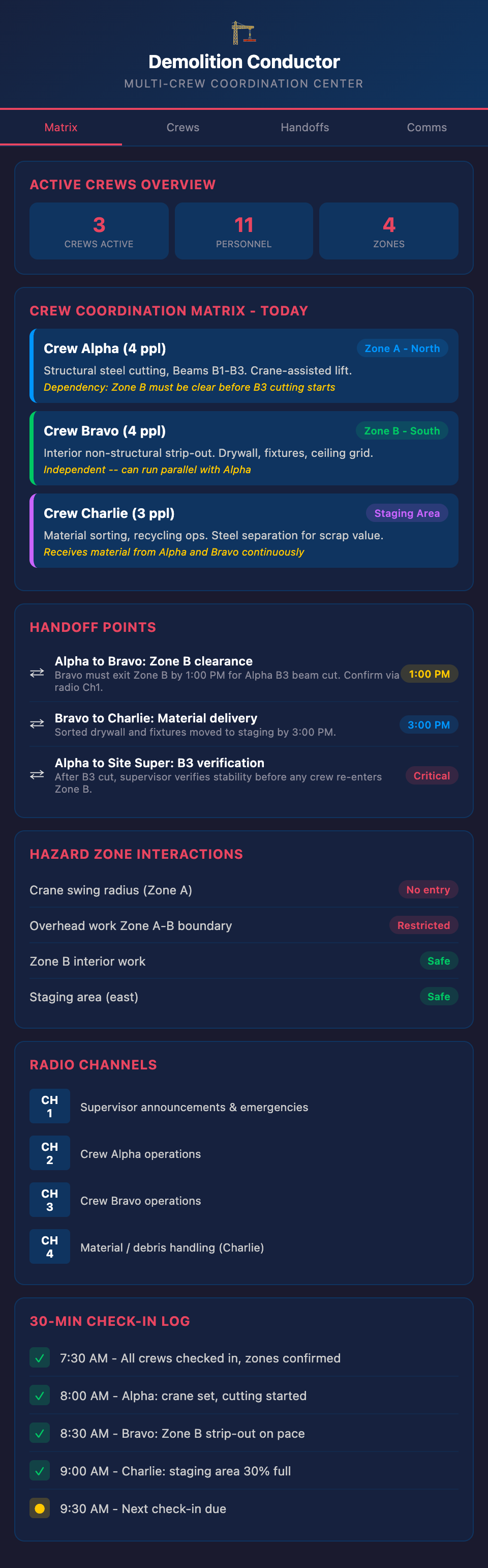
Map each crew's area, tasks, timing, and dependencies in a visual format. Your orchestration tool should display:
-
Each crew's assigned zone with clear boundaries
-
Work phases and timing showing when Phase 1 ends and Phase 2 begins for each crew
-
Handoff points where one crew's completion enables another's work
-
Hazard zones where simultaneous work creates danger
-
Communication checkpoints where crews must confirm status before proceeding
Update this matrix daily. Site conditions change. A structural element may need reinforcement before removal. A material delivery may delay a phase. Crews must know about changes before they create hazards.
Daily Briefings and Real-Time Adjustment
Begin each day with a crew briefing showing:
-
Yesterday's accomplishments and how they affected the overall timeline
-
Today's specific task list for each crew
-
Dependency warnings for any tasks dependent on other crews finishing
-
Hazard alerts for new dangers identified overnight or from recent work
-
Changes from original plan and why changes occurred
Use visual representations. Crews absorb spatial information better from diagrams than from verbal descriptions. Show your orchestration tool's display on a tablet at the daily briefing so everyone sees the same information.
Assign one experienced supervisor to monitor the entire site's progress. This person doesn't direct individual crews but ensures sequences stay coordinated and hazards don't emerge from crew interaction.
Managing Material Flow Between Crews
Debris management impacts crew coordination. If one crew processes material faster than another crew delivers it, one backs up while the other stalls. Material staging areas need capacity for in-progress work.
Plan material handling as a separate operation that interacts with but doesn't block demolition crews. A dedicated recycling/sorting crew working on processed material keeps demolition crews moving without waiting.
Communication Technology
Radios provide real-time communication across large sites. Establish specific channels:
-
Channel 1: Supervisor announcements and emergencies
-
Channel 2: Crew A operations
-
Channel 3: Crew B operations
-
Channel 4: Material/debris handling
Test radios before each project and ensure all equipment is charged. Implement a "check-in" system where each crew verifies status every 30 minutes.
Preventing the Cascade Problem
The worst site disaster occurs when one crew's action triggers unexpected consequences in another area. A removed support causes unexpected settlement. An element falls into an occupied work area. Unexpected loads concentrate on a structure.
Prevent cascades by:
-
Verifying stability after each major removal
-
Inspecting unexpected settlement or movement immediately
-
Halting work if conditions change unexpectedly
-
Consulting the structural engineer before proceeding after surprises
Your orchestration tool should flag when major removal milestones occur, triggering safety verification steps.
Ready to Eliminate Coordination Chaos?
Multi-crew demolition demands precision that spreadsheets and verbal communication can't provide. Professional orchestration lets you visualize dependencies, synchronize crews, and prevent hazardous interactions.
Join our waitlist for early access to the coordination system that transforms chaos into choreography.