Cost Savings Through Optimized Removal Schedules
Where Demolition Costs Hide
Most small contractors price demolition projects with fixed estimates based on square footage or element count. But actual costs depend on how efficiently you sequence work:
-
Equipment rental costs are daily or weekly; stretching a project costs money
-
Crew overtime for schedule delays reduces profit margins
-
Idle time between phases wastes paid labor
-
Material handling costs multiply if removal sequences require repeated handling
-
Logistics overhead increases on extended schedules
The contractor who completes identical demolition in 4 weeks instead of 5 weeks saves 25% on equipment rental costs alone. Schedule efficiency directly impacts profitability.
The Hidden Efficiency Problem
You estimate a demolition project:
-
Estimate removal time for each element: 200 hours of labor
-
Multiply by labor rate: $20,000
-
Add 30% markup: $26,000 bid
The project goes smoothly and costs exactly the hours you estimated. But:
-
Rented equipment (excavator, dumpsters, shoring): $8,000 for 5 weeks
-
Crew transportation and logistics: $2,000
-
Supervisor time: $3,000
-
Actual labor: $18,000
You bid $26,000 for $31,000 in costs. You lose $5,000.
If you'd orchestrated the work to complete in 4 weeks instead of 5:
-
Equipment: $6,400 (20% savings)
-
Logistics: $1,600 (20% savings)
Now your $26,000 bid covers $27,600 in costs. You make modest profit instead of losing money.
The Sequence-Cost Relationship
Project duration depends on your removal sequence. Poor sequencing creates idle time:
Inefficient Sequence Example:
-
Week 1: Crew A removes interior non-structural elements (20 hours/week)
-
Week 1-2: Crew A removes supporting walls (40 hours)
-
Week 2: Crew A removes primary structural elements (30 hours)
-
Week 3: Crew B removes remaining material (20 hours)
-
Equipment rented: 3 weeks
The sequence works but involves idle time:
-
Crew A works only 20 hours in Week 1 while Crew B waits
-
Crew A works 40 hours in Week 2 while Crew B waits
-
Only Week 3 efficiently uses both crews
Optimized Sequence Example:
-
Week 1: Crew A removes non-structural from Building A (40 hours), Crew B removes non-structural from Building B (40 hours)
-
Week 2: Crew A removes supporting walls, Building A (40 hours), Crew B removes supporting walls, Building B (40 hours)
-
Week 2 end: Structural removal both buildings (combined 30 hours)
-
Equipment rented: 2 weeks
Both crews work full-time hours. Equipment rental drops to 2 weeks from 3. Total costs drop 30%.
Planning for Sequence Efficiency
Identify Opportunities for Parallelization
Work that can happen simultaneously:
-
Different buildings or separate structures
-
Non-overlapping interior zones
-
Material sorting and processing (dedicated crew)
-
Debris removal and site cleanup (dedicated crew)
Each opportunity to run parallel work reduces total project duration.
Identify and Minimize Idle Time
Where do crews wait?
-
Waiting for prerequisite work completion (Crew B can't start until Crew A finishes)
-
Waiting for equipment arrival (crane, specialized equipment)
-
Waiting for inspections or approvals
-
Waiting for permits or utility disconnections
Reduce idle time by:
-
Sequencing so dependent work happens after independent work (get independent work from multiple crews done in parallel)
-
Arranging equipment delivery for when it's needed, not before
-
Scheduling inspections when crews can continue other work simultaneously
-
Coordinating utility disconnections with your schedule, not around their availability
Load Balancing Across the Timeline
Distribute work so crews stay busy throughout the project:
-
Don't front-load easy work that leaves crews idle later
-
Save work that can happen in parallel for when you have multiple crews
-
Sequence complex work when you have maximum resources
-
Use flexible-timeline work to fill gaps
Account for Non-Labor Costs
Your schedule impacts more than labor:
-
Equipment daily/weekly cost decreases with shorter schedule
-
Project overhead (supervisor, insurance, permits) accrues daily
-
Facility costs (if protecting adjacent spaces) accrue daily
-
Material costs decrease if you minimize handling cycles
Each day you shorten saves more than just labor costs.
The Real-World Calculation
Let's cost a real project more carefully:
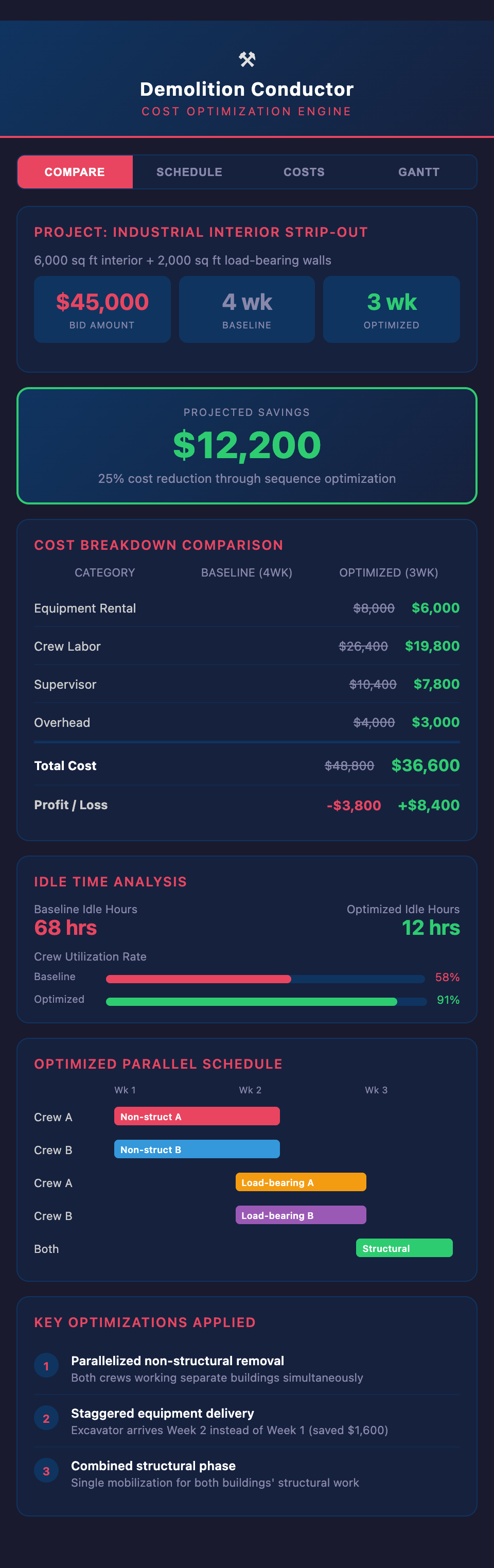
Project Scope: Remove 6,000 sq ft of interior, 2,000 sq ft of load-bearing walls
Assumption 1: Inefficient sequence, 4-week schedule
-
Equipment rental (excavator, dumpster, misc): $8,000
-
Crew (3 people × $55/hr × 160 hrs/month): $26,400
-
Supervisor (1 person × $65/hr × 160 hrs): $10,400
-
Overhead (insurance, permits, logistics): $4,000
-
Total cost: $48,800
Assumption 2: Optimized sequence, 3-week schedule
-
Equipment rental (same equipment, 3 weeks): $6,000
-
Crew (optimized to 120 hours): $19,800
-
Supervisor (120 hours): $7,800
-
Overhead (proportional): $3,000
-
Total cost: $36,600
Optimized sequencing saves 25% on project costs. If you bid $45,000, Assumption 1 loses $3,800. Assumption 2 nets $8,400 profit.
Your Sequence Planning Tool Should Calculate Costs
When you optimize your sequence, your planning system should calculate:
-
Total project duration days/weeks
-
Equipment rental cost at chosen duration
-
Labor cost at optimal crew count and hours
-
Overhead cost proportional to duration
-
Total project cost and margin
This lets you test sequence alternatives and choose the one maximizing profitability while meeting schedule requirements.
Invest in Planning, Harvest in Profits
Contractors who optimize demolition sequences don't work faster or harder. They work smarter, completing projects efficiently with minimal idle time.
Professional orchestration tools let you compare sequence alternatives and choose optimal approaches before committing crews to site. The planning investment pays back multiple times in improved project profitability.
Join our waitlist for orchestration tools that calculate cost implications of different demolition sequences, helping you choose the most profitable approach for every project.