Managing Heavy Equipment Logistics in Tight Demolition Sites
The Puzzle of Getting Equipment to Do Its Job
You need a crane to remove steel beams. You need an excavator to break concrete and load debris. You need a loader to move material to staging. But your site is constrained: narrow streets, close neighbors, limited on-site space, overhead utilities, underground pipes.
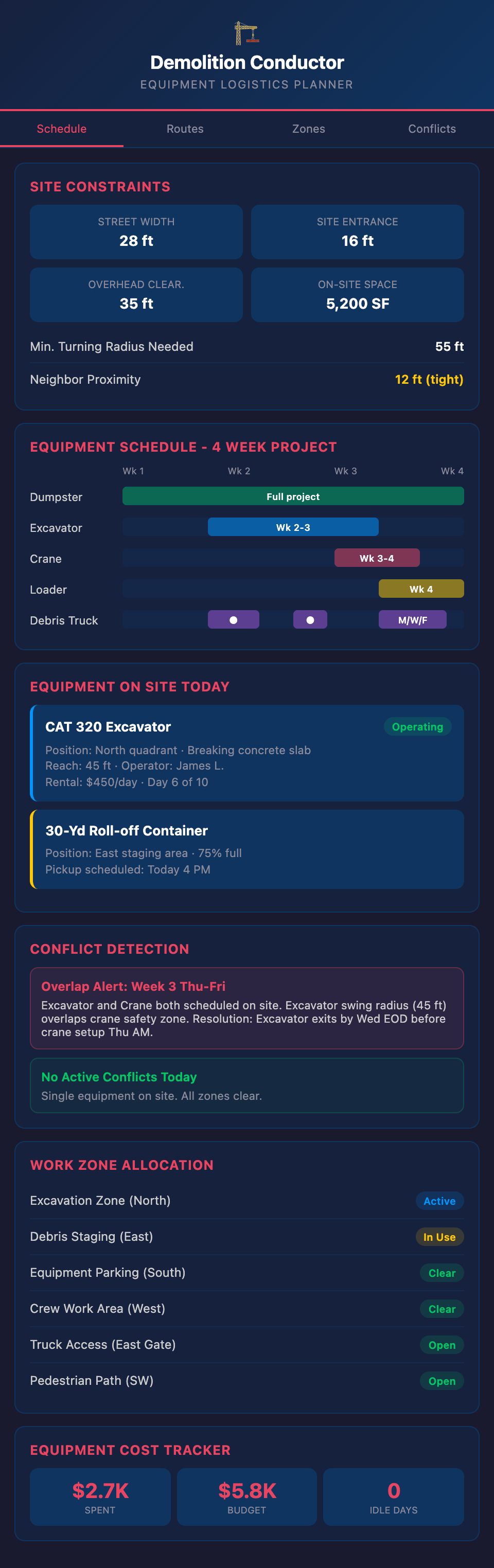
Getting all this equipment to work without them hitting each other, without the crane swing knocking over equipment, without the excavator bucket hitting the adjacent building—that's equipment logistics. Do it right and the project flows. Do it wrong and you lose days to conflicts and repositioning.
Understanding Your Site Constraints
Before you schedule equipment, map your site precisely:
Critical Measurements
-
Street width: How wide is the approach street? Can trucks make the turn into your site?
-
Site entrance width: When a truck enters your site, is there a utility pole, low wire, or fence that blocks it?
-
Turning radius: For large equipment, what's the minimum space needed to turn? Some items need 60+ feet.
-
Overhead clearance: What utilities run above the site? Cranes swing high; confirm clearance.
-
Underground utilities: Call before you dig. Map what's below and avoid damaging it.
-
On-site space: How much space do you have for equipment staging, debris piling, and maneuvering?
-
Neighbor proximity: How close are buildings? Crane swing radius must not hit them. Debris can't fall on them. Vibration must be controlled.
Use a tape measure. Walk the site multiple times. Take photos. Document constraints before you plan equipment routes.
The Master Equipment Schedule
Create a week-by-week schedule showing:
-
What equipment arrives and when
-
How long it stays
-
What work it performs
-
When it leaves
Example for a 4-week project:
-
Week 1: Dumpster, hand tools only. No heavy equipment.
-
Week 2: Excavator arrives day 1; works through week 2; leaves Friday. No crane yet.
-
Week 3: Excavator continues until Wednesday. Crane arrives Thursday. Excavator leaves Friday.
-
Week 4: Crane works through week 4. Loader works Mon-Fri. Debris truck pickup Mon, Wed, Fri.
This schedule prevents overlap where you're trying to use both the excavator and crane in limited space at the same time.
Equipment Route Planning
For each piece of equipment, plan its route:
Arriving: How does it get from the street to its on-site location?
-
Does it need a street closure or traffic control?
-
Are there curbs it must avoid?
-
Is there overhead clearance?
-
Where does it unload or set up?
Operating: What space does it need while operating?
-
Excavator: needs a stable platform and clearance in front of its bucket
-
Crane: needs clear swing radius from its base through the area where it lifts
-
Loader: needs access to debris pile, material, and truck loading area
-
Dump truck: needs a turnaround to exit (can't back out if not necessary)
Leaving: How does it exit?
-
Same route as arrival?
-
Need to wait for other equipment to move first?
-
Any equipment left behind that blocks the exit route?
Visualize these routes on a site map. This often reveals conflicts you didn't see mentally.
Preventing Equipment Conflicts
The most common conflict is two pieces of equipment that can't operate simultaneously because they fight over space:
Conflict Example: Excavator and Crane in Limited Space
A 5,000-square-foot site has a concrete slab that needs breaking (excavator) and structural steel that needs removing (crane). Both the excavator and crane need to work in the same general area.
If they're both on site simultaneously, the excavator's swing impacts the crane's safety zone. They interfere.
Solution: Schedule them sequentially. Excavator breaks concrete until it reaches areas that need crane removal. Excavator leaves. Crane arrives. Crane removes steel. After crane finishes, excavator returns to clean up remaining concrete.
Conflict Example: Loading Equipment and Debris Truck
You have a loader on site moving debris to a pile. A debris truck arrives to load and haul. Both need to be in the loading area simultaneously.
If the pile is too small or poorly positioned, the loader can't place material where the truck can load it. The truck sits idle. The loader moves debris elsewhere, creating multiple piles.
Solution: Position the debris pile so the truck can back up to it. The loader deposits material directly into the truck bed, not into a pile. Continuous flow, no waiting.
Space Allocation: Creating Distinct Work Zones
On a typical site, define:
-
Excavation zone: Area where heavy equipment operates
-
Debris staging zone: Area where material accumulates before hauling
-
Equipment parking: Where equipment sits when not active
-
Crew work area: Crew entrance, tool staging, rest area
-
Truck access: Path trucks use to enter, stage, load, and exit
-
Pedestrian pathway: How people move through the site safely
These zones must not overlap. Mark them on a site plan. Enforce them during work.
Crane Operations: The Special Planning
Cranes require their own planning because their safety radius is large and their operation is tightly regulated:
Crane Setup Requirements:
-
Level, stable ground (a crane tips if it's not level)
-
Clearance for the boom to swing (360 degrees, no obstructions at the height of the boom)
-
Safe distance from power lines (minimum 10 feet, varies by voltage)
-
Space for the counterweight and stabilizers
-
Spotter communication and movement (spotter must see load and ground zone)
Crane Operation Windows:
-
Weather limitations (high wind shuts down cranes; very cold affects hydraulics)
-
Utility clearance (power lines must be de-energized or equipment must maintain clearance)
-
Coordination with other equipment (no other equipment in the swing radius)
Crane Cost Impact:
-
Cranes rent at $500-2,000 per day
-
Setup/teardown takes 4-8 hours (on your time)
-
Moving a crane to a new location mid-project costs thousands
-
Every day a crane sits idle costs you regardless of whether it's working
This means: schedule crane work so it's productive every day. Don't bring a crane on site until you're ready to work continuously. Don't leave a crane on site after it's done—remove it immediately.
Excavator Positioning and Accessibility
Excavators need stable ground and clearance to reach their work:
Placement Considerations:
-
Sloping or soft ground can cause tipping; require a level, compacted surface
-
The excavator can reach ~45 feet from its position; plan where it sets up accordingly
-
Bucket capacity affects how many swings to fill a truck; position the excavator to load trucks efficiently
-
Rotating the excavator on soft ground creates ruts; minimize unnecessary rotation
Productivity Impact:
-
A poorly positioned excavator moves material less efficiently; it makes extra swings, repositions frequently, or moves to different positions
-
Frequent repositioning costs hours of lost time
-
Plan the excavator position to handle as much of the work as possible before moving
Managing Multiple Equipment Simultaneously
When you must run multiple pieces of equipment:
-
Define exclusive work zones for each piece
-
Use spotters to communicate between operators
-
Establish radio protocol and hand signals
-
Restrict other personnel from active equipment zones
-
Conduct a pre-operation briefing before starting simultaneous operations
This sounds formal, but it's the difference between safe, efficient operation and confusion that creates accidents or delays.
Weather Impact on Equipment Operations
Equipment doesn't operate the same in all conditions:
-
Rain: Wet ground loses traction; excavators and loaders slip. Crane operation may be suspended in high wind.
-
Extreme cold: Hydraulic fluid thickens; equipment is sluggish. Concrete breaks differently when cold.
-
Extreme heat: Hydraulic systems overheat; equipment throttles down.
-
Snow or ice: Equipment slips; unsafe for operation.
Build weather contingency into your schedule. In a 4-week project in a region with occasional rain, plan for 1-2 days of weather delay. In winter, plan for more.
The Cost of Poor Equipment Coordination
A project where equipment coordination is poor:
-
Crane sits idle day 2-3 (waiting for other work to finish): $1,500 in wasted rental
-
Excavator can't position efficiently (set up in wrong location): 2 extra days to finish = $800 in extended rental + $640 in crew labor
-
Debris truck can't load efficiently (debris piled wrong): 3 extra trips = $600 in hauling cost
$3,540 in losses from poor equipment coordination on a $45,000 project—8% margin lost.
Building Equipment Coordination Into Your Plan
Successful projects have equipment schedules that show:
-
When equipment arrives and leaves
-
What work it does
-
How it interacts with other equipment
-
How long it sits idle (you want zero, but minimize it)
-
Contingency for weather or delays
This schedule is as important as the demolition sequence. It ensures every piece of equipment works productively and safely.
Optimize equipment logistics on your demolition sites. Join our waitlist to access planning tools that help you schedule equipment efficiently, prevent conflicts, and coordinate complex operations on tight sites.