Real-Time Crew Coordination on Demolition Sites
Why Demolition Sites Need Real-Time Coordination
Demolition sites change by the minute. A crew finishes removing a wall early, creating a hazard for another crew working in the load path. An element takes longer than expected, delaying the next phase. Equipment delivery arrives earlier than scheduled. A safety hazard appears requiring immediate attention.
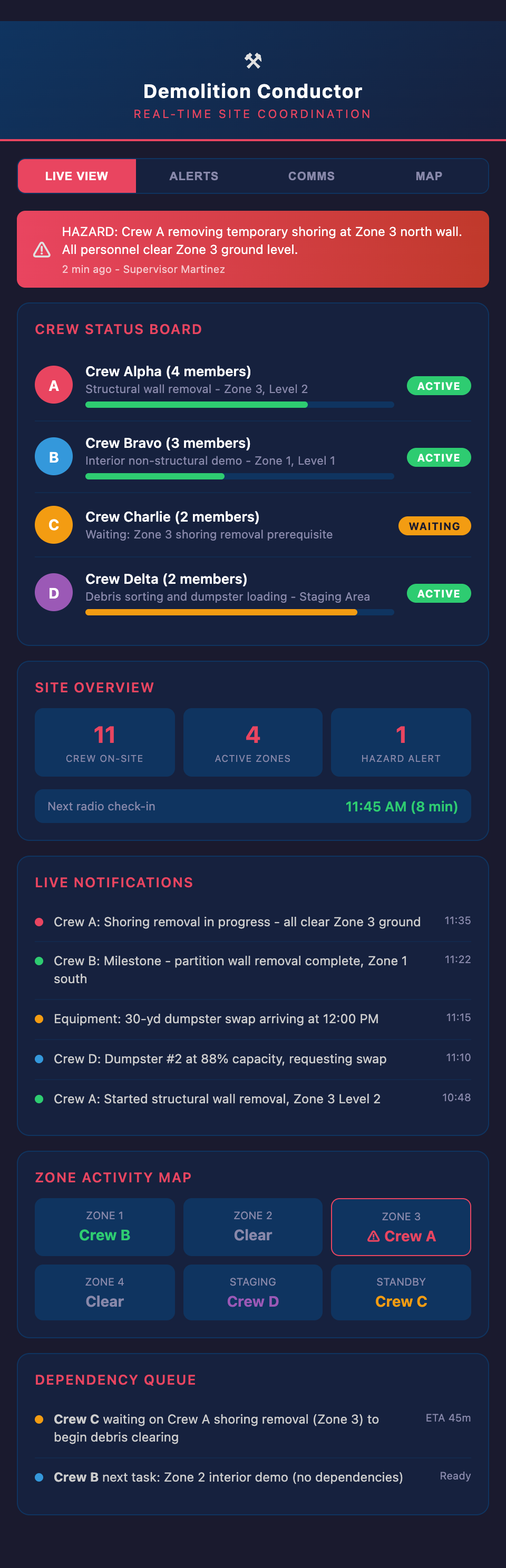
These changes ripple through the entire site. Crews not informed of changes create conflicts or safety violations. The supervisor can't personally oversee every detail on a large site. Traditional communication—phone calls, radio announcements—delays information flow. By the time one crew learns about changes, another crew may have already created a hazard.
Real-time coordination systems eliminate this delay.
How Demolition Sites Traditionally Communicate
Most small contractors use:
-
Radio check-ins every 30-60 minutes (delayed information)
-
Daily briefings covering plans made 12+ hours earlier (stale information)
-
Supervisor manual monitoring of site progress (incomplete visibility)
-
Phone calls for urgent issues (disruptive and error-prone)
-
Whiteboard updates that crews may miss (unreliable)
This system works for simple, linear demolition. It fails for complex multi-crew operations where work phases overlap and dependencies exist.
The Components of Real-Time Coordination
Effective real-time coordination requires:
1. Visual Display of Current Site Status
Crews need to see:
-
Where each crew is located and what they're working on
-
What work is in progress and expected completion time
-
What work is pending waiting for prerequisite completion
-
What hazard areas exist requiring protective measures
-
Where equipment is positioned to avoid conflicts
-
Current alert/warning status for immediate hazards
This information displayed on a tablet or monitor at each work area keeps crews synchronized without constant communication.
2. Automated Notifications for Status Changes
When a crew reaches a milestone, automated notifications should alert affected crews:
-
Crew A completes removing a load-bearing wall: Crew C (who needed that wall removed before their work) receives immediate notification that their prerequisite is complete
-
An unexpected element is discovered: All crews working near that area receive notification of the hazard
-
Equipment arrives: The crew scheduled to use it gets notification it's ready
-
A schedule change: All affected crews receive revised timing information
Notifications are immediate, not waiting for next radio check-in.
3. Real-Time Task Status Updates
Crews should update task status as they complete segments:
-
Start work: "Crew B beginning non-structural interior demolition, Zone 2"
-
Milestone completion: "Crew B completed interior demo Zone 2, wall now exposed"
-
Issues encountered: "Crew A found undocumented steel reinforcement at position X, halting work pending engineer assessment"
-
Crew repositioning: "Crew C completing material sorting, moving to Phase 2 tasks in Zone 1"
These updates are brief, submitted from mobile devices on site, and immediately visible to supervisors and other crews.
4. Hazard Alerts and Safety Notifications
Safety changes require immediate communication:
-
A crew working below a removal area must know when that area is being worked on and materials are falling
-
Adjacent crews must know when a temporary support is being removed
-
All crews must know immediately if a safety violation is observed
Hazard alerts supersede other communications. When a critical safety issue occurs, it gets immediate attention.
Implementation Tools and Technology
Real-time coordination doesn't require sophisticated technology. Effective systems use:
Radio with Check-In System
-
Each crew checks in every 15-30 minutes with brief status update
-
Supervisor immediately communicates any changes or hazards identified since last check-in
-
Established protocol ensures critical information gets communicated
Mobile App or Tablet-Based System
-
Site display showing crew locations and current tasks
-
Crews update task status as they transition between phases
-
Supervisor can push notifications or alerts to crews
-
Prevents email delays; information displays immediately
Coordinated Briefings
-
Begin-of-shift briefing reviewing expectations
-
Mid-shift check-in (radio or in-person) reviewing actual progress
-
End-of-shift briefing reviewing accomplishments and next-day plans
Cost-effective sites often combine radio communication (for voice, real-time alerts) with a simple visual status board (hand-written or digital) showing current state.
Supervisor Role in Real-Time Coordination
The site supervisor becomes the central coordinator:
-
Monitor overall progress against planned schedule
-
Receive status updates from each crew
-
Identify conflicts or dependencies that will cause issues if crews proceed
-
Communicate changes or alerts to affected crews immediately
-
Adjust plans as necessary based on actual progress
-
Verify crew compliance with adjusted plans
-
Respond to unexpected conditions with real-time problem-solving
This role requires presence on site, communication skills, and authority to make quick decisions. It cannot be delegated to someone distracted by other responsibilities.
Preventing Miscommunication
Real-time systems only work if information is accurate and clearly understood. Prevent miscommunication by:
-
Using standardized terminology so "Phase 2" means the same thing to all crews
-
Confirming critical changes verbally after written notification
-
Having crews repeat back critical information ("Crew B: Did you confirm the wall removal is complete?")
-
Using visual indicators like flags or markings on hazard areas
-
Assigning clarity responsibility to whoever communicates (if you communicate it, you're responsible it's clear)
The Competitive Advantage
Sites that coordinate in real time:
-
Complete faster because crews aren't waiting for information
-
Have fewer safety incidents because crews know what others are doing
-
Experience less rework because conflicts are caught immediately
-
Maintain better morale because crews aren't frustrated by unclear instructions
Contractors who master real-time coordination deliver projects more efficiently and safely.
Bring Your Site Into Real Time
Eliminate coordination delays that slow your project and create hazards. Professional orchestration with real-time crew coordination transforms chaotic sites into synchronized operations.
Join our waitlist for early access to the real-time site coordination features that keep your crews moving safely and efficiently.