Sequencing Structural Element Removal Safely
Understanding the Hierarchy of Structural Dependencies
Every building stands as an interconnected system where each element bears weight and stress from above and adjacent components. Small demolition contractors often face the most complex challenge: determining which elements must be removed first to maintain stability throughout the process.
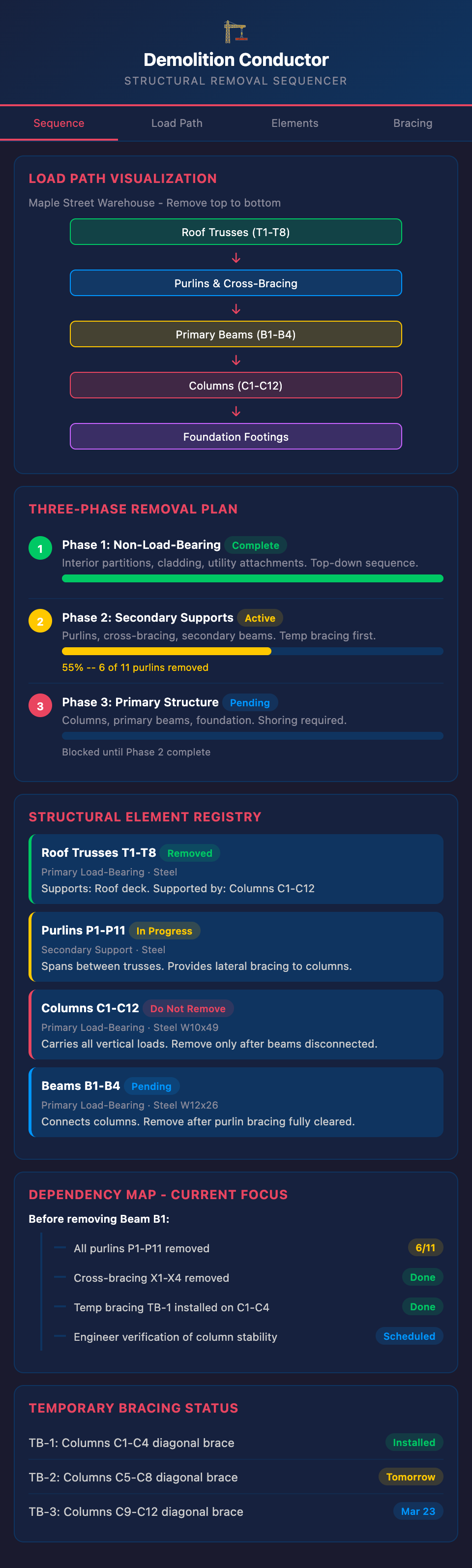
The foundation of safe demolition lies in understanding load paths—the routes that structural forces travel through a building. When you remove one element, that load must redistribute to remaining elements. If those remaining elements weren't designed to handle that load, catastrophic failure becomes imminent.
Creating Your Removal Sequence Map
Before your crews arrive on site, map every structural element that must come down. This includes:
-
Primary load-bearing walls and columns
-
Secondary supports and bracing
-
Floor systems and joists
-
Roof trusses and framing
-
Connection points between elements
Document which elements support which others. A second-floor joist depends on the first-floor wall beneath it. That wall depends on foundation footings. Removing the joist first is safe; removing the wall first is catastrophic.
The Three-Phase Removal Strategy
Phase 1: Non-Load-Bearing Removal
Start with elements that contribute nothing to structural stability. Interior partition walls, non-structural cladding, and utility attachments come first. This phase allows your crews to practice on simpler tasks while clearing the workspace.
Remove these elements systematically from top to bottom. This prevents debris from falling on completed work and eliminates hazards for crews working below.
Phase 2: Secondary Support Removal
Once non-structural elements are cleared, address secondary supports—cross-bracing, purlins, and secondary beams that assist but don't exclusively carry critical loads. These elements typically span shorter distances and carry less critical weight.
Temporarily brace remaining primary elements before removing secondary supports. This temporary bracing redistributes loads away from components you're about to remove.
Phase 3: Primary Structure Removal
Last comes the primary load-bearing system. By this point, the building should feel noticeably lighter and less rigid. The remaining elements may require systematic shoring and temporary support structures.
For complex primary structures, install permanent or temporary bracing immediately after removing each section. Never leave a gap in the load path unsupported.
Reading Building Plans for Sequence Planning
Structural drawings tell you which elements matter most. Look for:
-
Dimension annotations showing column spacing and load points
-
Load indicators showing weight direction
-
Connection details showing how elements interact
-
Material specifications indicating strength ratings
Walls thicker than surrounding walls are typically load-bearing. Columns sitting on girders bear loads. Trusses with web members distribute forces in patterns you must preserve.
When plans are missing or unclear, engage a structural engineer. The cost of consulting an engineer is microscopic compared to rebuilding from a collapse.
Practical Site Coordination
Your visual sequencing tool should display which elements can be removed simultaneously by different crews and which must wait for completion of other work. Color-code by phase and timing. Create timeline views showing crews what to expect week by week.
Communicate sequence changes immediately when site conditions differ from plans. If unexpected hidden structural supports appear, recalculate sequences before proceeding.
Ready to Master Your Demolition Planning?
Professional orchestration of complex demolition projects separates experienced contractors from those who barely survive. Our platform lets you visualize removal sequences, identify dependencies, and coordinate crews across phases with the precision of a musical score.
Join thousands of contractors improving safety and efficiency. Sign up for our waitlist today and receive a free consultation on planning your next complex project.