Training Crews on Complex Takedown Procedures
Why Training Prevents Accidents
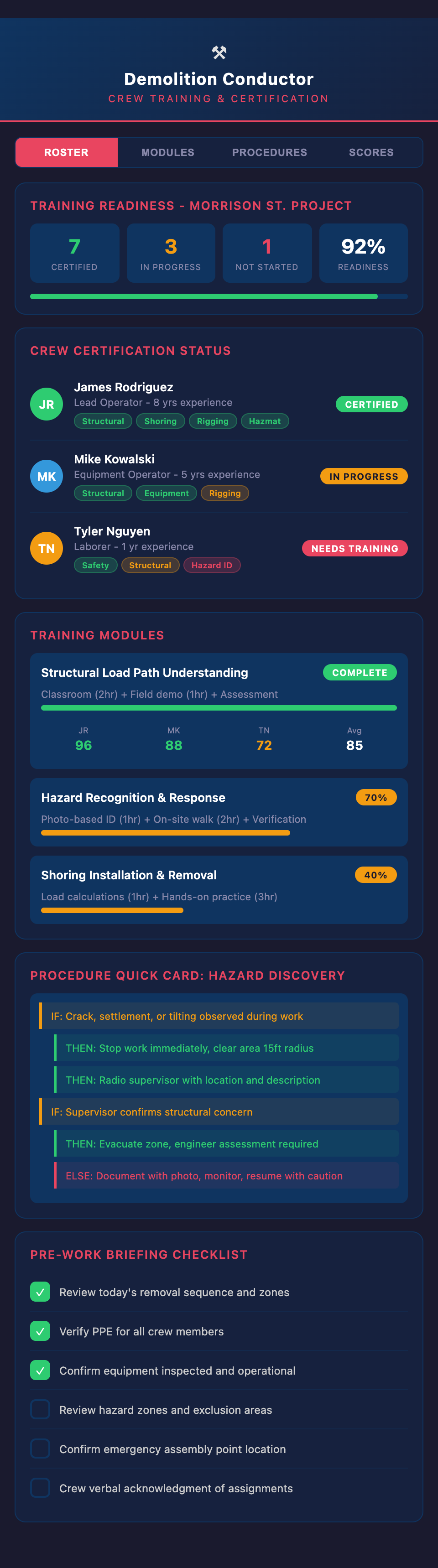
Most demolition work is learned by doing. Experienced crew members show newcomers the ropes on job sites. But complex demolition projects demand specialized knowledge that informal training doesn't provide:
-
Understanding load paths and structural dependencies
-
Safe operation of specialized equipment (shoring equipment, crane rigging)
-
Recognition of hazard conditions during work
-
Proper procedures for unexpected complications
-
Communication protocols for multi-crew coordination
Contractors who formalize training eliminate the most dangerous knowledge gaps.
Types of Knowledge That Require Formal Training
Structural Understanding
Crew members need to understand why they're removing elements in a specific sequence. If a crew member knows "remove the interior walls first because they're non-structural," they can make intelligent decisions if conditions change. If they only know "follow the removal list," they'll be confused and dangerous if the removal order shifts.
Equipment Operation
Specialized equipment used in demolition requires training:
-
Pneumatic breakers and powered tools
-
Hydraulic shoring equipment
-
Crane rigging and load calculations
-
Safety harnesses and fall protection
Using equipment incorrectly creates injuries and equipment damage.
Hazard Recognition
Experienced demolition crew members can spot conditions that pose danger:
-
Cracks indicating structural stress
-
Settlement indicating foundation failure
-
Tilting or shifting indicating loss of support
-
Sounds or vibrations indicating movement
Newer crew members don't recognize these hazards until taught.
Safety Procedures
Every site has specific safety requirements:
-
Where personnel can and cannot be during certain operations
-
How to communicate that everyone's clear before proceeding
-
How to protect adjacent structures or remaining building elements
-
Response procedures if hazards are discovered
Written procedures ensure everyone follows the same protocols.
Creating a Training Program
Start with Job-Specific Procedures
Document the specific demolition procedures for your project:
-
Pre-Work Briefing Procedures
-
What information crew members receive before starting work
-
How they verify they understand their assignments
-
Who they ask if questions arise
-
-
Equipment Setup and Verification
-
How equipment is inspected before use
-
What condition checks are required
-
Who approves equipment readiness
-
-
Work Sequencing and Coordination
-
How crews know what to work on
-
How they communicate completion of tasks
-
How they respond to changes in sequence
-
-
Hazard Recognition and Response
-
What conditions should halt work
-
How to report hazards to the supervisor
-
What to do while waiting for supervisor response
-
-
Material Handling and Cleanup
-
How removed material is staged
-
Safety procedures for heavy material handling
-
Debris cleanup expectations
-
-
Emergency Response
-
What constitutes an emergency
-
Who to notify
-
Where emergency assembly points are
-
Deliver Training Effectively
Documentation alone doesn't create competence. Effective training combines:
Classroom/Briefing Training
-
Supervisor explains procedures and reasoning
-
Crew members ask questions and discuss
-
Visual aids (photos, diagrams) illustrate procedures
-
Emphasis on why procedures matter, not just what to do
Hands-On Demonstration
-
Experienced crew members demonstrate procedures
-
New crew members perform procedures under supervision
-
Supervisor observes and provides feedback
-
Practice continues until competence is demonstrated
On-Site Verification
-
Supervisor observes crew members performing procedures independently
-
Immediate correction of errors
-
Praise for correct procedures
-
Assumption that procedures will improve with repetition
Create Written Procedure Documentation
Document critical procedures in simple, illustrated formats:
-
Single-page laminated cards for quick reference at work sites
-
Photo-based procedures showing step-by-step sequences
-
Checklist formats crew members can verify completion
-
Decision trees for complex procedures ("If X happens, do Y; if Z happens, do W")
Procedures posted at work areas remain accessible when crews need them, preventing memory errors.
Training for Specialized Situations
Complex projects may require specialized training:
Shoring Installation and Removal
-
How to calculate loads and verify shoring adequacy
-
Installation sequence ensuring loads transfer properly
-
Monitoring for settlement or excessive movement
-
Safe removal procedures
-
Recognition of signs that shoring is failing
Rigging and Hoisting
-
Load calculations
-
Selection of appropriate rigging hardware
-
Inspection of rigging equipment
-
Communication protocols during lifts
-
Recognition of conditions that make lifting unsafe
Hazardous Material Handling
If your project involves hazardous materials:
-
Proper personal protective equipment
-
Exposure routes and safety procedures
-
Emergency procedures for exposure incidents
-
Proper disposal procedures
-
Regulatory compliance verification
Historic Preservation Procedures
For historic structures:
-
Identification of character-defining features
-
Protection of historic elements during work
-
Salvage procedures for valuable materials
-
Documentation procedures
-
Compliance with preservation guidelines
Measuring Training Effectiveness
Training is effective when:
-
Crew members perform procedures correctly consistently
-
Few or no safety incidents occur related to trained procedures
-
Procedures improve project efficiency (less rework, fewer delays)
-
Crew members can explain the reasoning for procedures, not just follow them
-
Crew members adapt procedures appropriately when conditions change
If training doesn't produce these results, the training needs improvement.
The Professional Contractor Advantage
Contractors with formalized training programs:
-
Attract better crews because training shows professionalism
-
Experience fewer accidents improving safety records
-
Complete projects more efficiently because crews perform procedures correctly
-
Build reputation for quality and safety
-
Earn higher pay because their work quality justifies premium pricing
Training isn't overhead—it's an investment in your business's competitiveness.
Document, Train, and Execute
Complex demolition projects demand crews that understand the reasoning behind procedures, not just the procedures themselves. Formalized training creates that understanding.
Professional orchestration includes detailed procedure documentation and training support that helps crews understand their work's role in the larger project.
Join our waitlist for training resources that help your crews master complex demolition procedures and execute projects with precision and safety.