Managing Barge-Mounted Crane Operations for Over-Water Spans
The Stability Problem That Land-Based Plans Miss
In 2001, a crane mounted on a barge in the Houston Ship Channel capsized during a lifting operation, killing a worker and blocking commercial shipping for days. Investigators cited insufficient stability analysis for the combined crane-and-barge system under actual load conditions. The event was not unique in type — only in visibility. Crane on barge operations fail most often not because of crane capacity errors but because the barge behavior under dynamic load is treated as a background condition rather than a primary planning variable.
OSHA regulation 1926.1437 governing floating cranes establishes that a crane on a barge must not be operated when the list or trim exceeds five to seven degrees, that a qualified person must evaluate all lifts, and that manufacturer-issued barge/crane stability charts must be on site for every operation. These are not aspirational guidelines — they are legal minimums, and OSHA data consistently shows that barge crane incidents correlate with conditions where that list/trim threshold was exceeded without detection. Barge-mounted crane bridge demolition operations add a layer of structural unpredictability that pure land-based lifts do not face: the platform moves as the load moves, and tidal changes alter water depth and current velocity mid-lift.
For teams managing over-water span removal operations on aging infrastructure, this planning gap is compounding. The ASCE Infrastructure Report Card notes that 42% of U.S. bridges are over 50 years old, many of them water crossings with marine access as the only viable crane approach path. The volume of float-in crane bridge deconstruction work is increasing, and the planning frameworks available to most teams have not kept pace.
Scoring the Marine Lift Sequence
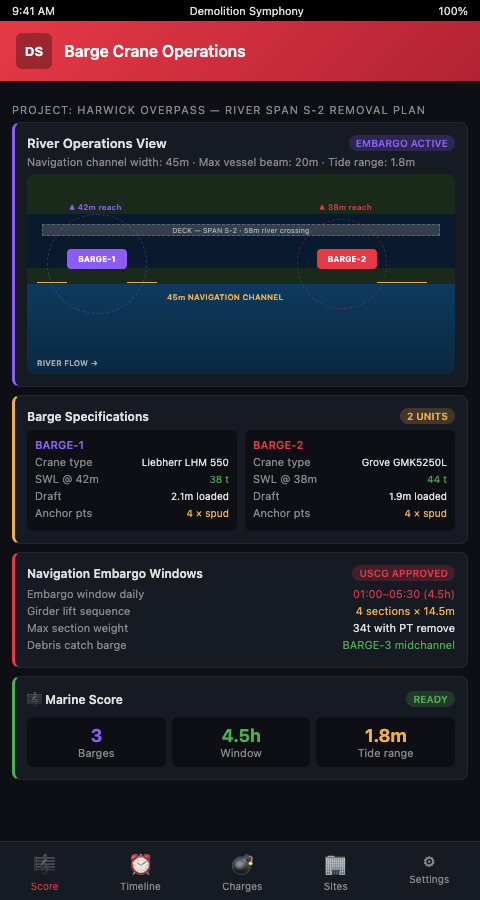
The Demolition Symphony Planner applies its sheet notation model to marine demolition work by treating each barge crane operation as a measure with four notated conditions: structural state of the span being lifted, barge stability status, waterway clearance status, and tidal window position. All four must clear before the measure begins. This is how the Demolition Symphony Planner differentiates marine work from land-based work — not by adding a separate marine module, but by adding marine-specific notation elements to the same score language the team already reads.
Tidal window notation as a time signature. In the Demolition Symphony Planner score, tidal windows function as the time signature for marine measures. A slack-water window might be four hours long, centered on low tide, with a two-hour effective work period after accounting for barge positioning and post-lift ballast adjustment time. The score marks this window as a bracketed measure with entry and exit gates. Work that cannot complete within the bracket is deferred to the next tidal window rather than extended beyond it. This is standard practice in marine construction, as confirmed by the U.S. Army Corps of Engineers and OSHA oversight guidance on crane operations over water.
Barge stability class as a phase prerequisite. Before any lift measure begins, the Demolition Symphony Planner records the barge class selected for the operation. Jack-up barges — those with deployable legs that rest on the waterway bed — provide the highest stability for heavy lifts because they eliminate the dynamic response of a floating platform. Where current or depth precludes jack-up deployment, the score notates the accepted list/trim range and the monitoring method used to track it during the lift. The ICSA guidance on working with land-based mobile cranes on vessels defines the stability assessment steps required before any configuration change during marine crane operations.
Waterway permit notation. Section 404 of the Clean Water Act, as administered for bridge demolitions, requires permits not only for debris discharge but for barge positioning that contacts the waterway bed. USCG Section 9 permits may be required for obstructions to navigable waterways during float-in crane operations. The Demolition Symphony Planner writes each active permit as a header annotation on the phase score — visible to every team member reading the document — so permit conditions (water quality monitoring, debris netting requirements, work window restrictions) are embedded in the plan rather than filed separately.
Rigging notation for asymmetric span sections. Many bridge span sections — particularly prestressed box girders — have asymmetric mass distributions that cause barge list during the lift even when the crane configuration is correctly sized. The score notates each lift with a predicted center of gravity offset and the corresponding barge ballast adjustment required before the hook is engaged. Teams familiar with how waterway containment controls apply to debris falling into water will recognize that the rigging notation and containment notation must be cross-referenced — a rigging failure that drops a span section releases debris into the waterway, triggering a separate response sequence.
Advanced Tactics for Over-Water Crane Operations
Ballast pre-loading before span attachment. The moment of maximum instability on a float-in crane bridge deconstruction lift is not the peak lift height — it is the transition from no load to first contact with the span section. Ballast pre-loading protocols specify that opposite-side ballast tanks are partially filled before the hook engages, so the barge is already compensating for the expected list vector before it develops. The Demolition Symphony Planner writes this as a pre-measure checklist embedded in the gate notation: ballast adjustment confirmed before hook lowers.
Multi-crane barge coordination. Some long span sections require simultaneous lifts from two barge-mounted cranes — one at each end of the section. Coordinating dual marine crane positioning for bridge demo requires that both cranes lift in sync; differential lift speed introduces torsional stress into the span section and unequal lateral loading into both barges. The score writes a synchronized lift cue — analogous to a conductor's simultaneous downbeat — that specifies the target lift rate and the allowable differential before the operation pauses.
Debris containment as a parallel track. Temporary shoring during bridge deconstruction has a marine analog: debris containment systems that prevent cut fragments and demolition residue from entering the water column. Turbidity curtains, debris netting suspended below the cut zone, and barge-mounted collection platforms are all notated as parallel tracks in the Demolition Symphony Planner score — running alongside the structural sequence track rather than as a separate document. The parallel track notation ensures that containment deployment is completed before cutting begins, not after.
Weather hold notation for waterway-specific conditions. The key factors in crane stability identified in marine construction practice include wind speed, current velocity, and wave height — all of which change more rapidly on open water than on land. The Demolition Symphony Planner writes explicit weather hold thresholds into the score for each phase: wind exceeds 25 mph — measure pauses; current velocity exceeds 2 knots at the pier base — barge repositioning required before lift resumes; forecast calls for 30%+ chance of thunder within 60 minutes — measure deferred to next tidal window. These are not improvised field calls; they are pre-written score markings the superintendent reads the same way every day.
High-rise rigging analogy for vertical constraint. Demolition teams transitioning from high-rise work to bridge marine operations will recognize that roof truss rigging sequences in active work zones share the same pre-lift checklist logic: confirm attachment points, verify crane capacity against actual section weight, and establish abort criteria before the load leaves the structure. The marine context adds barge stability to that list, but the score format — prerequisites logged before the measure begins — is identical.
What Unscored Marine Operations Look Like
Without a unified score, marine bridge demolition planning typically distributes across three separate documents: the structural engineer's span removal plan, the marine contractor's barge operation manual, and the environmental permit conditions. None of these documents reference each other's constraints in real time. The barge contractor doesn't know that the environmental permit requires work to stop if turbidity exceeds a threshold. The structural engineer's plan doesn't account for tidal window restrictions that compress the available work time per measure. The permit conditions don't specify what happens structurally if work must stop mid-phase due to a tidal constraint.
The coordination gap between these three documents is where over-water span removal incidents originate. A barge crew operating from a marine operations manual that does not show the structural state of the span being lifted does not know that the partial-cut configuration they are lifting is critically sensitive to lateral load — the condition the structural plan specifies but the barge manual does not include. The gap is not a failure of individual expertise. It is a failure of document integration.
The Demolition Symphony Planner writes all three constraint sets into the same score. The result is not a longer document — it is a cleaner one, where every note is played with full knowledge of the conditions that govern it. When the barge crew, the structural engineer, and the environmental monitor read from the same score, the coordination gaps that cause marine demolition incidents are eliminated before any crew boards the barge.
Plan Your Next Span Removal
Bridge and overpass demolition teams working on water crossings face a planning environment that land-based projects do not encounter: a platform that moves, permits that restrict water contact, and tidal windows that constrain every work measure. Start your over-water demolition planning with the Demolition Symphony Planner and build a score that gives your barge operator, structural engineer, and environmental monitor a single shared document — so tidal window constraints, stability gates, and waterway permit conditions are all visible in the same place your structural sequence is written.
Over-water span removal scores written with the Demolition Symphony Planner also generate the environmental compliance documentation that waterway permits require. When each tidal window is logged as a scored measure with timestamped gate confirmations, the project team has a complete record of when waterway access occurred, what structural operations were conducted during that window, and what containment was verified before the window opened. That record — automatically generated by the score — is the permit compliance documentation that environmental regulators review during project audits and that the team needs if an incident triggers a regulatory inquiry. Score your next barge-mounted crane removal with the Demolition Symphony Planner and give your bridge and overpass demolition team a plan where the environmental compliance record is built into the same document as the structural sequence.