Cruise Retention After Always-On Emotional-Labor Monitoring
Two Operators, Two Outcomes
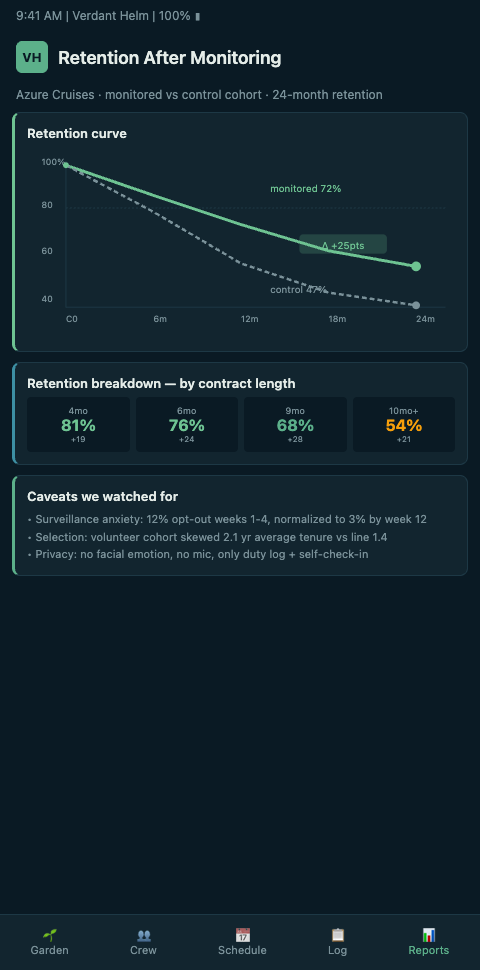
Operator A runs a five-ship premium fleet in the Mediterranean. In March 2024, they switched on continuous emotional-labor telemetry for all 2,800 guest-facing crew: stateroom attendants, cabin stewards, Lido cast members, main dining room servers, maître d' teams. By Q1 2025, their 12-month contract renewal rate had climbed from 61% to 75%. The Hotel Directors described the change as the single biggest retention shift they had seen in a decade. Their internal exit interview volume dropped 32%, not because fewer crew left, but because more of those who were going to leave had their concerns addressed before the exit conversation happened.
Operator B runs an eight-ship contemporary brand on Caribbean turnaround itineraries. They turned on the same telemetry in April 2024. By August, three ships had seen crew letters to the Hotel Director objecting to the monitoring. Two cabin steward leads threatened to quit. A Hotel Director escalated to corporate. The rollout was paused at the end of Q3 pending a redesign of how the telemetry was presented to crew. Travel-agency commentary on the three affected ships picked up a subtle but persistent thread of "service felt tense" — a phrase that almost never showed up in pre-rollout reviews, and which tracked precisely to the weeks the crew pushback was building.
Same software. Same underlying signals. Radically different outcomes. The postmortem across both operators lined up with the ACM systematic review of biometric monitoring in the workplace, which found that frontline workers react negatively to monitoring when recovery time shrinks rather than grows. Operator A used the telemetry to expand recovery; Operator B's ships were using it to tighten shifts. Crew noticed immediately. The difference was not the technology but the operational posture the technology was embedded in — and the crew on both operators read that posture within weeks of the rollout.
The Botanical Garden Of Continuous Care
Always-on monitoring is only useful if the garden metaphor holds operationally. A garden that is watched continuously but never tended generates resentment. A garden where the gardener shows up every morning with water and pruning shears generates trust. Verdant Helm's always-on mode is not surveillance — it is the gardener noticing which perennials are wilting before anyone asks, and acting. On a 5,500-guest megaship with 2,100 crew spread across 14 guest-facing departments, the gardener role is distributed: the Hotel Director, the assistant Hotel Director, the cabin steward leads, the maître d', the Lido supervisor, and the shoreside welfare officer all tend different beds.
Operator A built the always-on rollout around a daily welfare standup on each ship. The Hotel Director, the assistant Hotel Director, and the cabin steward leads spent 20 minutes each morning reviewing the garden dashboard. Which beds were blooming? Which were wilting? Which sinks were pooling energy below the recovery threshold? Every wilt signal over a set threshold triggered an operational intervention before the next shift started. A Filipino cabin steward flagged on the morning of a Barcelona port day was quietly pulled off the afternoon turndown rotation and given a four-hour ashore block.
A Croatian maître d' flagged during the third sea day had her seating load redistributed across her two assistant maître d's for the evening service. The ISWAN Social Interaction Matters project, which ran Fitbit and daily mobile surveys across 200 crew on six vessels including cruise ships, found the same pattern: continuous data produces benefit only when paired with continuous response.
Operator B launched the telemetry without a standup. The dashboards rendered on screens in the Hotel Director's office and the shoreside welfare team's Miami location. Crew knew they were being monitored. They did not see any change in how they were treated. The Springer research on work precarity and workplace surveillance shows that precarious workers react worst to monitoring precisely when the monitoring is not visibly paired with care, and cruise hotel crew on 9-month contracts sit squarely in that precarity band. The specific failure was not the absence of intent — the Miami welfare team reviewed dashboards daily — but the absence of a visible feedback loop. Crew saw the sensing, not the tending.
The redesign Operator B ran in Q4 2024 fixed the imbalance. They added the daily standup. They added a visible "garden tended" signal that crew could see on their own devices — showing which shifts had been adjusted based on wilt signals and which recovery activities had been pre-booked. They added a crew-representative seat on the welfare review meetings, rotating among cabin steward leads and senior servers by department. By Q1 2025, the pushback had eased and the retention curve had started to bend positive, though not yet matching Operator A's trajectory. The lag matters: Operator B lost roughly 14 months of retention gain to the pushback period, and the brand's Q3 and Q4 2024 NPS numbers showed a 6-point dip that the CVP is still explaining to the board.
The PMC study on passive AI detection of stress and burnout in frontline workers frames the underlying principle: always-on passive sensing can detect burnout signals without survey fatigue, but only if the sensing is visibly in service of the worker. Cruise hotel crew already carry surveillance from guest feedback forms, NPS surveys, service scores, and complaint tracking. Adding a welfare garden on top only helps if it visibly reduces their load rather than amplifying it. The Filipino stateroom attendant carrying 18 cabins on a seven-day itinerary already knows her every interaction is being rated; the garden either gives her visible protection or becomes one more surveillance layer she has to manage around.
Advanced Tactics For Earning Crew Trust
The difference between the two operator outcomes generalizes into four tactical principles worth stealing.
Transparency about signals beats transparency about data. Cruise crew do not need to see raw heart rate variability streams. They need to see that when the garden flags them as wilting, something concrete changes in their next two shifts. Operator A's crew-visible dashboard showed "rotation adjusted" or "shore activity pre-booked" rather than showing the underlying biometric signal. This aligned with the Nautilus International reporting on wearable tech for seafarer wellbeing, which emphasized that wearable data only builds trust when it visibly produces action. The counterfactual at Operator B was direct: crew could see they were being measured but not what was being done with the measurement, and the absence of visible action was read correctly as absence of real action.
Crew representation in the review loop is load-bearing. Operator A had a cabin steward lead in the daily welfare standup. Operator B's pre-redesign standup was Hotel Director and assistant Hotel Director only. When cabin steward leads helped interpret garden signals, the interpretations were more accurate and the interventions landed better with crew. An Indonesian F&B server who stopped attending crew karaoke nights might be pre-non-renewal — or she might just be dealing with a difficult family call from home. The cabin steward lead often knows which, and the Hotel Director rarely does without the peer interpretation. The BMC Psychology systematic review of maritime personnel mental health grounds what continuous monitoring should track, and peer interpretation is consistently more trusted than manager interpretation.
Monitoring load must match tending load. If the garden is surfacing 40 wilt signals a day and the welfare team can only act on 10, the remaining 30 become evidence that monitoring is not in service of crew. Operator A tuned the signal thresholds so the daily flagged count matched their intervention capacity — roughly 12 flags per day across a five-ship fleet. Operator B initially flagged three times what they could act on, and crew correctly read the gap as performative monitoring. The tuning is not cosmetic; it determines whether the always-on model earns trust or burns it.
The CLIA welfare reporting evolution frames where this is all heading: continuous, evidence-backed welfare data is becoming the reporting norm, and the service score recovery patterns piece shows how always-on telemetry ties into NPS root-cause tracing. The wind industry is running a parallel experiment — the continuous fatigue streams across wind O&M post documents similar trust-building challenges on offshore technician teams.
What Cruise Operators Should Do Before Turning It On
If you are considering always-on emotional-labor monitoring for your fleet, design the tending loop before you design the sensing loop. Stand up the daily welfare standup, staff the shoreside recovery orchestration, and build the crew-visible "garden tended" signal before the first telemetry stream goes live. Get your cabin steward leads and dining venue managers into the review meetings from day one. Book a Verdant Helm always-on readiness review with your Cruise HR leader and your senior Hotel Directors, and walk through what your tending capacity actually is before you commit to the sensing capacity. The operators who skip this step end up redesigning mid-rollout, which is expensive and erodes crew trust for years.
The readiness review should answer a single quantitative question before the rollout gets signed: at the signal thresholds you plan to set, how many daily interventions will the welfare team be asked to run per ship. If the number exceeds what the Hotel Director, assistant Hotel Director, and cabin steward leads can actually act on in a 20-minute standup, the threshold is miscalibrated. Operator B's initial failure traces directly to that miscalibration — three ships received 35 to 40 daily flags against an intervention capacity of around twelve.
Cruise HR Leaders negotiating the rollout with their CVP should push back on any deployment timeline that does not include a threshold-tuning period where flags-per-day and interventions-per-day get matched. The tuning is usually three to four weeks of paired observation before the crew-visible signals go live. Skipping it is the single most expensive decision a cruise operator can make on this kind of deployment, and the damage shows up not in the dashboards but in the travel-agency commentary that takes two to three quarters to pick up and another year to repair.