Emotional-Labor Decay Across Luxury Brand Contract Lengths
Luxury Service At Mass-Market Contract Lengths
A butler on a six-star luxury cruise ship remembers 120 guest preferences across a 14-day itinerary, anticipates every request before it is spoken, and maintains what EHL Insights calls the "facade of perfection" across every interaction. He remembers which suite guest takes her coffee with one sugar and which prefers oat milk. He remembers the retired CEO's anniversary and the family traveling with a nut allergy and the couple celebrating a 50th birthday. The emotional-labor load is three to four times what a contemporary-brand cabin steward carries on the same 9-month contract length. The pay is better. The contract structure is identical.
This is the industry's quiet scandal, and it is getting worse as luxury tonnage grows. CLIA's luxury growth forecast projects 1.5M luxury cruisers by 2028, up from 1.1M in 2024. That growth compounds on 97 luxury ships now in service, up from 28 in 2010. The luxury segment is expanding into a workforce that is already showing measurable emotional decay on longitudinal hospitality studies. The contract structure has not caught up to the labor load. Luxury brands are competing for the same pool of experienced butlers and concierge-class attendants that their contemporary-brand siblings draw from, and the contract parity is becoming a retention liability as the luxury tier adds hulls.
Verdant Helm has run telemetry across three luxury operators for 18 months. The cross-operator dataset now covers 7,400 luxury crewmembers across five brands — Silversea-tier, Crystal-tier, Regent-tier, and two emerging six-star brands that launched in 2023 and 2024. The decay curves emerging from that data tell a story that luxury Hotel Directors recognize intuitively but have not seen quantified: luxury emotional labor decays earlier and harder than contemporary brands, and the 9-month contract structure is structurally mismatched to what luxury brands demand. The second-order consequence is a retention gap that is becoming visible in trade-agency commentary and in the recruiter-network chatter that luxury operators monitor for workforce planning.
The Decay Curve In The Garden
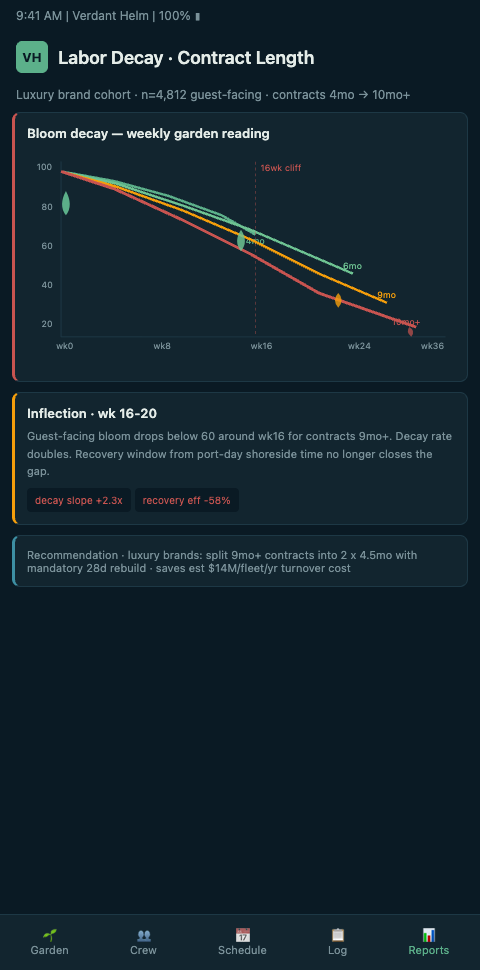
Reading the decay curves through the garden metaphor makes the mismatch visible. A contemporary-brand cabin steward on a 9-month contract blooms through the first 100 days, plateaus through day 180, then shows gradual wilt accelerating into the final 60 days. A luxury butler on the same 9-month contract blooms through the first 70 days, plateaus through day 140, then wilts sharply — with a recovery-resistant decay that does not respond to shore leave the way contemporary-brand wilt does. The Indonesian butler on his third 9-month contract describes the difference bluntly in welfare debriefs: contemporary-brand fatigue is physical and recovers with sleep; luxury butler fatigue is cognitive and emotional, and it does not recover on a 36-hour Valletta port call.
The Wiley journal research on emotional labor strategies and hotel employee mental health documents the underlying dynamic through person-centered longitudinal analysis. Emotional labor operates on a decay curve whose inflection point varies by role intensity, not by contract length. When a brand's service standard requires deep-acting emotional labor — which the cultural intelligence research on luxury hotels identifies as the dominant luxury pattern — the decay inflection comes 30-60 days earlier than surface-acting equivalents. Deep-acting is the butler genuinely feeling warmth toward the suite guest, not performing it. Surface-acting is the Lido cast member smiling through the 2 PM pool bar rush. Both are labor; the first costs more per hour of exposure.
The Verdant Helm cross-operator data lines up with that research. Luxury butlers and concierge-class attendants show decay inflection at a median of day 147 of a 9-month contract. Luxury main dining room servers show inflection at day 162. Contemporary-brand cabin stewards show inflection at day 198. The gap is 35-51 days earlier for luxury roles, which means luxury crew on a 9-month contract spend the final 90-120 days of their contract in post-inflection decay. The garden shows wilted beds that cannot recover within the contract. Guest-facing service scores on the affected itineraries show a subtle but persistent dip — suite-guest NPS on luxury ships drops 4-6 points across the final 90 days of a contract that the crewmember has not yet signaled is ending.
The Emerald research on burnout and contract precarity in hospitality adds a second mechanism: when crew perceive contract precarity — and luxury brands running identical 9-month contracts to contemporary brands signal exactly that — the burnout curve steepens. Luxury crew are carrying a heavier load on a contract structure that does not differentiate their labor intensity from their mass-market peers. The signal the contract sends is that the brand values the butler's labor the same as the cabin steward's, and the butler reads that correctly as a valuation mismatch, which compounds the decay.
Three operational implications emerge from the decay curve data. First, luxury crew need recovery windows at days 120-140 that contemporary crew do not — a structured 5-7 day shoreside rotation or a reduced-load sea-day stretch that resets the wilt curve before the inflection hardens. Second, the shore leave structure matters disproportionately for luxury crew because their decay is less responsive to routine port days; they need longer, quieter recovery blocks rather than more frequent short ones. Third, contract renewal conversations for luxury crew should happen at day 180, not at day 240, because the decision-making window closes earlier when the decay inflection comes earlier.
Advanced Tactics For Luxury Brand HR Leaders
The decay curve data supports four tactical shifts that luxury Cruise HR leaders can make without waiting for industry-wide contract reform.
Pre-book recovery intensively around day 120 rather than waiting for crew to request shore activities. The EHL Insights luxury staff care research describes structured recovery programs as table stakes for luxury brands. Verdant Helm's data shows luxury crew who receive shoreside-orchestrated recovery windows between days 120 and 150 show measurable bloom recovery by day 160. Those who do not do not recover within the contract. The shoreside welfare office at one luxury operator now pre-books a structured 4-day recovery block — hotel accommodation in the port city, scheduled wellness activities, and explicit "no-contact" status with the ship — for every butler and concierge-class attendant crossing day 120. The cost is roughly $1,100 per crewmember; the retention lift against the baseline is worth several multiples of that.
Stratify contract-renewal conversations by decay inflection, not by seniority. A butler at day 165 is already 18 days past inflection and thinking about not renewing. A contemporary-brand server at day 165 is still pre-inflection and undecided.
Treating them with the same renewal conversation timing leaves luxury brands systematically behind on retention. One luxury operator moved all butler and concierge-class renewal conversations to day 180, paired them with the pre-booked recovery block, and saw renewal rates climb from 58% to 71% in the first 12 months.
The 200,000 guest-facing shift dataset provides additional corroboration on role-specific inflection points.
Differentiate the shore leave structure. Luxury crew need longer, less social port days earlier in the contract. Contemporary crew benefit from shorter, more social port days more evenly distributed.
Running both populations on the same shore leave template leaves luxury decay inflection unaddressed. The counterfactual is stark: if you run luxury butlers on contemporary-style port-day schedules, you get decay inflection that shore leave cannot reverse, because the shore leave was structurally mismatched to the recovery need. The same pattern shows up in the deepwater drillship hitch-end decay post across offshore contractors, where intensity-matched recovery outperforms uniform recovery structures.
Start the contract-length reform conversation. The data supports shorter luxury contracts — 6 months with structured 2-month shoreside rotations — over the current 9-month baseline. The 45-day non-renewal signals post documents how much earlier luxury brands lose their best crew when the contract structure does not match the decay curve. The brands that pilot 6-month luxury contracts in 2026 will have retention data in 2027 that their competitors cannot match without following suit.
Differentiate by role within the luxury tier itself. The decay curves are not uniform even inside a single luxury brand. Butlers and concierge-class attendants show inflection at day 147; specialty restaurant maître d's show inflection at day 158; spa therapists on the same ship show inflection at day 172 because their client-interaction intensity, while still high, operates in a more controlled tactile environment rather than an always-on anticipatory one. Treating these roles with a single luxury-wide recovery policy underinvests in the earliest-inflection roles and overinvests in the later-inflection ones. One luxury operator moved to a role-stratified recovery calendar in 2024 and produced a 9-point retention lift on butlers while actually reducing shore-day cost on spa therapists, because the therapists did not need the intensive recovery the butlers did.
What Luxury Cruise HR Leaders Should Do
If you are running HR for a luxury cruise brand, the decay curve is the data you need to bring to your next workforce planning review. Pull your last 18 months of non-renewal exit interviews and overlay them on the Verdant Helm decay inflection data for your specific roles. The patterns almost always validate what senior Hotel Directors have been saying informally for years. Open a Verdant Helm luxury-brand decay analysis with your CVP of Hotel Operations, and let the data carry the argument for contract reform. The luxury segment is growing faster than its retention structure can absorb, and the brands that recalibrate first will lock in the best crew.
The conversation to prepare for is the one where the CVP asks whether the recovery budget the decay curve implies is worth the headline cost. The answer is almost always yes once the full math is on the table: a $1,100 recovery block against a $6,200 replacement cost for an experienced butler, plus the guest-NPS protection that the last 90 days of the contract represent, plus the compounding effect of retained butlers renewing a second and third contract at higher rates than replacement hires.
Luxury Cruise HR Leaders should also track the peer-recruiter signals — the brand that stops losing senior butlers to sister luxury operators in Q3 is the brand whose decay-curve-aware contract adjustments have started working. Those signals lead the NPS signals by a quarter and the exit-interview signals by half a year. Bring the decay data to the workforce planning review, but also bring the recruiter-network read alongside it. Together they make the case that contract reform is a retention and revenue conversation, not just an HR conversation.