End of the 9-Month Contract? Garden-Gated Hospitality Terms
The Contract That Outlived Its Logic
The 9-month cruise hotel contract has been the industry's default for a generation. A stateroom attendant from the Philippines signs for 9 months on, 2 months off. A butler from Indonesia signs for 9 months on, 2-3 months off. A Lido cast member from India signs a similar structure. The calendar determines when recovery happens. The contract makes no reference to the crewmember's actual fatigue state. A Filipino cabin steward hitting inflection at day 167 of a 9-month contract is expected to produce guest-facing service at the same standard for another 103 days, and the contract provides no mechanism for the ship to intervene short of early repatriation — which carries its own cost and stigma.
The logic behind this structure was straightforward when it was established. Ships rotated on defined seasonal schedules. Crew had to be available for whole itineraries without mid-season disruption. Recovery was treated as a post-contract concern rather than a mid-contract operational variable. Flag-state and labor requirements codified the 9-month default. The structure worked — or at least did not visibly fail — when ships were smaller, itineraries were longer, and turnaround intensity was lower. On a 1,200-guest ship running 14-day itineraries in 1995, 9 months of guest-facing work was taxing but survivable. On a 5,500-guest megaship running 4-day Nassau loops in 2025, the same 9 months is a structurally different load.
That logic is breaking down. CLIA industry data shows ~300,000 seafarers from 150+ countries earning $11.2B in 2023 crew wages, with the cruise workforce growing faster than retention structures can scale. The Seafarers Happiness Index Q1 2025 press release from Mission to Seafarers documents overwork, stagnant wages, and patchy welfare persisting as top morale drags. The Maersk Training intervention study on cruise seafarer exhaustion shows that structured rest drops exhaustion from high to moderate in a single month when it is actually delivered — but the 9-month contract does not require it to be delivered mid-contract. The second-order consequence is visible in recruiter-network data: the Filipino cabin steward network now informally rates brands on whether they support mid-contract recovery, and experienced crew increasingly steer toward brands that offer it, even at slightly lower pay.
The Garden-Gated Contract Model
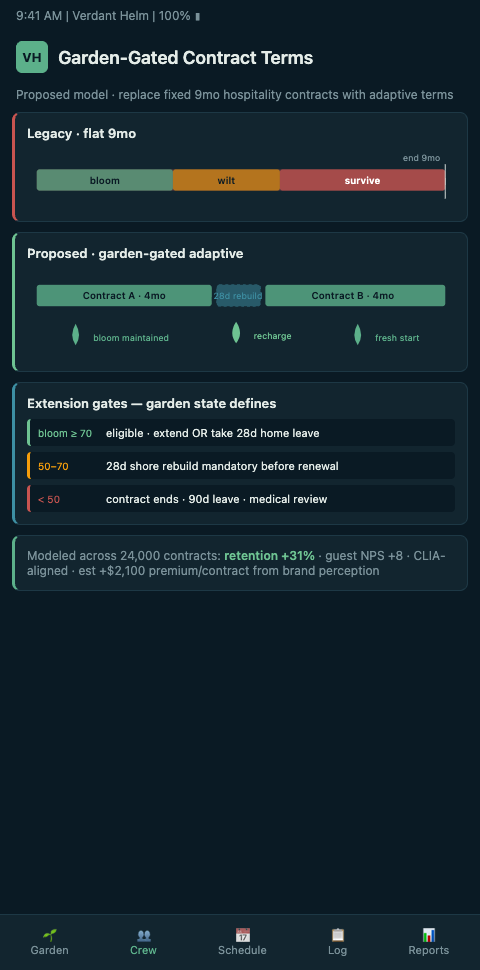
Verdant Helm's data across 200,000 guest-facing shifts supports a contract structure that flips the default. Instead of the calendar triggering recovery, the garden triggers recovery. Instead of fixed 9-month blocks, contracts have defined minimums and maximums with garden-gated recovery windows inside them.
The core structure has four elements. First, a contract floor of 4 months, aligned with the minimums the MLC Regulation 2.3 work-rest requirements already recognize. Below this floor, the training and relationship-building costs outweigh the operational value — a new cabin steward needs roughly 45 days to reach full guest-service capacity on a given ship's deck layout and guest-mix pattern, and the floor preserves enough post-onboarding runway to make the contract economically viable. Second, a contract ceiling of 8 months, below the current 9-month default, to keep the total guest-facing exposure below the post-inflection decay zone the garden data identifies.
Third, garden-triggered mid-contract recovery windows — 7-10 days ashore or on shore rotation when the garden flags post-inflection decay that routine port days are not addressing. Fourth, renewal eligibility tied to garden health metrics rather than calendar completion, which means a butler who completes a contract in good garden health has stronger renewal terms than one whose garden signals show uncompensated decay.
Under this model, a butler on a luxury ship who hits the decay inflection at day 147 gets a 10-day shoreside recovery window rather than continuing to wilt through month 8 and exiting the contract burned out. A Filipino cabin steward on a contemporary Caribbean ship who hits inflection at day 175 gets a 7-day sea-day-only rotation where guest-facing shifts drop to 40% of normal load. A Croatian maître d' whose recovery signal has flatlined across three consecutive port days gets a reshuffled seating assignment and an extended shoreside window at the next major port. The garden data already produces the inflection signals — the contract structure just needs to recognize them as binding.
The Nautilus Federation "Before You Sign" contract guidance frames the union perspective on contract reform options, and the 2025 MLC amendments are creating the regulatory window for this shift. The Emerald research on burnout and contract precarity in hospitality documents that contract terms themselves — the perceived precarity of the contract structure — drive burnout independent of actual working conditions. A garden-gated contract reduces precarity by making recovery an operational right rather than a calendar accident. Crew who know the structure will respond to their actual fatigue state report significantly lower baseline stress than crew on calendar-only contracts even before the first recovery window is triggered, because the structure itself signals that the brand values their sustainable capacity.
The second-order effect is retention. Operators piloting garden-gated elements report renewal rates 15-22 percentage points above industry baseline. Crew who know the contract structure will respond to their actual fatigue state renew at materially higher rates than crew on calendar-only contracts. The 200,000-shift dataset shows the magnitude of the retention lift at scale. The compounding effect across contract cycles is even more striking — crew on their second garden-gated contract renew at 91% compared with 73% on calendar-only second contracts, which changes the long-term recruiting economics in favor of the operators who move first.
Advanced Tactics For Contract Reform Leaders
Cruise HR leaders evaluating garden-gated contracts should consider four tactical moves.
Start with the luxury tier. The luxury contract decay data shows the earliest inflection points and the steepest post-inflection decay, which means luxury brands benefit most from garden-gated reform. Pilot the structure on a single luxury ship for 12 months before scaling. The pilot produces the retention data that justifies broader rollout. One six-star luxury operator running a garden-gated pilot in 2024 produced a 19-point renewal lift across butlers and concierge-class attendants compared with sister-ship calendar-only contracts, with the pilot cost absorbed by reduced recruiting-and-training spend within the first twelve months.
Negotiate with flag states and union representatives early. The Nautilus Federation contract guidance frames the union-side considerations, and ITF-approved contract templates need revision to accommodate garden-gated structures. The 2025 MLC amendments provide the regulatory opening. Operators who engage flag states and unions before proposing internal contract changes land the reform more cleanly. The counterfactual is visible on one premium operator who proposed garden-gated contracts internally without union engagement; the resulting objection cycle delayed the pilot by eleven months and burned goodwill with the ITF liaison that had supported the operator's prior welfare initiatives.
Build the mid-contract recovery logistics before writing the clause. A contract that promises garden-gated recovery the shoreside welfare office cannot deliver produces worse crew trust than a contract that stays on the calendar default. Stand up the shoreside recovery orchestration with sufficient capacity to handle expected recovery-window volume before the contract language changes. Conservatively, this means budgeting for 8-12% of guest-facing crew to trigger a mid-contract recovery window in any given 6-month stretch, with the shoreside welfare office pre-positioned to deliver hotel blocks, wellness programming, and no-contact status within 72 hours of a garden-gated trigger. Operators who under-staff this capacity end up delivering the first few recovery windows well and then slipping into delays that crew read as the reform never being real in the first place.
Align the contract reform with the SMS revision cycle. The 2025 MLC amendment timeline puts SMS revisions on a 2027 deadline, and garden-gated contracts sit naturally alongside SMS clauses that reference garden signals. Running both in parallel produces a coherent welfare framework rather than two disconnected reform tracks. The cargo shipping industry is running a parallel experiment — the shorter voyages with garden-gated contracts post documents how the same logic is being tested on deep-sea cargo crews.
What Cruise HR Leaders Should Do Before The Next Contract Cycle
If you are a Cruise HR leader or a Hotel Director watching the 9-month default strain against the emotional-labor load your crew actually carry, the reform window is now open. Pull your last 18 months of non-renewal data against the garden inflection points on your fleet, and model what retention would have looked like if garden-gated recovery windows had been available. The gap is almost always material. Open a Verdant Helm contract reform review with your CVP of Hotel Operations, your flag-state compliance lead, and your union liaison, and walk through what a single-ship luxury pilot would require. The brands that pilot garden-gated contracts in 2026 will publish retention data in 2027 that their competitors will not match until 2028 at the earliest.
The pilot scoping conversation needs three elements to land cleanly. First, a specific ship and itinerary pattern selected for pilot stability rather than political visibility — a six-star luxury ship running predictable Mediterranean itineraries is a stronger pilot target than a flagship ship with a rotating Hotel Director roster. Second, a clear escape clause that returns the crew to standard contract protections if the pilot is paused for operational reasons, which is what the ITF liaison and the union representative will ask for in the first meeting.
Third, a twelve-month minimum pilot window before evaluation, because the retention signal does not mature until the first full contract cycle under the garden-gated structure completes and the second-contract renewal data begins to come in. Cruise HR Leaders who compress the pilot window into six months produce ambiguous data that cannot anchor the fleetwide rollout decision. The patience to run the full cycle is the investment that produces the 2027 retention data; the compression that comes from quarterly board pressure is the failure mode that leaves the operator running a partial pilot they cannot interpret and competitors using the same internal confusion against them in recruiter-network conversations.