The Month-Four Cliff: Why Guest-Facing Contracts Get Cut Short
The Shape Every Cruise HR Team Knows
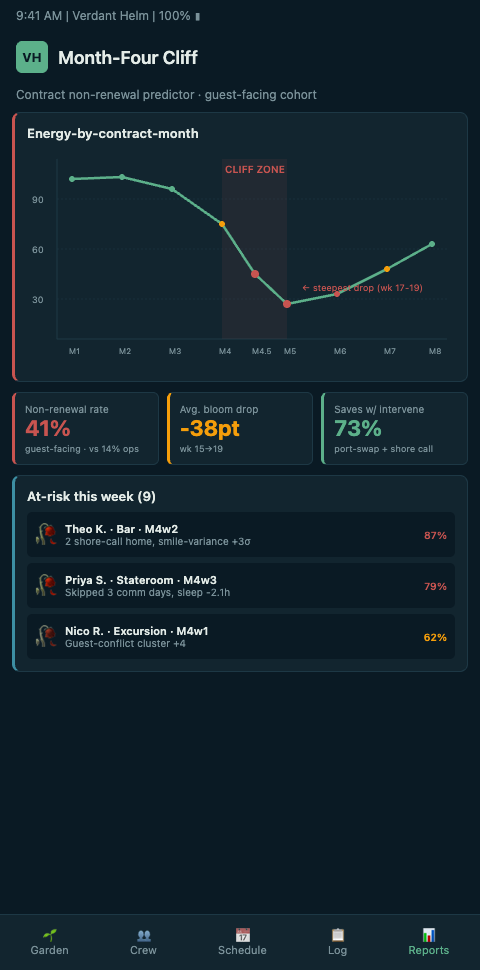
On a premium-segment cruise line operating 18 ships, the Cruise HR Leader pulled four years of contract-exit data and stacked it by month. The shape was identical across every ship and every brand. Sign-ons spike in months zero and one. Voluntary exits are flat through months two and three. Month four produces a cliff — non-renewal inquiries and early-exit requests jump 4 to 6x the monthly rate of months two and three, then partially subside. The cliff is sharper in stateroom attendants and dining-team servers than in back-of-house. It is especially pronounced on seven-month contracts, where the cliff falls squarely inside the second third of the term.
The industry has coped by over-recruiting. But over-recruiting does not protect the NPS that drops when month-four exits replace senior crew with new starts mid-contract. And it does not address the underlying physiology driving the cliff.
The Nautilus Federation's recruitment and retention synthesis identifies mid-contract exit factors including career-stage fit, family convergence, and workload patterns. A WMU Journal of Maritime Affairs review on seafarer retention adds lack of career prospects as a dominant mid-career driver. The ITF Seafarers' Trust and Yale mental health study documents higher depression frequency among shorter-tenure seafarers, with the early-contract vulnerability window extending into the mid-contract months. Safety4Sea reporting on seafarer work hours finds average 74.9-hour weeks against the ILO 43-hour standard, with 28% violating rest-hour protections — a baseline condition that makes the cliff inevitable if left unchecked.
The cliff is not a career-stage problem. It is a cumulative emotional-labor problem that hits a threshold in month four.
The Cliff Through a Garden Lens
Think of the seven-month guest-facing contract as a perennial's growing season. Months zero through two are the planting and rooting phase — bloom is shallow, but the root system is putting down resources. Months three through four are the peak bloom — guests see the best of the crew member, NPS contributions peak, and shift compatibility is highest. But peak bloom is also peak draw. Without a deliberate tending cadence, the roots run thin in exactly the same window. The month-four cliff is the moment the above-ground bloom meets the below-ground depletion. The perennial can either be pruned and rewatered — or it wilts and the crew member asks out.
Verdant Helm reads the cliff's formation three weeks early. The three signals that reliably lead a month-four exit inquiry are: first, a bloom-to-depletion gap opening between contract week 10 and week 12, where surface performance stays high but wilt markers accelerate; second, a shore-leave recovery deficit — port-day recovery windows not producing the typical energy rebound; third, a complaint-route signature — the specific kinds of guest interactions the crew member starts to avoid or truncate. Each signal on its own is noisy. The three together, running in the same direction, produce a 75%+ hit rate on mid-contract exit inquiries 18 to 22 days in advance.
The intervention menu Verdant Helm surfaces is not a retention incentive. It is a gardening action. For a stateroom attendant showing the pre-cliff pattern, the move is often a corridor rotation that reduces repeat-guest density for two voyages, paired with an extended shoreside window on the next port day. For a dining-room server, the move is a seating-time rotation — off the 8:30 main seating for three nights, onto a specialty restaurant for two — which breaks the emotional-labor repetition without reducing hours. For a guest-services desk agent, the move is often a complaint-lead rotation where escalation response goes to a different agent for a week. Each move is targeted, cheap, and reversible. The cumulative effect across a voyage is that the month-four cliff flattens noticeably.
Academic research on employee engagement as a predictor of seafarer retention confirms engagement's strong positive relationship with retention. The garden view gives Hotel Directors and Cruise HR Leaders the ability to operationalize engagement at the bed level rather than at the survey level. The cliff's shape is the absence of that operational discipline; the cliff flattens when it is present.
Scaling the Cliff Response Across the Fleet
Hospitality turnover runs roughly 73.8% annually with replacement cost averaging $5,864 per frontline exit. On an 18-ship fleet, moving the cliff by 20% — even a modest flattening — translates into hundreds of prevented exits and millions in protected contribution margin, before counting the NPS compounding effect. That is the business case, but it understates the operational case. The voyages running after a month-four exit spike absorb 4 to 8 NPS points of wake damage from the green crew members stepping in.
The first scaling mistake is treating the cliff as a compensation problem. Pay raises do not repair the emotional-labor depletion; they delay the exit decision by one to two voyages without rebuilding the roots. The cliff still falls, just later. Verdant Helm's intervention menu is explicitly non-compensatory because the underlying mechanism is not financial.
The second mistake is running the cliff response centrally from HR without involving the Hotel Director. The intervention window is operational — rotations, seating assignments, shoreside windows — and those decisions live with the Hotel Director. Cruise HR Leaders who try to manage the cliff through central retention programs routinely find that the initiatives dissolve when they hit the ship because they do not fit the operational rhythm. Verdant Helm's model keeps HR as the fleet-view owner of the pattern and the Hotel Director as the action owner on the ship.
The third mistake is neglecting the post-cliff pattern. Crews that make it past month four enter a different bloom phase, but the voyage that follows the cliff still carries scar tissue — crew members who stayed but watched peers exit carry additional emotional-labor burden.
Post-cruise NPS drops tied to energy dips often trace to these post-cliff voyages, and port-day recovery windows are the dominant lever for rebuilding.
Without deliberate tending in months five and six, the energy deficit carries forward to end-of-contract, affecting the next renewal conversation.
The adjacent pattern in other maritime sectors is the deep-sea cargo cliff.
Voyage week three near-miss clusters on deep-sea crews follow the same cumulative-labor curve — a threshold inside the middle third of the voyage where depletion converts into observable error. The cruise contract cliff and the cargo voyage cliff are mechanistic cousins. The tending discipline that flattens one is the tending discipline that flattens the other.
One edge case worth flagging: first-contract crew members show the cliff earlier — often week 12 to 14 rather than week 14 to 18 — because they have not yet built the emotional-labor resilience that seasoned crew carry. Verdant Helm distinguishes first-contract from repeat-contract crew in its threshold calibration so the Hotel Director gets appropriate lead time on both cohorts.
A second edge case is contract length variance. Seven-month contracts produce a month-four cliff; five-month contracts produce a month-three cliff; nine-month contracts produce a month-five cliff that is deeper but slower-forming. The underlying pattern is that the cliff tends to fall inside the second third of the contract term regardless of length — the emotional-labor accumulation curve is roughly proportional to contract duration. Verdant Helm's threshold calibration scales with contract length automatically so Hotel Directors managing mixed-contract crews (common on premium lines with varied role contracts) still see accurate lead-time reads across the manifest.
A third edge case is family-convergence effects. The WMU Journal research flagged family convergence as a major mid-career driver, and the signature is observable in the data: crew members whose family members have recent life events (births, eldercare changes, partner job shifts) produce different mid-contract exit patterns than peers without those events. Verdant Helm does not track personal life events — those stay private — but it does note when a crew member's shore-communication volume spikes over the preceding two weeks, which often correlates with convergence pressure. Hotel Directors reading this signal can offer a targeted conversation without intruding on personal detail; the offered flexibility often retains the crew member through the cliff window.
The fourth edge case is role-specific variation. Stateroom attendants and dining servers show a sharp month-four cliff; guest-services desk agents show a flatter curve that extends through months three to five; cast and entertainment show an earlier month-three inflection. Verdant Helm applies role-specific cliff models so the Hotel Director gets the right timing for each bed, rather than applying a single month-four heuristic to every guest-facing role.
For Hotel Directors and Cruise HR Leaders
If your quarterly retention review opens with exit-interview summaries from the month-four cohort, you are reviewing what already happened. Verdant Helm is built to put the cliff on the operating dashboard 18 to 22 days before the exit inquiry forms. Hotel Directors who fold the cliff radar into their weekly Hotel Department review start making rotation decisions that prevent exits the survey never saw coming. Cruise HR Leaders who run the fleet-level cliff view spot the systemic patterns — itinerary shape, recruitment sourcing, ship-specific sink beds — that individual ships cannot see from their own data. The first ninety days of a Verdant Helm rollout typically flatten the cliff by 15 to 25%, and the effect compounds as the tending rhythm takes hold.
The implementation sequence matters more than the rollout speed. Start with a single ship on a single itinerary for the first two contract cycles, so the cliff data calibrates against real sink patterns rather than generic thresholds. Hotel Directors who skip this step and turn on the cliff radar fleet-wide in month one see false alarms spike in the first voyage, lose the Executive Housekeeper and F&B Director's trust inside four voyages, and end up using the dashboard as a post-hoc report rather than an operational radar.
Cruise HR Leaders should mirror the operational rollout with a parallel HR discipline: the month-three contract-renewal conversation becomes the first touchpoint where the cliff indicators get reviewed, not the month-five exit-interview. That shift moves the HR function from recording loss to preventing it. When the conversation in month three names the specific beds the crew member has been tending, the shoreside recovery windows she did or did not get, and the complaint-route pressure she absorbed, the retention decision rests on operational truth rather than abstract engagement scores. Hotel Directors who pair this conversation with a concrete rotation offer in months four and five lift the through-contract completion rate significantly across a single season.