Why 4-on-8-off Watchkeeping Builds Hidden Cognitive Debt
The 5.6 hours that compliance hides
On a Rotterdam-to-Santos transatlantic aboard a 82,000 DWT Panamax bulker, a British Chief Mate keeping the 04:00-08:00 and 16:00-20:00 watches logged 5 hours 20 minutes of sleep per 24 hours by voyage day nine. His rest-hour form showed 10h/24h compliance for every day of the passage. At 02:40 on day eleven, a close-quarters situation with a southbound tanker developed that the Filipino OOW missed until the CPA was 0.8 nautical miles. The Chief Mate, called to the bridge, had been asleep for 97 minutes of a planned 4-hour sleep window. The vessel was mid-Atlantic, five days from the nearest pilot boarding, with a cargo-operation turnaround at Santos that required bridge team presence through the berthing-and-draft survey sequence.
A 2023 PMC survey of watch officers found that on 4/8 split-watch systems, crews average 5.6 hours of sleep per 24 hours, with sleepiness spiking in the 00:00-04:00 window. BIMCO's watchstander fatigue analysis, reported by gCaptain, documented the same pattern across two-watch and split regimes on cargo ships: hidden alertness decay that forms cannot detect. This is not a compliance failure. It is a structural property of the rotation. The 4-on-8-off pattern cannot deliver a single consolidated eight-hour sleep window, ever. What it delivers is two four-hour windows, one of which is always split across a biological circadian low. On a VLCC running Ras Tanura to Ulsan, the pattern compounds with elevated cargo-watch demands during bunkering at Singapore midway, turning the theoretical 8 hours off-watch into a measured 3-4 hours of actual sleep.
Cognitive debt as a drought-stressed garden
A 4-on-8-off rotation is a garden on a schedule that never lets the soil fully rehydrate. Each off-watch is a watering, and each watering is shorter than the plant's root zone needs to absorb. The perennial keeps its shape for the first week of the voyage. By day seven the leaves are slightly cupped. By day ten the stomata are closing during the hottest part of the day — the 02:00-04:00 biological low — and photosynthesis is running at a fraction of its rated capacity. The plant looks the same. It is not the same.
Verdant Helm renders this as a cumulative cognitive-debt reading on each officer's perennial. The reading is not sleep hours — those are already compliant. It is the ratio of sleep delivered within the circadian sweet spot to sleep delivered during biologically suboptimal windows. A 22:00-02:00 sleep block counts more than a 09:00-13:00 sleep block of the same length, because the former aligns with the melatonin curve and the latter fights it. The garden shows which officers are drought-stressed even when the watering record shows full compliance. On a ULCC crossing the Indian Ocean, a Filipino Second Mate on the 00:00-04:00 and 12:00-16:00 rotation accumulates debt twice as fast as a Greek Chief Mate on the 04:00-08:00 and 16:00-20:00 rotation, because the former's primary sleep window falls entirely during biological daylight.
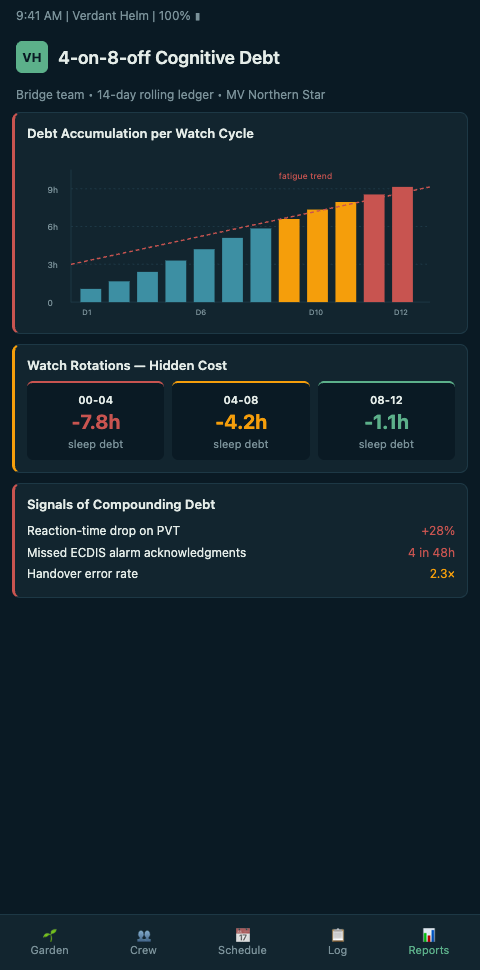
The Nautical Institute's 6-on/6-off comparison documented cognitive debt accumulation across split regimes in a study of bridge and engine-control-room performance. The pattern generalises to 4/8 with slightly different kinetics. The key finding was that cognitive debt is non-linear: the first three voyage days show minimal decay, days four through seven show accelerating decay, and days eight onward show the cognitive equivalent of a drought response — leaves still present, function reduced, recovery slow even with watering. The Institute's follow-up fieldwork on container vessel bridge teams showed the decay accelerating further when the 16:00-20:00 watch coincides with cargo-planning meetings or port-approach paperwork, compressing the afternoon off-watch beyond the nominal four hours.
The ScienceDirect mathematical modelling of sleep under maritime watch schedules quantified this buildup. Biomathematical models of the 4/8 and 6/6 systems show that sleep debt accumulates faster on 4/8 and recovers slower, because the split reduces the consolidated sleep window below the minimum required for slow-wave sleep in the first window of each 24-hour cycle. A perennial that misses its overnight watering does not recover on the midday one. The midday watering keeps it alive. The overnight one is what makes it bloom. The models, run against actual transpacific and transatlantic voyage profiles, predict a debt crossover point between voyage days seven and nine where the cognitive reserve margin drops below the level required to absorb a collision-avoidance scenario at the circadian low.
The MCA MIN 452 summary of Project HORIZON translated this into regulator language: the UK MIN explicitly flagged shift-pattern implications and fatigue-toolkit recommendations. None of that implementation has landed on most cargo vessels, which still run the same 4/8 rotation because it is what the manning scale supports. The garden does not change the rotation. It makes the drought visible so that tending decisions — a fourth officer, a scheduled recovery day in port, a TSS transit rescheduled around the trough — get made on state rather than on assumption. MARTHA's longitudinal data reinforced the pattern across a seven-year observation window covering bulk, container, and tanker fleets on long-haul trades.
Nautilus International's fatigue findings showed 18% of seafarers fell asleep at work in the past twelve months and 59% fight sleepiness monthly. These are the cognitive-debt curve's surface readings. ISF Watchkeeper and similar rest-hour compliance software track 77h/week STCW minima — they confirm the watering happened. They cannot tell whether the watering reached the roots. A Chief Mate on a 28-day Long Beach-Rotterdam round voyage passes the 77h/week check every week, and still shows up at a Port State Control inspection in Rotterdam with a bloom state two standard deviations below his own voyage-one baseline.
Advanced tactics for reading hidden debt
Three tactics separate a garden that reads cognitive debt from one that only mirrors the rest-hour log. First, weight each sleep window by its alignment with the officer's individual circadian profile, not by a fleet average. A British Chief Mate who habitually sleeps 22:00-02:00 at home and 22:00-02:00 at sea has a minimal phase shift. A Filipino Second Mate who sleeps 01:00-05:00 at home and is assigned 08:00-12:00 for sleep at sea has a four-hour phase shift that the garden should read as a drought factor, regardless of total hours. Crews drawn from mixed nationalities — a common pattern on European-flag bulk and tanker fleets with Filipino deck crews and Greek, British, or German officers — produce wider phase-shift distributions than single-nationality crews, and the garden's weighting must account for this.
Second, track the sleep-window length distribution, not the sum. Two four-hour blocks deliver less restorative sleep than one eight-hour block, even though the total is identical. The garden flags the distribution as an architectural drought — soil that is being watered frequently but never deeply. Verdant Helm renders this as a root-depth reading: perennials with shallow roots wilt fastest in the next heat wave, which on a cargo voyage is the next TSS transit or close-quarters situation. An OOW coming off two consecutive nights of fragmented sleep on the Shanghai-Long Beach leg enters the San Pedro Bay approach with a root depth that cannot support the pilot-boarding workload, even if the 10h/24h count looks fine.
Third, project the debt forward across the remaining voyage. A voyage with eight days to run and an officer already at 5.6 hours/24 has a predictable trajectory: the debt compounds until a recovery opportunity exists. On a transpacific with no port call for ten more days, that recovery does not exist at sea. The garden reads this as a perennial approaching its wilt point and prompts the tending decision — a longer off-watch block by redistributing duties, a temporary rota change across a planned quiet-water segment, or a formal reduced-duties day before the TSS transit.
On a Rotterdam-Jebel Ali leg with a Suez Canal transit at voyage day seven and a Hormuz transit at day fourteen, the debt projection tells the Master which of the two chokepoints will fall on a wilted bed and which on a recovered one, and whether the Canal convoy slot can be shifted by a convoy cycle to rebalance.
The pattern-matching to catching circadian drift before the next bridge watch shows how this debt surfaces at the individual-watch level once it has accumulated. Masters who have seen the day-eleven Chief Mate crash on a transpacific will recognise the same curve — voyage length is what converts hidden debt into a failure mode. The garden approach parallels the 1.5-metre sea state reset for offshore wind technicians, where environmental factors compound fatigue on a different rhythm but the reading principle is the same.
What deep-sea cargo fleet leaders should do next
DPAs and fleet superintendents overseeing transatlantic, TransPacific, and tramp voyages can use Verdant Helm to read the hidden cognitive-debt curve on each officer across every leg. The rotation stays 4-on-8-off. What changes is what the Master sees before assigning a TSS transit, scheduling a port-state-control inspection, or running a COLREGS drill. The garden renders the drought before the officer feels it. Book a review: send us a voyage abstract from your most recent TransPacific and our team will overlay the debt curve on it — the failure points in retrospect almost always line up with where the perennials had already wilted.
Before the overlay meeting, ask the Master to pull the past 90 days of rest-hour forms for his Second Mate and Chief Mate. The overlay reveals which of the compliance-clean weeks were actually drought weeks and which were genuinely hydrated. On a Suezmax running Ras Tanura-Rotterdam with a mid-leg Fujairah bunker call, the overlay typically shows the Chief Mate's debt bottoming on the inbound approach where the MLC form read compliant across every daily cell.
The DPA gets a fleet-wide report that flags which voyages are heading into a week-two trough during a port-approach window, with a specific tending recommendation — a supplementary Third Mate watch, a deferred Navtex review batch, a bunker plan pushed forward three voyage days — attached to each flagged voyage. Port state control inspectors in Rotterdam, Singapore, and Long Beach read the same trace when the binder gets pulled, and the conversation shifts from reconstructing a week-old form to reading a continuous record the bridge has been tending all along.