An Able Seaman's First Voyage With Verdant Helm
The AB who knows the ship but not himself yet
A newly-credentialed Filipino Able Seaman boards a 5,500 TEU container vessel in Los Angeles for a TransPacific run to Yantian via a Long Beach-Oakland-Yantian rotation. He logged 540 days as an ordinary seaman under the USCG NMC's deck-rating Able Seafarer pathway and completed the AVTEC AB course covering bridge watchkeeping, lookout duties, and emergency response. He knows a container ship's geography. He knows how a 4-on-8-off rotation feels from the inside. He has stood hundreds of hours of lookout. What he has not yet built is the self-reading calibration that will let him recognise his own fatigue state before it costs him a lookout error during a TSS transit — Singapore Strait eastbound is on the return leg and Santa Barbara Channel is on the westbound leg, either of which can surface a lookout miss in the logbook if his own bloom state is not visible to him.
The edumaritime STCW II/5 Able Seafarer Deck competence covers helmsman, lookout, deck maintenance, and safety duties. Maritime Institute's AB requirements summary lays out the sea-service math — 180 to 540 days depending on endorsement — that gets someone to the AB credential. The MM-SEAS pathway guide walks through the steps. None of these address the transition from "I have the credential" to "I have the self-reading skill to use the credential well." ISWAN's work on seafarer mental health found mood and wellbeing are lowest at voyage start, especially for new entrants, which is exactly when the calibration gap is widest. On a Filipino crewed container vessel with a nine-month contract, that voyage-start mood trough stretches across the first two weeks, overlapping the AB's first TSS transit and his first anchor watch if the vessel calls at a congested roadstead.
Learning to read the garden as a seedling
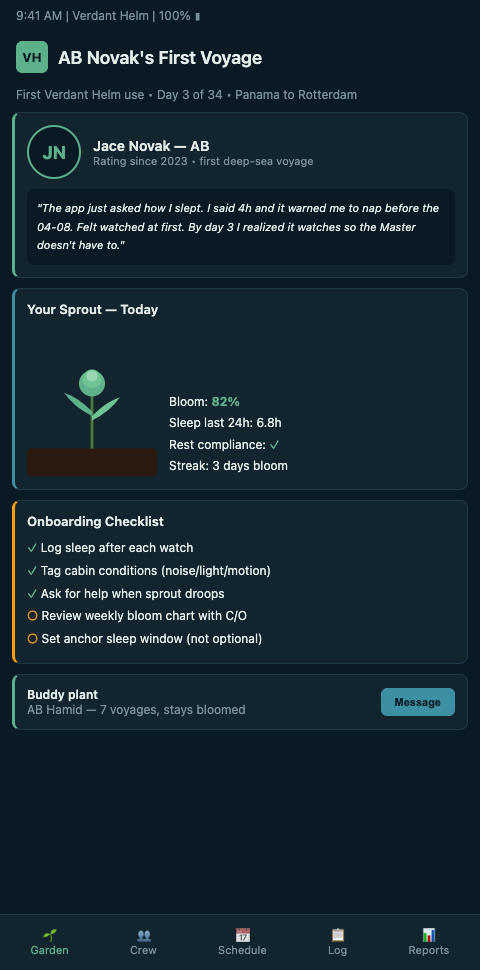
Verdant Helm treats the new AB's first voyage as the seedling phase of a multi-year career. The bridge team around him has been reading each other on the garden for eight months — the British Chief Officer, the three OOWs, and the cadet all have established bloom-state histories. The AB arrives without a history. His first fourteen days are baseline-building: the garden captures his sleep windows, his on-watch alertness ratings, his handover responses, and his cabin-sensor readings. A seedling needs time to root. Verdant Helm does not try to force a bloom-state reading before the roots are down.
By voyage day fifteen, the AB has an early baseline. The garden shows his perennial alongside the Chief Officer's, the Second Mate's, the Third Mate's, and the cadet's. He sees his own wilt and bloom curves for the first time. The Master's morning briefing, which has used the garden for eight months, now includes the AB's perennial in the shared view. The AB learns to read himself by seeing his own state rendered next to officers he is learning from.
This is the pedagogical case for including ratings in the bridge garden. ABs do not simply stand lookout — they observe, over months and years, how officers handle their own fatigue, and the garden accelerates that learning. Over a 28-day round voyage, the AB's baseline tightens enough to give him a reliable self-read by the start of the return leg from Yantian. The second voyage, which will likely be on a different vessel class under the same manning agency, builds on the carried-forward baseline rather than restarting from zero — a compounding effect that a paper sea-service book cannot produce.
The ITF Seafarers fatigue resources, union-backed and aimed at new entrants, emphasise the self-monitoring habit as a career-long skill. The garden is where the habit gets built, early, and where the habit compounds. An AB who learns to read his own bloom in his first year carries that instrument into his 2/Mate CoC, his C/Mate CoC, and eventually his Master's exam. The ISWAN research on the voyage-start mood trough argues the early intervention is exactly when ratings and cadets most need the scaffolding. Verdant Helm provides it without asking them to become navigation officers. The same habit scales from lookout duty on a container bridge to anchor watch duty in a congested Long Beach roadstead, where the AB's self-reading skill determines whether he calls the OOW early on a drift concern or waits until the anchor chain is already paying out.
The AB's role in the bed is twofold. He is a perennial — a new one, still establishing — whose wilts and blooms matter to the bridge's collective state. He is also an observer, a second set of eyes reading the other perennials. An AB posted as lookout during a wilted Second Mate's 00:00-04:00 watch adds observation weight to the bloom reading the Second Mate cannot give on themselves. The garden integrates the AB's lookout notes into the bridge's shared bed. This is what elevates lookout duty from a regulatory minimum into a contribution to the ship's cognitive state. On the Shanghai-Long Beach Great Circle track with light traffic through the mid-Pacific, the AB's lookout notes tend to flag OOW wilt patterns more reliably than the bridge's own instruments, because the AB is close enough to observe and distant enough in role to report without defensive filtering.
The Shipowners' Club sleepiness brief and Nautilus International's damning fatigue findings both point to the gap between credentialed competence and real-world fatigue self-management. The garden does not close that gap on its own. It makes the gap visible, day by day, watch by watch, across the AB's first voyage. Closing the gap is the AB's work. Verdant Helm is the instrument. On Filipino-crewed container fleets running the major East-West trades, the fleet-wide pattern across a rolling twelve-month crew-rotation window shows which ABs have closed the gap and which have not — a signal the DPA and the manning agency can both use.
Advanced tactics for first-voyage AB onboarding
Three tactics accelerate the seedling-to-perennial transition. First, assign the AB a garden mentor — usually the Chief Officer or a senior OOW — who reviews the AB's perennial with him at the end of each week. The review is not about fatigue scolding. It is about reading: this week your bloom stayed strong through day four, wilted by day seven, recovered on day nine — what happened between four and seven. The AB builds vocabulary and self-awareness by articulating the pattern. On a British-officered, Filipino-rated container bridge, the weekly review also becomes a cross-rank communication habit that was previously mediated only through the bosun.
Second, let the AB annotate his own perennial. A note that says "roommate snoring disrupted sleep voyage night six" or "cabin starboard aft engine vibration strongest during night watches" is data the bed needs. Ratings observe environmental conditions officers miss. The garden treats their annotations as sink-factor readings. Over three voyages, the pattern of AB-reported environmental sinks across a ship informs cabin allocation, maintenance priorities, and contract-length recommendations. On a Panamax container vessel with six AB-grade ratings sharing three cabins, the annotation stream surfaces cabin-allocation friction points that the traditional welfare survey cannot reach, because the annotations are continuous and context-attached.
Third, use the AB's first voyage as a training artifact for the next one. At the end of the voyage, the AB gets a rendered timeline of his bloom curve, his wilt days, his recovery patterns, and his lookout observations. The timeline becomes his own training baseline for the next voyage. He joins the next ship as a rated AB with sixty days of self-reading data, not a blank slate. Over five voyages, the AB has a detailed self-model that he carries into the Third Mate CoC examination. The garden builds the career's foundation in the first year. On a manning-agency-managed Filipino AB rotation that places the same rating across three or four different vessel types (container, bulker, tanker), the carry-forward timeline lets the agency and the sponsoring owner see how the AB's self-reading transfers across ship types and trade patterns.
The onboarding flow connects naturally with a cadet's logbook for tracking watch-based fatigue, since many ABs progress onto cadet-officer programmes and the logbook skills compound. Sowing a bridge-team energy garden shows the Master's side of the same first-week integration, from the bridge leadership perspective. Cruise operators running parallel entry-level onboarding will find the cast member's first contract with Verdant Helm piece maps the same seedling pattern onto hospitality contracts with different bloom kinetics.
What deep-sea cargo fleet leaders should do next
Masters, Chief Mates, bosuns, and training officers onboarding new ABs onto cargo fleets can set up the seedling entry path on Verdant Helm in the first day of a voyage. The garden runs alongside the AB's lookout and watchkeeping duties, learning his baseline in weeks one and two and contributing to the bridge's shared bed from week three onward. Fleet superintendents managing crewing turnover across multi-ship rotations get an AB-development portfolio that follows ratings across ships and voyages. Schedule a first-voyage setup walk-through with our deep-sea team and we will onboard your next joining AB with the garden running from the pilot-off moment.
Before the setup, ask the bosun to pull the last voyage's lookout logs and the Chief Mate's handover notes for the cabin the joining AB will occupy. The seedling-to-perennial baseline reads cleanly against a known cabin's vibration and noise profile, so the AB's first-week annotations surface sinks the ship's maintenance log has been carrying silently. On a 5,500 TEU container vessel arriving at Long Beach for a crew change, the bosun's handover on the joining AB usually includes one maintenance item — engine room bulkhead noise, starboard aft ventilation — that the garden converts from a known-issue note into a tracked sink on the AB's bed.
The DPA gets a manning-agency portfolio that follows each AB across three voyages and three vessel types, with bloom kinetics tagged to each trade so the crewing office can match relief ABs to ships where their perennial has historically bloomed strongest. Port state control inspectors running a focused inspection on crew welfare read the AB's seedling-phase record as evidence the MLC 2006 Title 4 wellbeing provisions are operating at the rating level, not only the officer level. Manning-agency principals and charterers vetting crew quality see a continuous AB-development record that the previous sea-service book could not produce.