Why Chief Mates Crash Eleven Days Into a TransPacific
The day 11 pattern that every Master recognises
Ask any Master working the transpacific container trade what day eleven looks like for the Chief Mate and you will get the same description. The first week of the passage is busy but manageable. Cargo reconciliations, ballast planning, port call preparation for the far side — the Chief Mate drives the list. Week two often includes a port call or a pilot boarding, which creates a brief spike of intense work followed by a crew change in the pilot station. By day ten, everyone on board has stopped thinking about the far-side port as a future event and started thinking about it as something to survive. On a 14,000 TEU Panamax or a larger Neo-Panamax box boat, the Chief Mate's cargo reconciliation workload compounds with the vessel's operational tempo, and the paper-chase accelerates around day eight.
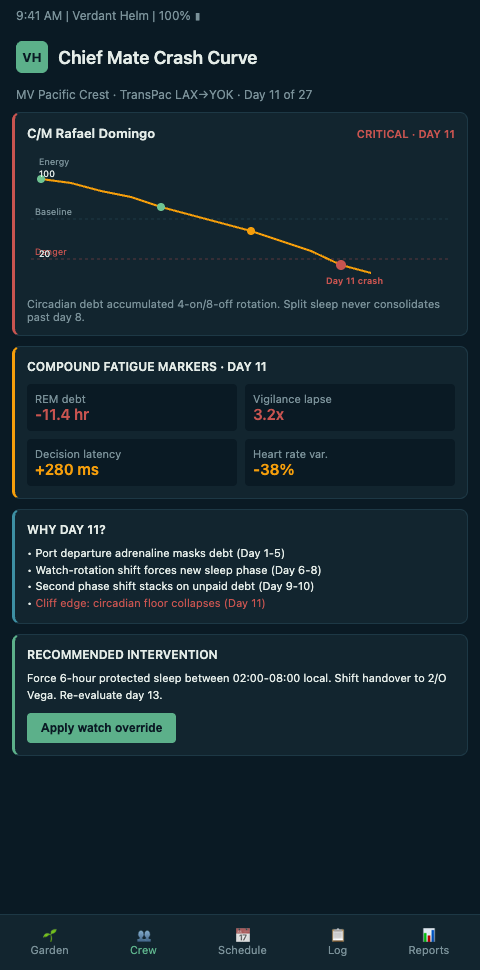
Around day eleven, Chief Mates crash. They miss a handover note. They snap at the bosun over a lashing sequence. They take forty-five minutes to produce a cargo plan that normally takes ten. The Project MARTHA final report documented this across more than 1,000 seafarers — fatigue and stress grow with voyage length, motivation falls, and Masters and Chief Officers are the worst-hit ranks because they carry compounded responsibility. The Nautilus SIRC Cardiff research characterises seafarer fatigue as at crisis levels, with deterioration over voyage. On Europe-Asia rotations that include a Suez transit and a Singapore Strait TSS in the same seven-day window, the day-11 crash can migrate to day 9. On a VLCC running Ras Tanura to Yeosu, the same crash appears around day 12 because the single-transit structure gives no mid-voyage recovery window.
The BMC Psychology systematic review quantifies the contributing load — officer mental stress driven 82% by high responsibility and 81% by administrative burden. The PMC review on seafarer mental health and career intentions puts burnout prevalence around 10%, with overcommitment especially prevalent among officers. These are not generic findings. These are the statistical shape of the day 11 crash. A DPA seeing three separate internal reports citing Chief Mate capacity failures around day 11 on the same rotation has a pattern, not three isolated incidents. The Chief Mate's administrative burden on a container vessel specifically includes ECDIS passage-plan updates, cargo loading computer reconciliations, MLC rest-hour oversight, and ISM document reviews — the 81% figure has a specific operational shape on deep-sea cargo crews.
Read the Chief Mate's perennial, not his to-do list
The Verdant Helm approach stops treating the Chief Mate's capacity as a function of his to-do list and starts treating it as a perennial in the ship's botanical garden. A perennial carries energy from voyage to voyage; it is not reset by a port call. A Chief Mate who joined the ship already depleted — because the last voyage ended with a fumigation delay and a short home leave — starts day one at half-bloom and crosses the crash threshold earlier. The starting depth is the signal the crewing team has never had in a readable form, and it is the signal that most directly predicts where the crash will land.
The garden renders the Chief Mate's perennial explicitly. Day one shows the starting depth — a function of previous voyages, previous leave, and entry health. The bloom cycle over the first week tells the Master whether the Chief Mate is recovering or drawing down. If drawing down, the garden projects forward — at this rate, the Chief Mate crosses the crash threshold around day ten.
The Project HORIZON simulator study on six-on-six-off watchkeepers provides the empirical grounding; 45% fell asleep on the midnight-to-06:00 watch during simulated passage. The perennial's colour shifts from fresh green in early bloom through amber to deep russet as the crash approaches, giving the Master a watch-cycle colour cue consistent with the rest of the garden. Project HORIZON's finding maps onto the Chief Mate's specific load pattern — he is rarely on a midnight watch, but the accumulated daywork and port-call paper load reaches the same cognitive floor by mid-voyage.
The intervention is structural. The Master, holding the garden, can redistribute load. A port-call preparation task that has been sitting with the Chief Mate for three days can be handed to the Second Mate earlier than usual. A cargo reconciliation can be pulled forward into the first week when the Chief Mate's bloom is strong. A rest window on day nine can be protected with a supplementary watch coverage that the Master and Second Mate split. These moves are invisible on the classic to-do list. They are obvious on the garden. A bosun given advance notice that the Chief Mate will be on a protected rest window on day 9 can queue up a morning deck brief that does not need the Chief Mate's sign-off for that 24-hour period. A cadet on his first TransPacific voyage can watch the intervention happen and learn the operational grammar the garden makes teachable.
Over a transpacific, the garden also captures the ship's social cohesion — the InterManager summary of MARTHA reports individual and social cohesion start to suffer after six months on board. On a specific voyage, a Chief Mate crashing on day eleven often reflects compounded months-at-sea history that a single voyage log cannot see. The perennial carries that history across contract boundaries and leave cycles, so a Chief Mate returning after six weeks of leave does not start fresh in the dataset — his carry-over energy is measured against the baseline he finished his last voyage with. The bosun and the Second Mate, whose own perennials are running against different carry-over histories, appear as separate beds so the Master reads team dynamics rather than a single-officer signal.
Advanced: voyage structure as the intervention
The deeper capability is redesigning the voyage itself around the perennial forecast. Once the Master has the crash forecast in hand on day one, the voyage plan can be drafted to route demand away from the predicted trough. Cargo plan reconciliations scheduled for the first week. Port call preparation front-loaded. Crew changes and watch rotations aligned so the Second Mate carries more of day nine through twelve. On a VLCC on a 21-day Gulf-to-Asia rotation, the same logic pulls tank-cleaning reconciliations into the ballast leg and pushes bunker transfer preparation into the first five days of the loaded leg.
That reshaping is the specific capability the Tandfonline study on burnout in seafarers argues for — it links burnout prevalence to incident rate and identifies workload as the exhaustion driver. If workload is the driver and the perennial is the visibility surface, then the management move is to shift workload across the voyage with the perennial as the load-balancing instrument. DPAs and fleet superintendents can track whether the shift is working voyage over voyage; when it is, the day-11 crash softens into a day-11 dip and eventually a day-11 note in the log rather than a casualty precursor. A Master reporting to the fleet superintendent at the end of a 14-day rotation with a flat day-11 perennial has a different conversation than a Master reporting the usual crash story; the superintendent can approve a similar pattern on the next voyage with a structural basis.
Fleet superintendents can use aggregated perennials to redesign the trade itself. If Chief Mates across the fleet consistently crash on a 14-day transpacific rotation, the rotation length may need to come down, or the mid-voyage port-call cadence may need to shift. Those are strategic decisions that currently rest on Master anecdotes; with aggregated data the decision is evidentiary.
A board committee reviewing TransPacific service with 14-day and 21-day rotations side by side can read the perennial traces and understand which pattern is producing the faster recovery in the following cycle. The same logic applies to ULCC and VLCC rotations on Europe-Asia trades; the board's service pattern question has a perennial-distribution answer rather than a charter-party-balance answer.
Post 7 on voyage week-three near-miss clusters extends the same temporal pattern into the casualty record. Post 23 on the eight-day warning of cognitive debt at sea is the operational case study of the perennial-as-forecast. The logic carries cleanly into passenger fleets as well — post 16 on excursion desk staff burnout showing early documents the equivalent day-11 pattern in hospitality roles.
For deep-sea cargo fleet leaders running long transpacific rotations
If your Chief Mates are crashing somewhere between day 9 and day 12 of your transpacific service and your crewing team is running short of answers, Verdant Helm will pull the perennial trace across the last three voyages of one vessel and produce a voyage-redesign brief. Schedule the perennial review with your crewing superintendent and a Master currently working the trade, and bring the last two port-call preparation schedules so the load redistribution is anchored to real task lists.
Before the review, pull the Chief Mate's rest-hour forms, cargo-plan submissions, ECDIS passage-plan revisions, and port-call checklists from the three voyages in question. The trace almost always exposes a carry-over starting depth from the preceding voyage plus a compounding administrative load clustered between days five and nine. On a 14,000 TEU Neo-Panamax running Long Beach-Yantian with a Yokohama bunker call, the perennial typically shows a first-week bloom then a bosun-driven lashing inspection spike on day six and an ISM document review on day eight that together pull the trunk below the crash threshold by day ten.
The DPA and crewing superintendent get a voyage-redesign brief that moves the cargo reconciliation forward, hands the port-call preparation to the Second Mate earlier, and places a Master-supervised rest window on day nine. Charterers and P&I clubs reviewing the fleet's incident history see a Chief Mate capacity profile that has structurally flattened the day-eleven crash rather than one managed by after-action reports.