Retiring MLC Rest-Hour Paperwork for a Live Bridge Dashboard
The form that everyone knows is wrong
The ILO Maritime Labour Convention sets the minimum rest pattern — ten hours in any 24-hour period and 77 hours in any seven-day period. The Paris MoU concentrated inspection campaign of 2014 found that 14% of detentions in that window tied back to rest-hour records that were not properly kept. The 2022 joint Tokyo and Paris MoU campaign on STCW reinforced the pattern — records did not reflect reality. On VLCC and ULCC hulls crossing the Singapore Strait every 14 days, the mismatch between the form and the watch log is close to routine. On a Feeder container vessel running a North European 7-day rotation with five port calls, the form and the lived reality diverge inside the first 48 hours, and the Chief Mate spends the rest of the voyage backfilling numbers that the PSC officer will accept.
The reality gap is not a secret. A ScienceDirect paper on seafarers' adjustment of work and rest records documents a ship-first culture where routine log adjustment is the norm, not the exception. A second ScienceDirect study quantifies the gap: PSC reports show above 90% compliance; seafarers estimate true compliance at 11.7 to 16.1%. The Seatrade Maritime summary of the ITF and WMU survey reports 64.3% of seafarers admitting to adjusting records and 60.1% saying the company expects it. The gap is widest on liner trades where port-call density forces overtime that the 10-in-24 window cannot absorb without falsification. On tanker trades, the gap appears during port-call operations where cargo pumping, tank inspections, and ship-to-ship operations push the bosun and the bridge team past the 77-in-7 ceiling before the voyage even clears harbour limits.
The MLC form, in other words, is not compliance evidence. It is a ritual that neither the seafarer filling it in, nor the PSC officer reviewing it, believes carries the signal the treaty intended. The ITF Seafarers fatigue resource page is explicit about the gap between the paperwork and the lived fatigue. Masters know this. Chief Mates know it. Cadets learn within three months of signing on that the form is a performance for an absent audience. The bosun signs the form because the Chief Mate asks, and the ratings sign because the bosun asks, and the entire chain operates on a mutual understanding that the numbers are approximations at best.
Replace the form with a live bridge garden
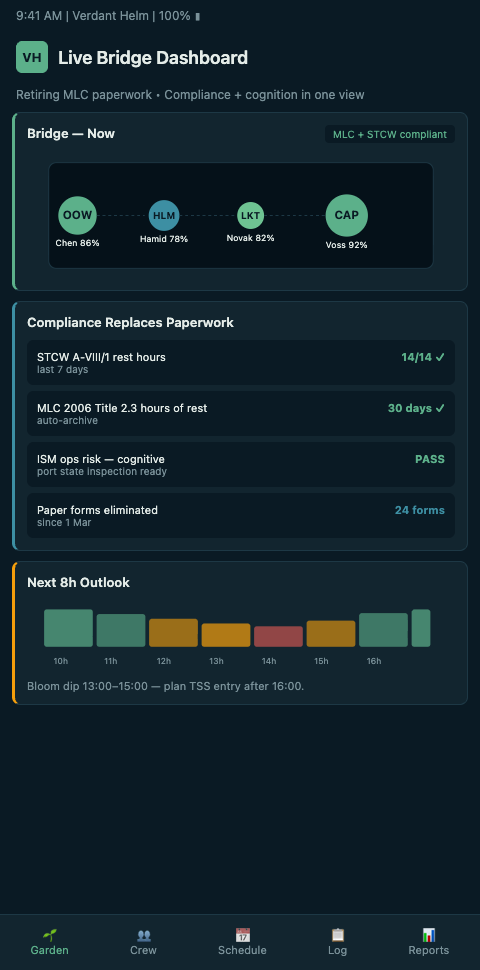
The Verdant Helm approach replaces the MLC spreadsheet with a continuous bridge dashboard that tracks actual rest, not self-reported rest. The ship's botanical garden carries each officer's perennial across voyages; the rest dashboard attaches to the garden so that the 10-in-24 window and the 77-in-7 window are rendered as bands around the perennial, not as cells in a form. Each bosun, AB, and Ordinary Seaman has the same rendering; the dashboard does not stop at the bridge team.
The rendering is simple. Each watchkeeper's bed shows their rest band. When the last 24 hours of rest exceed ten, the band is full. When it dips below, the band shows the exact shortfall. When the band has been short for three days, the perennial's trunk is visibly thinner — a compounded deficit that the form never shows because the form only looks at compliance per day. The ITF fatigue guidance on cumulative debt is rendered as visible botanical structure. Watch-cycle colour carries through; the 10-hour band fills green when satisfied, amber when marginal, russet when the shortfall runs consecutive days. A Master looking at three wilted perennials before a pilot boarding reads the risk instantly and can call for a standby engineer or a bosun's additional deck lookout without writing a memo.
The data source is actual, not reported. Watch handovers tick a timestamp. Cabin presence can be inferred from badge access on newer ships. Bridge activity is logged by the ECDIS and radar systems. The Master reviews the dashboard at each watch change. Discrepancies — a watchkeeper whose cabin time was 30 minutes less than the form would have reported — are visible and investigable at the time, not at the next PSC inspection.
An OOW on a 4-on-8-off who routinely reports eleven hours rest but whose badge log shows six hours in the cabin is a conversation the Master can have immediately rather than at a disciplinary meeting three months later. The conversation is usually not disciplinary at all; it is diagnostic, and it typically surfaces an underlying workload issue — a Chief Mate assigning port-call prep tasks during rest windows, a bosun scheduling deck rounds too close to watch handovers — that the master can correct with a small rota adjustment.
For the PSC officer, the dashboard produces a far richer compliance artefact than the paper form. It carries actual rest times, the cognitive garden state, and the Master's decisions over time. Paris MoU inspection reports have historically relied on spot-checking the paper forms because the paper forms are the only artefact available; a dashboard that surfaces real data removes the incentive to falsify and gives the inspector a defensible view. A Panamax container ship docking in Long Beach with a PSC focused-inspection letter already issued can present the dashboard instead of the binder and save the inspector six hours of interview time. The inspection still runs its full course, but the interview takes the form of a data walk-through rather than a reconstruction of memories.
Advanced: moving from compliance form to management surface
Once the paper form is retired, the MLC data becomes a management surface rather than a filing obligation. Fleet superintendents can see rest-hour patterns across vessels, routes, and trades. A container ship on a tight liner schedule through the Suez is visibly pushing into the 10-hour floor; a bulker on a ballast leg to Australia has slack that can be redistributed. A Feeder container vessel running a 7-day North Europe rotation shows a different pattern again — port calls every 18 hours compress the rest bands to the minimum, and the trace makes the compression visible to the crewing team before a Master complains. A VLCC on a Middle-East-to-Asia loaded leg has a different compression pattern again; the bosun and the deck gang accumulate rest-hour debt during the loading port call that the subsequent fourteen-day sea passage cannot fully clear without active rota intervention.
The surface supports negotiation with charterers. When a charterer requests an unrealistic arrival window that will force the bridge team into an eight-hour rest night on the approach, the Master has data showing the consequence. The MLC treaty text itself is unambiguous on the minimums; what has been missing is a data layer that makes non-compliance visible before it happens. The Master presenting the dashboard to a charterer's operations desk shifts the conversation from anecdote to evidence, and the commercial team ashore has a record they can reference in the next laycan negotiation. On a VLCC bound for a loading terminal with a tight laycan, that evidence translates directly into a defensible port-call delay that does not create a demurrage dispute.
DPAs gain a clear audit posture. Three quarters of data, continuously recorded, with every discrepancy annotated — that is an ISM audit package that does not depend on the memory of the crew or the honesty of the form. When the flag-state surveyor asks for evidence that the SMS addresses fatigue, the dashboard is the evidence. The same dataset supports PSC response, charter-party disputes, and internal casualty review; the DPA stops maintaining three separate records. Chief Mates and Masters coming off leave can read the previous cycle's trace before joining, and land-based crewing coordinators can match relief crews to actual rest patterns rather than planned ones. Cadets promoting to OOW also benefit; the appraisal conversation moves from a form-based ticking exercise to a shared reading of actual rest discipline across three voyages, which is the appraisal material a senior OOW has always wanted and rarely received in paper form.
For cargo fleet leaders weighing the transition, three neighbouring pieces are relevant. Post 6 on Masters replacing STCW rest-hour forms covers the master's-eye view of the same transition, and post 20 on ISM audit readiness from continuous cognitive-debt metrics shows how the MLC dashboard rolls into the wider audit regime. The upstream sector has already trialled a similar retirement of paper; post 15 on replacing paper fatigue logs with rig garden displays documents the drilling-rig version of the same shift, and the cultural barriers have been comparable.
For deep-sea cargo fleet leaders retiring MLC paperwork
If your fleet has taken a PSC detention for rest-hour records in the last 24 months, Verdant Helm will stand up the live MLC dashboard on one vessel and shadow-run against the paper form for a single voyage cycle. Schedule the shadow run and invite your DPA and Master to compare the two records against each other at the end of the voyage, with the Chief Mate and bosun present so the full crew chain reads the same output.
Before the shadow run, pull the detention notice and the preceding four weeks of rest-hour forms across the bridge team and the deck gang. The dashboard typically exposes the exact window where the paper form's 10-in-24 cell read compliant and the cabin badge record showed six hours in the bunk. On a Feeder container vessel running a seven-day North European rotation with five port calls, the shadow run usually locates the compression in the 30 hours after the third port departure, where the Chief Mate's rest window got eaten by cargo reconciliation and the bosun's deck gang carried an unbilled overtime block.
The DPA gets a fleet-wide dashboard that ranks every in-service vessel by the gap between paper and telemetry, with the Master's rota-adjustment choices attached to each flagged window. Paris MoU and Tokyo MoU inspectors boarding the next voyage see a record continuous across the preceding 30 days, which changes the inspection from a discrepancy hunt into a directed data walk-through the Master can close in one sitting.