Reading OOW Alertness Like an ECDIS Drift Alarm
The Muros grounding and the alarm that was never built
At 02:40 on 3 December 2016, the 2,998 GT bulk carrier Muros grounded on the Haisborough Sand off the Norfolk coast. The MAIB investigation found the ECDIS had an offset chart datum, the anti-grounding alarms had been effectively bypassed, and the OOW had been alone on the bridge for the preceding 100 minutes with no lookout posted. gCaptain's coverage of the MAIB report noted the ECDIS safeguards were "overlooked, disabled or ignored" — a phrasing that matched the alarm-fatigue pattern across dozens of similar cases. The OOW was a European deck officer on a North Sea short-sea trade, a rotation pattern where the 00:00-04:00 watch falls on an officer whose recent sleep windows have been chopped by pilotage and port calls every 36 hours.
The OOW was not asleep. The drift alarm that would have mattered was not on the ECDIS. It was on the officer himself. The bridge had built elaborate infrastructure to detect the ship drifting off a planned track. It had built essentially none to detect the officer drifting off an alert baseline. The Nautical Institute's analysis of ECDIS-related groundings described the same mismatch across multiple case studies: configuration and alarm-suppression failures mirror human alertness lapses, and neither the equipment nor the human gets the same monitoring rigour. Subsequent MAIB case files through 2023 — the Priscilla grounding, the Ruyter grounding, the Sunmi 1 grounding — all showed the same pattern of an OOW who was technically awake but whose alertness had drifted two to three hours before the ECDIS track showed any deviation worth alarming on.
OOW alertness as a garden alarm
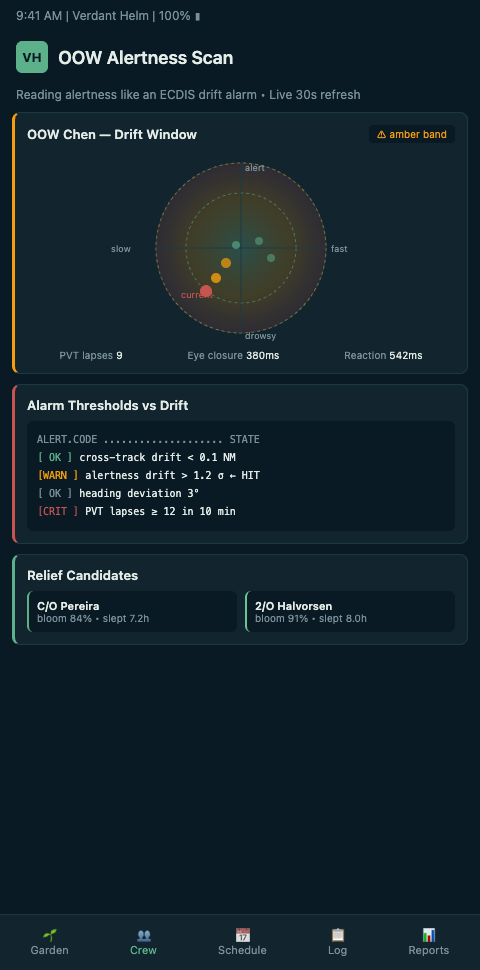
Verdant Helm treats each officer on watch as a perennial with its own drift threshold. An ECDIS has cross-track deviation limits, safety-contour depths, and look-ahead windows that trigger audible alarms when breached. A garden has the botanical equivalents. A perennial whose bloom state has dropped two standard deviations below its seven-day baseline triggers an alertness drift alarm. A perennial that has remained stable but whose root-zone moisture — the trailing sleep reading — has fallen below 5.8 hours/24 for three consecutive days triggers a sustained-debt alarm. A perennial that is heading into a watch window in its personal circadian trough triggers a pre-watch susceptibility alarm.
These are the same categories of alarm the bridge already respects on its ECDIS. What Verdant Helm adds is the rendering and the tendability. An ECDIS alarm is binary — it fires or it does not. A garden alarm is stateful — it shows the trend, the margin to threshold, and the tending action that would reset it. The Master who glances at the bridge garden sees four perennials and their alarm states simultaneously, in the same peripheral way he glances at the ECDIS. On a VLCC with a four-officer bridge team and an elevated cargo-watch schedule during an STS operation off Fujairah, the garden's four-perennial view is the only instrument that shows the compensating reserves across the team when one officer's alarm fires.
Lloyd's Register's research on alarm fatigue in maritime operations framed the core problem. Frequent and insignificant alerts mask genuine attention lapses. The fix the literature recommends — refined alarm audio and reduced false positives — applies equally to human alertness alarms. A garden that fires daily on every officer loses signal fast. A garden that fires when a perennial drifts across a personalised threshold, tuned to that officer's baseline, holds attention the way a well-configured ECDIS does. The Lloyd's data drew on bridge audio recordings from container vessel voyages where the average alarm-fire rate per 24 hours was over forty, and the officer acknowledgement rate degraded sharply after the twentieth alarm.
The Taylor & Francis peer-reviewed work on audible ECDIS alerts showed that refined audio alarms improve early navigational situation awareness. The same principle applies to fatigue alarms. An OOW alertness drift does not need to fire a klaxon. It needs to change the colour state of a perennial in a peripheral field and, if it persists, to prompt the Master with a tending choice. Riviera Maritime's coverage of ECDIS alarm management showed officers routinely mute or disable mechanical alarms that fire too often — the same failure mode the garden is built to avoid. On the Dover Strait near-miss incidents logged by the MAIB across 2019-2023, several case files noted that bridge alarms had been acknowledged but not acted on, a behaviour signature that reads as alarm-saturation rather than officer inattention.
Gard's bridge resource management observations, published in their insights series, made an adjacent point. Bridge under-performance is collective, not individual. An OOW drifting is a bridge system state, not only an officer state. The garden captures this by showing the full bridge team's perennials in one view, so the Master can read the compensating officer's bloom as easily as the drifting one's wilt. A fresh Third Mate with a healthy perennial can be scheduled onto the bridge for the final hour of a wilting Second Mate's watch — a pairing the ECDIS cannot see and the rest-hour form cannot prescribe. On a Panamax container bridge transiting the Singapore Strait eastbound, the compensating-redundancy reading determines whether the Master stays on the bridge for the transit or trusts the OOW plus lookout pairing.
Advanced tactics for bridge-alarm alignment
Three tactics raise the rigour of OOW alertness monitoring to match ECDIS discipline. First, define the personalised drift threshold per officer, not a fleet-wide value. An ECDIS cross-track deviation of 0.5 nautical miles may be tight on a blue-water leg and loose in a TSS. An alertness drift of two bloom-state points may be routine for a Filipino Third Mate on hour three of a 00:00-04:00 watch and severe for a Greek Chief Mate at the start of one. The garden calibrates per-perennial, the way a well-configured ECDIS calibrates per-leg. An ULCC running Ras Tanura to Rotterdam carries a single Chief Mate for the entire 25-day passage, whose threshold on voyage day three reads different from his threshold on voyage day nineteen.
Second, log every alarm with acknowledgement, context, and tending action. ECDIS alarm logs are what the MAIB pulls first after a casualty. Garden alarm logs are what a Master, DPA, or port state control inspector should be able to pull with the same ease. Verdant Helm stores the alarm fire, the bloom-state context at the moment, the tending action taken (officer swap, lookout added, watch shortened), and the follow-up bloom state two watches later. The loop is closed the way an ECDIS XTE log is closed. On PSC inspections in Rotterdam, Singapore, and Long Beach, the garden alarm log reads as a continuous bridge-state record that complements the STCW rest-hour format rather than competing with it.
Third, connect the garden alarm to a pre-briefed tending runbook, not an ad-hoc decision. An ECDIS anti-grounding alarm has a textbook response — check position, verify safety contour, alter course if required. A garden alarm needs the equivalent. A Verdant Helm runbook might specify: on a pre-watch susceptibility alarm at 03:45, add a lookout for the first hour of the watch; on a sustained-debt alarm on day eight, lodge a reduced-duties flag with the DPA; on a drift alarm during a watch, run a brief with the OOW on their last three hours of alertness and extend the handover.
Bridge teams on Greek-flag bulk carriers running the Black Sea to Far East trade report the runbook as the single change that moved the garden from a dashboard-glance tool to an active bridge-resource-management instrument. On a Rotterdam-Santos round voyage with the equatorial crossing at roughly voyage day eight and the Santos pilot station at day thirteen, the runbook triggers twice per voyage on predictable debt-curve anchors, which gives the Master a repeatable pattern of decisions rather than a series of one-off calls.
OCIMF's recommendations on ECDIS usage and incident prevention tied ECDIS misuse to grounding patterns and configuration drift. The parallel for human alertness is that misconfigured or ignored alertness monitoring leads to the same class of casualty. Our work on correlating ECDIS events with crew energy timelines pairs the two telemetry streams so that a Master can see them together. The able seaman's first voyage with Verdant Helm shows how even lookout-rated crew contribute bloom-state readings that feed the bridge garden. Offshore rig operators working the same pattern will find reading rig crew energy through the drilling-fluid report applies the same vitals-reading discipline to the drill floor.
What deep-sea cargo fleet leaders should do next
Masters and Chief Mates on container, bulk, and tanker bridges can begin reading OOW alertness with ECDIS-grade rigour today. Verdant Helm ships with a pre-configured alarm schema that maps to bloom-state thresholds and pairs each alarm with a tending runbook. DPAs running multi-vessel fleets get a consolidated alarm feed per ship, with the same acknowledgement and audit trail ECDIS logs already provide. Book a review with our deep-sea cargo team: send us a recent near-miss report and we will show which garden alarms would have fired and when — almost always, the drift was readable hours before the ECDIS saw anything.
Before the walk-through, pull the bridge alarm log from the watch the near-miss occurred on and the two watches preceding it. The garden almost always shows a sustained-debt reading on the OOW across the preceding 72 hours and a pre-watch susceptibility reading on the watch itself. On a Panamax bulker approaching Haisborough Sand inbound or a Feeder container vessel clearing the Dover Strait southbound, the drift trace has the same shape — the alarm fire count climbs through the second hour of the watch and the acknowledgement latency creeps beyond fifteen seconds.
DPAs get a quarterly fleet report that ranks vessels by pre-watch alarm state and pairs each flagged OOW with a tending runbook the Master has already executed or can execute. P&I clubs and charterers reviewing the same record see a bridge posture that reads human alarms with the same discipline the ECDIS already receives, which changes how the next vetting conversation opens.