Split Anchor-Watch Rotas Driven by Garden Signals
Four days at anchor, and a rota drawn against the wrong axis
A container vessel waiting for a berth off Eastern Anchorage, Singapore, settles into anchor watch for what looks like a short stop and turns into four days. The Master draws a rota against the clock. Chief Officer: 00:00 to 06:00 and 12:00 to 18:00. Second Mate: 06:00 to 12:00 and 18:00 to 00:00. Clean. Symmetrical. Easy to defend if the P&I club asks. The bosun holds a standing deck round every two hours to check the anchor chain, and the engine room keeps a reduced watch on the main engine. Paper-wise, the operation is textbook.
The rota is a flat split against a four-day anchorage that is not flat at all. Safety4Sea's summary of STCW.7/Circular 14 describes the anchor watch as continuous monitoring of swing circle, rate of turn, and master readiness. Britannia P&I's guidance on dragging anchor prevention names squalls and tide-over-wind as the dragging causes; the continuous alert watchkeeper is the early-detection instrument. Squalls do not arrive on a clock-split schedule. They arrive at 03:30 and at 16:45 and at 11:20 — usually at a moment the flat rota has a watchkeeper at the end of a wilt. On a VLCC held at Fujairah for a laycan, the afternoon thermal squalls cluster in the hottest months; the flat rota puts the most wilted OOW in the bridge chair for three of the four highest-risk hours of the day.
Four days of watchkeeping at anchor also stretches the crew differently from watchkeeping at sea. The Shipowners' Club guidance on anchoring describes the split-rota reality; watchkeepers are not at sea but are not at rest either. The perennial dips. The bloom never quite builds. Some officers adapt; others accumulate a quiet debt that the anchorage rota has no instrument to surface. On a VLCC held off Fujairah for a laycan slot, that debt compounds from the ballast leg, and the loaded-leg departure is already drawing against a depleted bank. A Chief Mate who arrives at the berth with a wilted perennial then faces the pilot boarding, the terminal briefing, the cargo plan, and the bunker schedule on the same morning — a stack of demands that the anchorage rest-hour form will not show as consumed.
Draft the rota against the garden's bloom bands
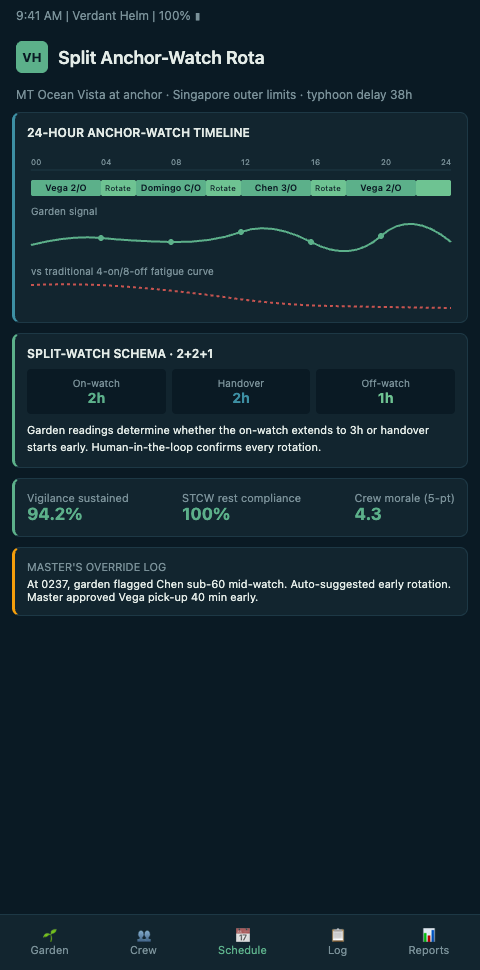
The Verdant Helm approach draws the anchor watch rota against each officer's predicted bloom bands rather than the clock. The ship's botanical garden shows, for the next 96 hours, when each officer's perennial will be in strongest bloom. The rota assigns watches to bloom bands and rest to wilt bands. A Chief Officer whose strongest bloom runs 09:00 to 13:00 and 19:00 to 22:00 gets those watches, not 00:00 to 06:00. The garden's watch-cycle colour language reads cleanly on the bridge tablet — fresh green around bloom peaks, amber into the shoulders of each bloom, russet through the deep wilts the rota must avoid.
The rota becomes asymmetric. Chief Officer takes three watches over 96 hours. Second Mate takes four. Third Mate takes three. The total watch hours per officer match labour expectations and fall inside MLC bounds. The placement is what shifts. When a squall forecast arrives, the Master can see which officer will be in deepest bloom at the forecast arrival and adjust the rota to put that officer on the bridge during the squall window. The Nautical Institute's science of anchoring paper provides the technical foundation — the bloom-band placement is the operational expression of it.
On a Panamax container vessel held off Long Beach during a West Coast berth queue, the same bloom-band logic tends to put the Second Mate on during the afternoon sea-breeze squalls and the Chief Mate on during the early-morning tide-turn window. The Third Mate, usually the most junior OOW, gets the calmer middle-night hours where the cognitive demand is lower and the training exposure is manageable.
The rota also responds to anchor-specific events. When the Nautilus summary of the MAIB safety bulletin on cruise ship anchor failures notes repeated anchor failures and watchkeeper response time as critical, the garden is the surface that protects the response time. A watchkeeper at the bottom of a wilt cannot respond to a dragging anchor in the available seconds. A watchkeeper in bloom can. The bosun coordinating deck rounds during the anchorage sees the same bloom map and can time chain checks to match the OOW's alert windows rather than to a rigid two-hour pattern. A cadet walking a learning round with the bosun during the afternoon bloom window develops real anchorage discipline rather than rote chain-check behaviour.
For the Master, the garden consolidates the decision. The anchor-watch rota no longer sits in a separate spreadsheet; it lives in the same botanical view as the voyage garden, the bridge garden, and the deck garden. When the vessel finally gets a berth slot and shifts from anchor watch to pilot-boarding preparation, the garden carries the state forward without a data reset. The Chief Officer who has just finished a strong-bloom anchor watch goes onto the arrival plan with a known perennial. A cadet who took a protected rest cycle across the anchorage shows up on the berth-approach deck gang with measurable readiness. The engine room's reduced watch during the anchorage is also visible — a Second Engineer who ran the reduced watch on odd-hour blocks arrives at the standby-engine request with a perennial that the Chief Engineer can plan around rather than discover at the worst moment.
Advanced: from split rota to anchorage risk score
The deeper capability is the anchorage risk score the garden enables. Every hour of the anchorage carries a measurable risk — the probability of dragging, given wind, tide, holding ground, and adjacent shipping — and a measurable defence — the cognitive state of the watchkeeper on the bridge. The product of the two is an hourly anchorage risk score. Across a 96-hour anchorage call, the score rises and falls as the bloom bands and the weather bands interact, and the Master has an early-warning signal rather than a static rota. The score reads against COLREGS Rule 5 lookout requirements and ISM watchkeeping discipline without the Master having to interpret between them.
Across a fleet and a quarter, those scores aggregate into a decision surface for voyage planners. If Eastern Anchorage consistently produces the highest risk scores — because the wind patterns cluster at night and the flat-rota design consistently puts wilted watchkeepers there — the planning team can either redesign the rota posture for that anchorage or route vessels to alternative anchorages when the forecast is adverse. Safety4Sea's broader watchkeeping-at-anchor analysis provides the context on why fatigue and lookout gaps drive anchorage incidents; the risk score is the operational answer. A fleet superintendent comparing Eastern Anchorage scores against Fujairah scores across a quarter sees whether the risk is site-specific or rotation-specific and can brief the commercial desk accordingly. That briefing goes into the next charter-party negotiation and into the next P&I renewal discussion; the risk score has commercial legs beyond the operational deck.
DPAs can use the score to justify watchkeeping decisions to P&I clubs. When the club asks why a specific dragging event did not escalate, the DPA can produce the hourly record — Chief Officer on the bridge was at 85% bloom, response time 11 seconds, engine started, anchor held on additional scope. That is a defensible record, not an anecdote.
An ISM audit reviewing anchorage watch discipline reads the same record and sees evidence of an SMS that operates continuously rather than one that produces paperwork after the fact. A PSC boarding officer inspecting a VLCC that has been held at anchorage for six days can read the rota against the bloom-band pattern and verify that the Master's watchkeeping discipline operated continuously rather than collapsing into a clock-split shortcut on day four.
Post 17 on ballast watch planning with predictive circadian data covers the adjacent domain of the ballast passage where the same garden feeds the rota, and post 18 on how bosuns rotate deck crews using garden readings extends the method onto the deck. Wind operators run the same aggregation on their blade teams; post 19 on rotating blade teams using garden transfer documents the parallel in a very different operational tempo.
For deep-sea cargo fleet leaders managing long anchorages
If your vessels regularly sit four days on anchor waiting for berth and your last dragging event would have benefited from a faster bridge response, Verdant Helm will draft one vessel's next anchor watch rota against the bloom bands and sit a Master through the before-and-after. Schedule the anchor-rota review for your next expected long anchorage call, and bring the local port-authority weather archive so the bloom bands can be placed against the observed squall timing rather than against a generic climatological assumption.
Before the review, pull the last three anchorage watch rotas alongside the port-authority squall records, the Chief Mate and Second Mate rest-hour forms, and any dragging or near-dragging annotations from the bridge log. The drafted rota almost always exposes two or three hours where the flat clock-split put a wilting OOW on the bridge inside a historical squall window. On a Panamax container vessel held off Eastern Anchorage Singapore during a berth queue or a VLCC laycan at Fujairah, the revised asymmetric rota typically places the Chief Mate's strongest bloom over the morning tide-turn and the Second Mate's bloom over the afternoon thermal squalls, with the Third Mate taking the calmer middle-night hours.
The DPA gets an anchorage risk score for every extended anchorage call across the fleet, with the squall forecast and the bloom map in a single view. P&I clubs reviewing dragging claims and OCIMF vetting committees see an anchorage-watch discipline that separated a near-drag from a dragging event, which changes how the next club renewal and the next vetting brief read.