Why 12-Hour Handovers Leak More Safety Signals Than You Think
The 4-Minute Handover
A drillship in West Africa logged a shift handover at 05:58 that ran 4 minutes and 12 seconds before the outgoing driller signed off and walked to the galley. The handover board showed mud weight, hole depth, and the overnight kick drill. It did not show that a choke-manifold isolation had been left in a non-standard state during a quick repair two hours before change. Three shifts later, a near-miss investigation linked the choke-isolation confusion to a flow-check error that could have escalated.
The handover was logged as complete. The critical signal had not transferred from an exhausted night-tour driller to an incoming day-tour driller who had his own first 30 minutes of information to absorb. The investigation documented the missing signal and attributed it to "insufficient handover detail," which is true and unhelpful — the question is why the detail was insufficient, and the answer is that the outgoing driller's cognitive state at 05:58 on day 13 was no longer capable of reconstructing the non-standard isolation from memory without a structured prompt.
HSE UK's page on shift handover human factors frames the pattern: handover-related incidents are a recurring cause of plant accidents, with a clear majority involving planned maintenance work that crossed a shift boundary (HSE UK Shift Handover Human Factors). IChemE research cited by the same regulator puts a number on it — roughly 40% of plant incidents cluster around start-ups, shutdowns, and changeovers including shift transitions (IChemE Improving Shift Handover Value).
The Piper Alpha case, still the definitive offshore lesson, showed that a handover gap around a missing pressure-safety valve contributed to a disaster that killed 167 workers, with no written handover procedure and the PTW permit not discussed at shift change (The Chemical Engineer Piper Alpha: The Disaster in Detail; Human Factors 101 Piper Alpha). EHS Today's analysis of oil-and-gas handovers walks through how the same pattern still surfaces in modern incidents (EHS Today Why Poor Shift Handover Can Lead to Serious Oil & Gas Incidents).
Four minutes is not the problem in isolation. Four minutes with a wilted perennial handing a complex state to a partially-bloomed one, with no structured prompt, is the problem. The industry has made progress on written handover procedures since 1988, but the procedures often describe what should be said rather than who is cognitively capable of saying it, and the crew state behind the words remains invisible to the procedure itself.
The Garden-State Handover
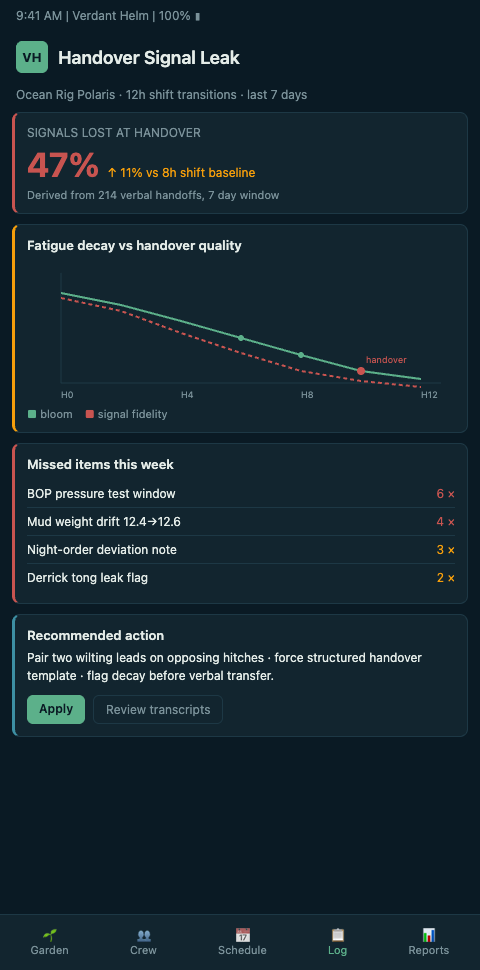
Verdant Helm reframes the handover around two perennials: the outgoing crew member, usually at the end of a long wilt curve, and the incoming crew member, fresh or recovering, depending on where they sit in their rotation. The handover is not a static form; it is a conversation between two plants with known state. The garden view surfaces that state before either person opens their mouth, so the structure of the handover adapts to the people in it. This is different from simply adding a question to the handover board; the structure itself changes shape.
Four design changes make the handover carry the signal. First, the handover form is dynamic. The outgoing driller's current energy state determines the prompt depth; a wilted crew member gets a longer structured check on isolation states, active permits, and in-progress work because their recall is known to be degrading. HSE's guidance on safety-critical communications reinforces that the medium must match the risk, and the garden state gives the medium a quantitative input (HSE Safety Critical Communications Overview). Second, the incoming crew's energy state determines the receive structure; an incoming driller who is still on the first recovery after crew-change gets a longer dwell on the critical items, not the routine ones.
Third, the permit-to-work set active at handover is forced into the verbal exchange with explicit yes/no on each permit's status; this is the Piper Alpha lesson, encoded. Fourth, the overlap window — which the rig already schedules for 10 to 20 minutes on paper — gets a minimum cognitive dwell based on the combined state of the two plants. If both are wilted, the overlap lengthens automatically, or a third crew member sits in. The minimum is a floor, not a target; the target is sufficiency.
Digital shift-log platforms for upstream oil and gas, such as IFS Shift Log, already handle the data-integration side of the handover, pulling SCADA context and work-order status into a single view (IFS Shift Log Software for Energy). The garden layer adds the human-state overlay on top of the SCADA view, so the handover is both system-rich and person-aware. The combination moves the conversation from "sign this page" to "walk me through the isolation on bay 3 again, because you've been on your feet for 11 hours and I want to hear it twice."
Advanced Tactics for High-Signal Handovers
Three tactics move the handover from compliant to diagnostic. The first is the double-back-to-back check. Rigs running back-to-back crew changes accumulate handover debt because the outgoing crew-change crew is already at the end of a compressed schedule.
Surface that specific pattern before the tour change and add a supervisor or OIM presence at the handover. This is not overhead; it is the moment where the hidden cost shows up.
The supervisor's job at the handover is not to lead it but to witness it, which keeps the handover's ownership with the line crew while adding a layer of cognitive redundancy.
The second tactic is structured challenge. The incoming crew member is explicitly prompted to ask two questions for which "no" is the wrong answer: "show me the active permit register" and "walk me through the last isolation change." These are not gotcha questions; they are friction that forces the wilted plant to articulate what would otherwise be assumed. The research on handover value shows that structured challenge is the single highest-leverage change in handover quality. The challenge questions rotate over hitches so the crew does not learn to prepare stock answers.
The third tactic is the handover-to-task chain. A handover that transfers a complex state should not immediately be followed by that same incoming crew running a derrick team trip out of hole in the first hour. The garden view shows the task density in the first two hours of the incoming tour and flags the cases where the load is front-heavy. The toolpusher can re-sequence or add a supervisor for the opening segment. The parallel practice on cruise fleets — excursion-desk staff burnout detected early — shows how the same handover attention scales into customer-facing roles.
A fourth tactic is handover artifact review. The handover board, the digital shift log, and the permit register should be cross-referenced during the exchange, not treated as parallel sources. When the garden view shows either party wilted, the cross-reference becomes mandatory rather than best-effort. A small friction at the handover is cheaper than a three-tour investigation later.
A fifth tactic is handover quality scoring. Over a rotation, each handover gets scored on duration relative to complexity, structured-prompt completion, and cross-reference consistency. The score is private to the toolpusher; it is not punitive for the crew. The aggregate trend flags which tour pairs have drifted into compressed exchanges that no longer match the state they are transferring. This is a coaching input, not a disciplinary one, and it converts handover quality from an opinion into a tracked metric.
Common mistakes include treating the handover as an outgoing-only download (which ignores the incoming state entirely), allowing the handover to compress when the outgoing crew is eager to leave (the wilt pulls toward brevity exactly when depth matters most), and signing off on a handover board without verbal cross-check. A subtle trap: the handover that runs 60 seconds because "nothing happened" is often the one where something small did happen and nobody coded it into the log. Another subtle pattern is the "same pair" drift — when the same outgoing and incoming crew members have handed over to each other for five or six consecutive tour changes, the handover shortens through familiarity, and the garden view needs to reset the expected duration when it detects the familiarity pattern combined with fatigue.
Audit Your Last Week of Tour Changes
If you run an OIM or toolpusher role, pull the handover logs from the last seven days and line them up against the energy bed scores of the outgoing and incoming crew. The short handovers, the late-hitch handovers, and the back-to-back-adjacent handovers will show a pattern, often concentrated on specific role pairings where familiarity has compressed the exchange below what the task complexity warrants. Verdant Helm then gives drilling supervisors the forward view to structure the next handover around the people actually in the room. Book a walkthrough: share the last 14 handover logs and we will return a garden overlay with three handover-structure changes matched to your crew's rotation, sequenced so the first change lands on the next tour boundary and the full suite is in place before the end of the current hitch.
The walkthrough is structured so the three proposed changes do not arrive as abstract recommendations. Each change is tied to a specific handover in the 14-log sample — the date, the outgoing driller, the incoming driller, the permits active at the exchange, and the garden state at the moment the log was signed. That specificity is what makes the review conversation operational rather than theoretical.
OIMs and toolpushers who have run the walkthrough typically find the three changes cluster in predictable ways: one change on the structure of the handover board itself, one change on the overlap window length for a specific tour pair, and one change on the permit-register verbal exchange for a specific permit class. The first change lands within 24 hours. The second requires a schedule conversation with the rota planner. The third becomes rig standard within the current hitch. Verdant Helm's analyst team stays available through the hitch to adjust any change that produces unexpected friction, which keeps the implementation honest.