Beyond 28/28: Fatigue-Gated Drilling Rotations
The Calendar Rotation Was Never the Only Option
The 28-day-on / 28-day-off rotation for offshore drilling crews — and its 21/21 and 14/14 variants — was negotiated in eras when logistics, contract structure, and regulatory limits made calendar-based rotation the only administrable option. Helicopter crew-change capacity, contractor scheduling systems, and HSE working-hours policy all assumed fixed rotation windows. The HSE UK SPC/ENF/160 shiftwork fatigue offshore policy guidance documents the UK regulator's framework for assessing management of shiftwork and fatigue offshore; the framework is designed around rotation patterns, not around individual-crew fatigue signals.
Calendar rotation made sense when the only signal available to a rotation-scheduling decision was the calendar. It makes less sense when each crew member's fatigue state is continuously measurable. The IOGP Report 626 on managing fatigue in the workplace — the IOGP-IPIECA flagship fatigue risk management systems report — is explicit that FRMS frameworks are preferable to static rotation policies when the telemetry exists. The IPIECA Managing Fatigue in the Workplace guidance reinforces the point: adaptive controls outperform static rotation policies when the supporting systems are in place.
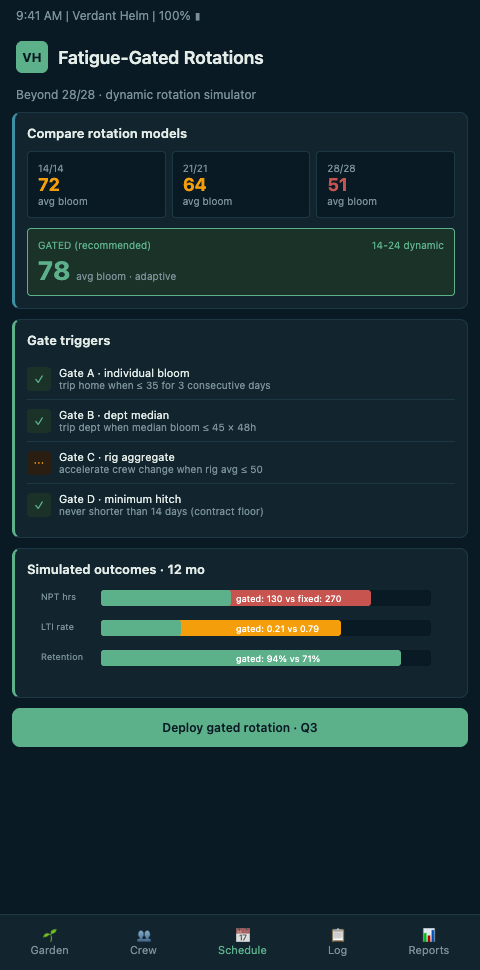
Fatigue-gated rotation is the name for the alternative. The return-home date is not fixed; it flexes based on welfare telemetry. A crew that is tracking healthy against the decay curve may extend by 48 hours to complete a well. A crew showing accelerated wilt may be demobbed 36 hours early. The calendar is a default; the garden is the override.
What Fatigue-Gating Actually Looks Like on a Rig
Verdant Helm renders crew as a living botanical garden across the hitch. Fatigue-gated rotation treats the garden's state at specific decision points as a gating signal for operational scheduling. Three decision points consistently anchor fatigue-gated pilots on the rigs currently running them.
Decision point one: day 21 of a nominal 28-day hitch. The OIM reviews the rig's garden against the fleet's 28-day decay curve baseline. If the rig is tracking at or above baseline, the hitch continues as planned. If the rig is tracking 1-2 standard deviations below baseline, the OIM flags a potential early demob and begins logistical prep. If the rig is tracking significantly above baseline, the OIM may agree to an extension window in return for a longer subsequent off-period.
Decision point two: day 24. The OIM reviews again with sharper criteria. The day-24 check is the last window where early demob is logistically achievable without emergency mobilisation. The Havtil Norwegian Ocean Industry Authority framework regulates working environment and rotation hours in Norwegian petroleum under the Working Environment Act — Norwegian-jurisdiction pilots of fatigue-gated rotation are designed to stay inside Havtil's envelope while varying rotation length within it.
Decision point three: day 26-27. The final pre-demob check is about task scheduling, not rotation length. Garden data informs which tasks can safely be run in the final 48 hours and which should be deferred to the incoming hitch. This decision point is where fatigue-gated thinking produces the most immediate operational benefit, even when the nominal 28-day window is not flexed.
Implementing these decision points requires four supporting systems: continuous welfare telemetry generating the garden state, a rotation-baseline reference drawn from fleet-scale data, operator-contractor agreement that gating decisions are joint calls, and logistics flexibility to mobilise crew on 36-48 hour windows rather than fixed crew-change days. The Texas A&M ACELAB rotating shiftwork naturalistic study measured fatigue variability that directly supports fatigue-gated rotation decisions.
What Stands in the Way
Fatigue-gated rotation is not difficult technically. The welfare telemetry exists, the decay curves are visible, the decision points are straightforward to implement. It is difficult organisationally and regulatorily, and the resistance comes from six specific sources.
First, contract structure. Day rates are quoted against fixed rotations. Contractors who demob early lose rate days; operators who extend pay premium. Neither party is incentivised to flex the window without rebalanced contract structure. New contract templates are emerging but still rare.
Second, helicopter logistics. Crew-change helicopters are scheduled weeks in advance. Moving a demob by 36 hours requires logistical agility that most operator-contractor helicopter contracts do not build in. This is addressable, but it is a real gating constraint.
Third, regulatory uncertainty. The UK HSE, Norway's Havtil, and the US BSEE have not published explicit frameworks for fatigue-gated rotation. Operators piloting fatigue-gating need bilateral agreement with their regulator, which is achievable but slow.
Fourth, crew perception. A crew member who expected demob on day 28 and is held for 30 hours by a welfare-based extension may read the signal as the operator manipulating schedules. Communicating that fatigue-gating cuts both ways — early demob possible, extension rare — requires cultural groundwork before the first pilot runs. The NIOSH FRAME survey on fatigue risk assessment in high-risk environments supports the tool-development side; crew-communication is the organisational complement.
Fifth, bridging document language. Most bridging documents specify fixed rotation lengths. Fatigue-gated pilots require bridging-doc revisions that explicitly authorise variance. For the mechanics of making those revisions, see bridging document revisions for energy-aware drilling ops.
Sixth, the Frontiers in Physiology review of fatigue monitoring wearables makes the case that wearable-based continuous fatigue monitoring enables fatigue-gated rather than calendar-based rotations, but the coverage of that case is still uneven across vendors and regulators. The Fatigue Science readiness wearables overview describes the operational state of wearable alertness monitoring — useful, but not yet ubiquitous.
The Pilot Results That Are Becoming Public
A handful of North Sea and Norwegian Continental Shelf rigs have run fatigue-gated pilots across 2024-2025 with results that are now starting to appear in industry conferences and operator disclosures. The patterns across these pilots are consistent enough to outline, even while the sample remains small.
Early-demob interventions were rarer than the pilots' designers expected. Across 38 hitches on pilot rigs, only four triggered early-demob decisions under the gating criteria. The common case was the nominal calendar rotation proceeding as scheduled. What changed was the information available during the hitch — OIMs had earlier warning of crews approaching wilt thresholds and could intervene at scope or scheduling level before the gating decision became necessary.
Extension decisions were even rarer — two of the 38 hitches extended by more than 24 hours, both in operational contexts where the alternative was mobilising an unfamiliar incoming crew into a time-critical drilling phase. In both cases, the extending crew was tracking near or above baseline bloom, making the extension defensible on welfare terms.
The most consistent finding across pilots was improvement in final-week task scheduling. Decision point three — the day 26-27 check — reshaped task selection on roughly 70% of hitches. Tasks that would have been attempted on the calendar were deferred or restructured when the garden showed accelerated wilt; tasks that had been deferred were brought forward when the garden showed unusual resilience. This narrower flexibility, well within calendar-rotation norms, produced operational benefit without the contract or regulatory complications of full rotation-length flex.
Advanced Tactics: Piloting Fatigue-Gated Rotation Cleanly
OIMs and drilling supervisors positioned to pilot fatigue-gated rotation on a single rig over the next 12 months have three tactics that separate successful pilots from stalled ones.
First, scope the pilot narrowly. Run fatigue-gated thinking at decision point three only (final task scheduling), not at points one or two, in the first pilot hitch. Let the rig team build muscle memory on the narrowest decision before flexing rotation length. The subsequent quarter can expand to point two. The quarter after that can include point one.
Second, document the counterfactual. For each decision point, the OIM records what the nominal calendar-based decision would have been and what the fatigue-gated decision actually was. After six hitches, the counterfactual log is the basis for evaluating whether fatigue-gating produced operational or safety benefit. Without the counterfactual, the pilot produces anecdote.
Third, bring the regulator into the pilot from day one, not at the reporting stage. Norwegian pilots have reported smoother progress when Havtil participated in design; UK pilots have reported similar results with early HSE engagement. The regulator is not the obstacle; uncommunicated pilots are. The 10,000-hitch dataset analysis of 21-day rotations provides the statistical grounding UK and Norwegian regulators routinely ask for during pilot design. A parallel conversation is emerging in deep-sea cargo, where garden-gated voyage-length contracts are being piloted under similar regulatory frameworks — the cross-sector pattern gives an OIM a useful reference when making the case to a drilling regulator.
The Next Hitch Decision
OIMs and drilling supervisors running 28/28 or 21/21 rotations on a rig with existing welfare telemetry should run a day-26-27 fatigue-gated task-scheduling review on the next hitch. Scope it to final-two-days task selection only; no rotation-length flex in the first pilot. Document what the calendar-based decision would have been and what the welfare-based decision was. After six hitches, you have a defensible basis for expanding the pilot. Verdant Helm supports the decision-point workflow with built-in counterfactual logging. Book a pilot-scoping call with your OIM and contractor rep — we will help you design the first hitch's scope and the measurement protocol for the six-hitch evaluation.