The Hidden Cost of Back-to-Back Crew Changes
The Cost That Travels Hitch-to-Hitch
A roustabout on a Gulf of Mexico jackup volunteers for a back-to-back when his relief is fog-delayed in Houma. The OIM approves the extension because the alternative is running the next day's operation one hand short. On day 32 — day 11 of what is effectively the second hitch — the same roustabout catches a hand on a pin during a tubular operation. The injury report names the pin and the procedure. What it does not name is the fact that this crew member was operating on a sleep debt from the tail of the first hitch that had never been cleared. The cost was in the rotation book, not the incident report. The pin only revealed it.
The pattern is well-documented but rarely costed. A Maritime Executive report on an OSV platform allision details an NTSB finding where a mate had worked 19 hours and slept 5 in the 24 hours before his vessel hit an offshore platform. Back-to-back work-rest violations were named as contributing factors. A CDC MMWR database analysis of 470 oil and gas fatalities from 2014-2019 identified schedule pressure as a frequently-missing data factor in OSHA records — the rotation context that would have made incidents diagnosable was rarely captured. UK HSE's operational guidance SPC/ENF/160 takes the direct position that offshore should target zero overtime, which is effectively an enforcement stance against back-to-backs. The regulatory view is settled. The field practice is not.
The Garden Cannot Be Double-Cropped
A useful frame for back-to-back hitches is the gardener's rule against double-cropping without a fallow period. Every perennial in the garden has a recovery window between blooms. Skip the fallow and the next bloom is thinner, the roots shallower, the wilt earlier. Offshore crews are the same. A Chronobiology International study on 2-weeks-on / 2-weeks-off rotations documents a distinct post-offshore recovery period — skipping it compounds deficits on the next hitch. The back-to-back is not one long hitch. It is two hitches stacked without the fallow between them, and the cost accumulates in the root system before the bloom fails.
A PMC systematic review on rotation workers in mining, offshore O&G, and construction links extended and consecutive rotations to worse physical and mental health outcomes. The mechanism is cumulative — sleep debt, circadian disruption, muscular fatigue, cognitive drift — and each one amplifies the others. ScienceDirect research on extended work periods in offshore petroleum synthesizes the risks of stacked offshore work periods, specifically naming consecutive rotations as a higher-risk schedule than single-hitch overruns. A PubMed analysis of shift rotation, overtime, age, and anxiety as predictors of offshore sleep patterns found that overtime and stacked rotations specifically predict worse sleep outcomes hitch after hitch. The back-to-back does not reset on shift change. The root system carries it forward.
Verdant Helm operationalizes the fallow rule by keeping the crew member's garden state visible across hitches. When a roustabout or derrickhand returns to the rig after leave, their opening garden tile shows the cumulative sleep-debt index from their prior hitch — not in clinical detail, but as a contextual marker that the OIM and toolpusher can read. If the index is above threshold, the hitch plan adjusts. A crew member who arrives with elevated baseline is paired with a fresh partner on high-risk tasks, given an extended onboarding day, and kept off critical lifts for the first 72 hours. The garden metaphor makes the intervention intuitive. A perennial that was wilting last season does not get planted into the hottest bed this season.
What Verdant Helm prevents by design is the invisible back-to-back — the roustabout whose home leave was disrupted by a family illness, or a contractor who worked a different site between hitches. The garden state travels. The crew member's self-logged pulse from the two weeks off is part of the return-to-rig record. Nobody is surveilled on leave — the pulse is voluntary — but the returning crew member can share their own state with the OIM as input to hitch planning. When leave has been restorative, the tile is green and the hitch proceeds normally. When leave has been disruptive, the tile opens yellow and the rig responds.
The day-14 rotation safety trajectory post covers the within-hitch curve. The back-to-back discussion here is about the between-hitch cost — the fallow period that has to be respected for the within-hitch curve to start where it should. Both together give the OIM a two-axis picture of crew state.
The Back-to-Back Cost Calculator
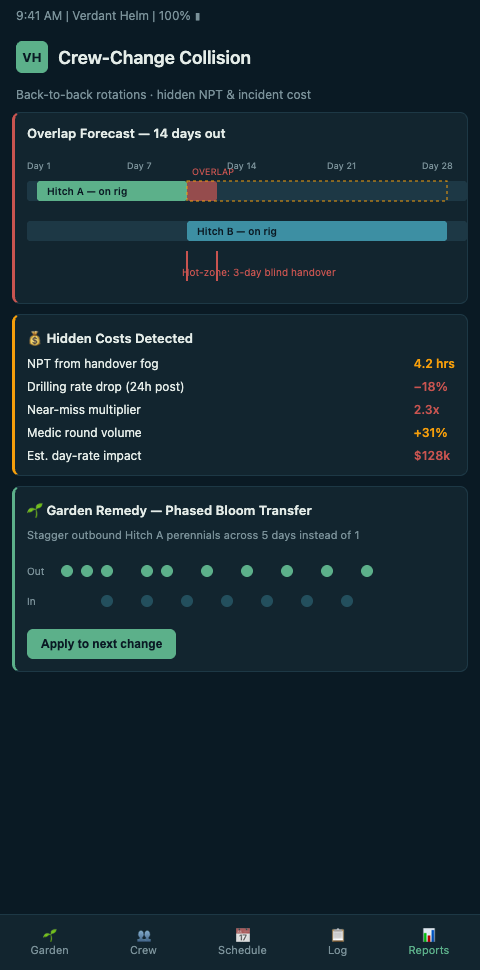
The cost-calculator view Verdant Helm produces for an OIM evaluating a back-to-back request takes the current hitch's cumulative sleep-debt index, overlays the predicted trajectory of a continued second hitch without fallow, and compares it to the baseline risk curve for a fully-rested crew. The output is a single number — risk multiple relative to baseline — and a recommendation that explains which tasks in the planned second hitch should be deferred, re-crewed, or protected by extended JSA if the back-to-back is approved. The calculator does not make the decision. It makes the cost visible.
The calculator runs in under 90 seconds once the roustabout's request hits the OIM's inbox. Three inputs drive the output — the current hitch's garden trajectory, the planned operations envelope for the proposed second hitch, and the crew pairing the second hitch would run. The output is a single page the OIM can print or hand to the drilling supervisor during the approval conversation. The risk multiple sits at the top. Below it, three specific task categories appear with either a green check, a yellow flag for extended JSA, or a red flag for deferral.
At the bottom, the named crew members whose exposure would change sit alongside the specific shifts where the change would land. An OIM signing off on a back-to-back without the calculator signs off on an abstract cost. An OIM signing with the calculator in hand signs off on a specific downstream trajectory with named mitigations. That shift from abstract to concrete is what makes the approval defensible under post-incident review and ALARP scrutiny.
Advanced Tactics: Managing the Pipeline, Not Just the Extension
Three tactics shift back-to-back management from exception handling to pipeline management. First, forecast the pipeline. The crew-change flight planning post covers how rig operators feed garden-state data into helicopter scheduling. When the fleet planner can see which rigs will have which crew-state gaps in two weeks, back-to-back requests become a scheduling problem rather than a day-of decision. Verdant Helm's fleet view surfaces the forecast.
Second, separate voluntary from involuntary back-to-backs. The OIM's approval weight should differ depending on whether the extension is crew-driven (a roustabout wants the pay) or operator-driven (relief is delayed). Voluntary extensions at low-hitch-age are low-risk. Operator-driven extensions at high-hitch-age are high-risk. Treating them as a single category underprotects the second case. A permit-like approval flow with different gates by category is the discipline most rigs lack. Verdant Helm builds the flow into the extension request.
Third, plan against adjacent-industry load patterns. Offshore wind SOV crews face the same stacked-hitch problem when weather windows let them run consecutive work periods. The stacked good-weather-weeks hidden cost post documents the SOV industry's emerging discipline on back-to-back management. Drilling operators can learn from SOV operators' earlier exposure to the pattern, since offshore wind's growth has forced the issue faster than oil and gas.
The common mistake is to treat the back-to-back as a permission question handled by the OIM in a vacuum. The cost of the back-to-back lands later, often on a different crew member than the one extended (partners of a fatigued derrickhand inherit the risk), and always with context that was not in the extension approval form. Verdant Helm's calculator makes the downstream cost visible at the point of decision. The OIM still decides. The decision has the numbers.
A fourth tactic is to build a fleet-level view of extension frequency. When one rig in a fleet of 14 shows a pattern of extensions clustered in a particular quarter, the fleet operations team has a logistics signal — probably weather-window-driven relief delays — that deserves pipeline attention before it becomes normalized. The calculator outputs roll up into a fleet dashboard that exposes the pattern. Fleet operations can then adjust helicopter booking, transit hotel contracts, or crew roster staging to reduce the structural pressure that drives extensions. The structural fix beats the case-by-case approval every time.
A fifth tactic is to include extension history in the return-to-rig baseline check. A crew member returning to the rig after a recent back-to-back gets a modified hitch plan automatically — lower JSA complexity in week one, paired work on tasks above a certain risk threshold, extended first-shift handover. The modification lasts through the first seven days and then releases based on the garden reading. That graduated return pattern is what separates sustainable rotation management from extension-driven schedule chaos. A drilling contractor that applies the pattern consistently across the fleet will see back-to-back frequency decline without any explicit policy change, because crews stop volunteering when the downstream cost is visible.
A sixth tactic is to communicate the calculator's output back to the crew member before the extension is finalized. A roustabout volunteering for a back-to-back who sees the downstream risk multiple their extension would generate is a roustabout who can choose with real information. Most crew members, given the number, reconsider voluntary extensions in favor of a cleaner fallow period. Transparency at the individual level reduces the incidence of extensions without any enforcement change. The OIM preserves authority. The crew member gains agency. Both sides trust the record.
CTA: For OIMs and Drilling Supervisors Signing Off on Extensions
For OIMs and drilling supervisors who have signed a back-to-back in the last quarter and wondered what the downstream cost was, the next useful move is to trace one recent extension through the full hitch that followed it. Verdant Helm can reconstruct the crew-state trajectory from your fatigue logs and IADC reports to show how the second hitch actually unfolded. Run the analysis on two or three recent extensions and the pattern will surface — the cost is rarely where you expected it, and the calculator becomes a tool you want at the next approval.
The retrospective reconstruction takes about four hours of Verdant Helm's analyst time per extension and produces a one-page trajectory report the OIM can read in five minutes. The report shows the crew member's sleep-debt index across both hitches, the specific tasks performed during the extended period, any near-miss or first-aid records tagged to the crew member in the following 30 days, and the pairing patterns the toolpusher used to distribute load. OIMs who have run the reconstruction on three or four extensions consistently find the same thing: the cost did not land where the approval form expected.
A back-to-back signed off because "the derrickhand volunteered" often shows up in a partner roustabout's shoulder strain two weeks later, not in the extended crew member's own record. That asymmetric cost is what the forward-looking calculator captures at the point of approval. Book a 30-minute scoping call and bring two recent extension approvals — the reconstruction will run during the following week and the debrief call compares what the calculator would have predicted against what actually happened.