Why HSE Audits Are Moving to Continuous Telemetry
The 36-Hour Audit Was Built for a Different Era
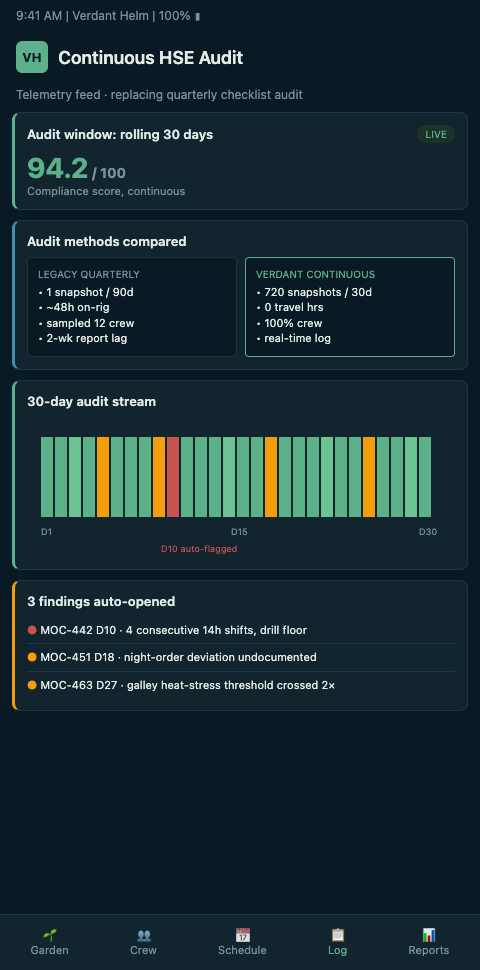
A UK HSE inspector lands by helicopter, spends 36 hours on a drilling rig, reviews permit-to-work logs, observes two shift changes, interviews the OIM and medic, inspects the drill floor, and leaves with notes that will become a formal report weeks later. That template was built when the primary inspection signal was the inspector's own eyes and ears. It still produces valuable findings. It also misses everything that happens during the 89 days between audits, and it misses most patterns that require a time series to see at all.
The HSE UK inspection of offshore installations guidance documents that the UK regulator's audit model now prioritises installations by hazard, performance, and intelligence signals — which means the regulator already wants continuous inputs, not just point-in-time inspections. The HSE UK Key Programme final reports track multi-year KP programmes whose KPIs increasingly feed ongoing integrity dashboards rather than static audit reports. The structural shift is visible in the regulator's own published reasoning.
The shift is not that regulators have decided to run audits differently. It is that operators already collect continuous signals for their own purposes — real-time drilling data, wearable telemetry, permit throughput, garden views of crew energy — and those signals either become the substrate of future audits or stay locked inside operational systems while audits remain blind. The direction of travel is one-way. The question for rig operators is how to prepare.
What Continuous Telemetry Actually Replaces
Periodic HSE audits do four things: they verify that SMS documents exist, they sample compliance with those documents, they interview people whose narratives are hard to audit continuously, and they signal that the regulator is watching. Continuous telemetry changes three of those four.
Document verification does not need audits at all once SMS systems are digitised. The BSEE Best Practices Real Time Monitoring report documents how real-time telemetry enables continuous compliance beyond point-in-time audits for offshore well construction — the same logic applies to SMS compliance. An auditor does not need to land to verify that permit-to-work volumes are being logged. A stream does that.
Compliance sampling is where the largest shift happens. Instead of the inspector sampling 30 permits during a visit, the operator streams permit metadata continuously and the regulator's analytics flag anomalies. The HSE Hazardous Installations Directorate inspection guide already describes safety-critical element verification in terms that support continuous performance-standard monitoring. What changes is the sampling frequency — from 30 permits per audit to 30,000 per quarter.
The interview function is the one continuous telemetry does not replace. Inspector conversations with OIMs, medics, and crew surface narrative signal that numeric streams cannot. The audit of the future is an inspector visit focused on conversation, calibrated by the telemetry the inspector reviewed before landing. The Step Change in Safety specialist guidance library is one of the industry resources supporting UKCS operators through this shift.
Where the Garden Fits
Verdant Helm renders crew energy as a botanical garden. Each crew member is a perennial, beds bloom and wilt, sinks pool energy across shared tasks, and the OIM prunes and tends the beds across the hitch. The garden is a continuous signal — not because an inspector can see it, but because the operator already uses it for day-to-day scheduling. That same signal, aggregated into audit-grade summaries, is what the next generation of HSE reviews will read.
What makes the garden suitable for audit context, not just operational context, is three properties. First, it captures patterns that are invisible in permit logs but visible in wilt across a shift — the derrickhand who passed every JSA but whose garden showed three consecutive wilted tours before dropping a tool. Second, it generates time-series data that exists whether or not an inspector is onboard, so it cannot be cleaned up for the audit window. Third, it produces summaries — monthly wilt duration, sink frequency, compensator concentration — that translate directly into the leading-indicator language the ICheme leading indicators framework already uses for drillwell blowout risk.
What Rig Operators Should Prepare For
The UK HSE has not yet formally adopted continuous-telemetry audit methods across all UKCS installations, and the rate of adoption varies by region — US BSEE is moving faster on real-time drilling data, the UK HSE on human factors. But three preparations are useful now regardless of regulator pace.
First, generate the telemetry in audit-ready form today, not in the quarter before the regulator asks for it. Petrolink's real-time drilling software exemplifies the ROC platform model that streams live drilling data; crew-energy telemetry should parallel that architecture. Rockwell Automation's offshore drilling systems show how integrated control platforms enable real-time HSE telemetry across rig operations. The operator who has three years of streamed data when the regulator asks is in a different position than the one who starts collecting the day of the request.
Second, build the summary layer, not the raw stream, as the audit artefact. Regulators do not want 100 gigabytes of JSON. They want narrative-grade monthly summaries anchored to specific incidents. The garden's monthly wilt report, cross-referenced to near-miss clusters and dropped-object events, is closer to what an inspector can act on than raw telemetry. The Inspenet smart automated offshore platforms coverage describes the architecture of continuous safety auditing — the summary layer is what the architecture makes possible.
Third, accept that continuous telemetry makes some incidents harder to argue away. An inspector at the end of a quarterly audit could accept a plausible narrative about a dropped-object incident. A time series showing three wilted tours in the crew that dropped the object is harder to reframe. Operators whose audit strategy has depended on narrative flexibility should expect that flexibility to narrow.
The Inspector's Day on a Telemetry-Ready Rig
What does the inspector's 36 hours look like on a rig that has already moved to continuous telemetry? The first six hours change shape most obviously. Rather than arriving cold and building context from document review, the inspector arrives having read three months of garden summaries, four weeks of permit throughput anomalies, and the rig's specific event log. The first six hours become targeted: the inspector knows which beds to examine, which crew to interview, which SMS procedures to verify against actual telemetry.
The next 24 hours shift from sampling to hypothesis testing. Instead of randomly selecting 30 permits to review, the inspector investigates the three anomalies the pre-visit telemetry surfaced. Instead of interviewing whichever crew are available, the inspector requests specific conversations with the compensator the telemetry flagged three weeks ago and the crew-change shift captain whose handover metrics deviated from fleet baseline. The conversation depth is higher because the context is higher.
The final six hours remain recognisable — closeout with OIM, written findings to the operator, helicopter off the deck. But the findings are anchored to telemetry the operator has already seen, which changes the adversarial posture. The conversation is less "I observed this during my visit" and more "this pattern has been present for eight weeks and here is what we should discuss about it." Operators who have piloted mock audits in this format report shorter closeout sessions and fewer disputed findings.
That shift in the inspector's workflow is why continuous telemetry is not simply an audit replacement. It is an audit amplifier. The inspector does more with the same 36 hours because the preparatory work happens before the helicopter lands.
Advanced Tactics: The Continuous-Audit-Ready Rig
OIMs and drilling supervisors on rigs that want to be ahead of this shift should run three specific practices across the next four quarters. First, stream crew-energy telemetry alongside drilling and production telemetry. Treat them as parallel streams that ROC dashboards already carry; the HSE-facing summary becomes one of many continuous reports rather than a special project.
Second, conduct quarterly internal reviews that mirror the audit format the regulator will eventually use — narrative-grade monthly summaries, cross-referenced to specific events, with the OIM present rather than just the HSE department. Quarterly reviews in this format both prepare the rig for external audits and expose gaps in the operational use of the telemetry today.
Third, negotiate the bridging document language around continuous telemetry before the regulator forces it. Most operator-contractor bridging documents were written when audits were periodic. They do not specify who owns continuous-telemetry artefacts, who reports anomalies to whom, or what happens when telemetry is lost.
Revising the bridging document for energy-aware drilling ops is low-stakes now and high-stakes later.
For a parallel view on how IADC daily drilling reports are absorbing the same continuous-telemetry shift, see IADC daily drilling reports powered by garden data.
For a cross-industry reference, the STCW telemetry reform discussion shows the same shift playing out in deep-sea cargo rule-making.
Verdant Helm exports audit-ready monthly summaries as a standard feature. Book an inspector-mock-audit session with us — we will take one of your last four audit cycles and show what a continuous-telemetry equivalent would have produced.