Best Practices for JSA Reviews on Fatigued Drill Crews
The 72-Second JSA on Day 19
On a jackup drilling in the Gulf of Mexico, a slips-and-elevators JSA closed in 72 seconds on day 19 of a 21-day rotation. The document was populated by the assistant driller from a template used 14 times in the previous week, the hazard list copied without edit, and the crew signatures collected one by one as they rotated off coffee break. Two tours later, an elevator latch swing struck a floorhand's hard hat.
The investigation categorized the JSA as "adequate but not executed with full engagement." The paper carried the right words. The crew that signed it had not paused long enough to rebuild the hazard picture for the task actually in front of them. The difference between the JSA as a diagnostic tool and the JSA as a compliance signature showed up on the same piece of paper, and the distinction tracks the crew's cognitive state more closely than any equipment inspection or training record.
A systematic review of JSA practice across industries documents the pattern: only 37% of reviewed JSA cases included genuine team participation, and tedious execution appears as the top recurring drawback (Applications, Shortcomings, and New Advances of JSA Systematic Review). ASSP's conference paper on effective risk assessment describes the same pathology from the practitioner side — rushed last-minute reviews, template drift, and signatures collected rather than earned (ASSP Effective Risk Assessment in TA, JHA, JSA, JSEA).
Field research on drilling crews sharpens the stakes: as fatigue rises through a hitch, hazard recognition (the foundation skill the JSA depends on) erodes precisely when the repetitive task hazards shift in subtle ways (Stress, fatigue, situation awareness and safety in offshore drilling crews). The JSA is not broken as a tool. The JSA review on a fatigued crew is. The contrast matters because the fix is not a new form, a new app, or a new training cycle; the fix is structural support for the review moment that reflects the crew's actual cognitive state.
Redesigning the JSA Review for the Garden State
Picture the drill floor crew as a bed of perennials. Early in the hitch, each plant is in bloom — attention budget high, pattern recognition sharp, willingness to challenge the template strong. By day 17, several plants have wilted. A signature from a wilted perennial does not carry the same diagnostic weight as the same signature in week one. The Verdant Helm framework does not discard the JSA; it changes what the review looks like as a function of the garden state around the floor. The same document, signed by the same crew, can represent very different decision quality depending on where the crew sits in the rotation curve. Treating those two cases identically is the root of the review-quality problem.
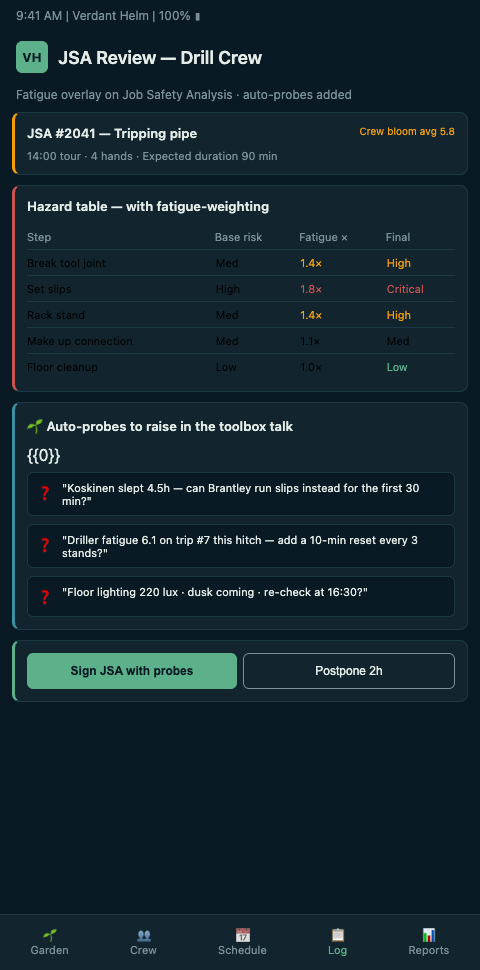
The framework rests on four practices. First, JSA depth scales with crew state. When the garden shows the executing crew in the top quartile, the standard 10-minute review runs as trained. When the crew sits in a trough, the driller runs a longer review with one change: an assigned "fresh set of eyes" (often a rested crew member from the other tour) walks the hazards with the group, asking three structured questions. This is not a paperwork change; it is a staffing move surfaced by the garden view. The three structured questions are drawn from the task-specific hazard register and rotate so the crew does not learn to anticipate them.
Second, template drift detection. The system tracks how much of today's JSA text matches the previous five JSAs for the same task. A drift score above 95% when the crew is fatigued flags a review-quality risk. OSHA's drilling JSA process explicitly requires a fresh hazard review on each execution, not a reuse of previous text (OSHA eTool Oil and Gas Well Drilling JSA Process). ABS's offshore JSA guidance carries the same expectation with a team-participation criterion (ABS Guidance Notes on JSA for Marine and Offshore Industries). Drift in itself is not always bad — repetitive tasks produce repetitive JSAs — but drift combined with crew wilt is a red flag that the review has become ceremonial.
Third, signature context. The JSA record captures each signer's current bed score alongside the signature. The record is not a gating mechanism in the normal case; it is evidence. When the HSE auditor asks "what was the state of the crew who signed this JSA?" the answer is a chart, not a memory. The evidence flows both ways: a JSA signed by a bloomed crew that still produced a near-miss tells the toolpusher the issue is not fatigue but something else (training, equipment, procedure), which is useful diagnostic information.
Fourth, supervisor loop. The toolpusher reviews a daily digest showing JSAs closed on fatigued crews, not every JSA. The review is by exception. IOGP's guidance on integrating JSA with permit-to-work treats the two as a single operational-readiness decision, and the garden data rides on that same decision without asking supervisors to run a new form (IOGP Report 577 JSA and Permit to Work). Existing JSA template libraries used across oilfield operations show how common the template-reuse pattern already is (BasinCheck JSA Template library) — the reuse is efficient when the crew is fresh and risky when it is not.
Advanced Tactics for Quality Review Under Fatigue
Three tactics make the practice stick on a live drill floor. The first is the "one-minute hazard rebuild." Instead of reading the template top-to-bottom, the driller asks the crew to name the three hazards on today's task that differ from yesterday. A fatigued crew struggles with this prompt. The struggle is the signal. If the crew cannot name three, the review slows down and the toolpusher gets a flag. This practice runs on any JSA form and takes less than two minutes. The struggle itself is diagnostically useful — it tells the toolpusher that the crew has stopped seeing the task fresh, which is a leading indicator regardless of whether today's hazards are new.
The second is the rotating challenger. A named crew member (selected by the garden view as the least wilted in the group) is explicitly assigned to challenge at least one hazard control on each JSA during a fatigue window. The challenger does not slow the review; they force engagement. Over a 21-day hitch, every crew member rotates into the challenger role, which builds the habit across the crew roster. The challenger role also has a cultural effect: it normalizes questioning within the crew, which reduces the implicit hierarchy that otherwise keeps junior roustabouts silent during a review.
The third is linking the JSA review to the permit-to-work gate. The permit-to-work crew energy integration treats the JSA as a precondition, and the garden data flows in one place for both. For dropped-object tasks specifically, the JSA review is the last structured opportunity to catch the precursor; dropped-object precursors hiding in energy dip curves shows how the same energy data flags risk before the tool falls. The equivalent bridge practice on cargo vessels — COLREGS drill timing on tired watchkeepers — runs the same playbook in a different regulatory frame.
A fourth tactic is the post-task debrief. A 90-second conversation at the end of each task about what the JSA missed (or anticipated well) creates a learning loop the review on its own cannot. The debrief feeds back into the template library, so the next JSA for the same task carries the lesson. This is how template drift becomes template evolution — the template genuinely improves across hitches rather than ossifying.
Common mistakes include treating the JSA review as a compliance artifact rather than a decision point, letting the driller run the review alone (which eliminates team participation by design), and trusting night-tour JSAs at the same depth as day-tour. A less obvious trap: the JSA that closes "perfectly" in 60 seconds is a warning sign, not a success. A real review has friction. Another subtle pattern is the "veteran trap" — where an experienced derrickhand or driller has seen the task so many times that their review runs on autopilot; the garden view catches this by flagging JSA duration that falls below the crew's own historical median when the crew is also wilted.
Walk One Hitch of JSAs
If you run a drilling supervisor or toolpusher role, pull the last 20 JSAs from your most recent hitch. Score the template drift, the average signature time, and the hitch day for each. A pattern usually emerges in under an hour, and the pattern is typically more actionable than a theoretical analysis because it sits inside your own rig's specific task mix.
Verdant Helm then gives OIMs and toolpushers a way to surface that pattern prospectively, at the point where the next JSA is about to be run, on the next tired crew, before the elevator swings. The prospective view is where the value lives; the retrospective analysis is where the case for the prospective view comes from. Book a review: send us two weeks of JSA metadata and we will return a garden overlay and three practice changes you can run on the next hitch — focused on the specific task categories where your review quality has drifted the most, with clear ownership for each change so the tailgate meeting on the next morning puts the new practice into the hands of the driller who runs the next JSA.