Split-Shift Mud Engineer Rotations With Garden Signals
The 90-Minute Flag
A mud engineer on a semi-sub in the Gulf of Mexico ran a rheology sweep at 02:00 on day 13 of a 21-day hitch. The 12-on/12-off pattern had her covering night-tour fluid checks on top of an extended morning handover session the previous day that had compressed her off-time into a 9-hour window. At 05:10, she flagged that the chloride trend in the pit returns did not match the drill floor's flow readings — a potential saltwater influx signal. The well behaved; the driller adjusted the weight and the formation held.
The garden record, reconstructed after the fact, showed that the same engineer at a full-bloom state on day 4 had caught equivalent signals in roughly half the time. The 90 minutes between what the garden predicted and what actually happened was the fatigue margin. The well did not exploit it. The next well might. The mud engineer role is a specialist detection function, and the margin between catching a signal in 30 minutes versus 90 minutes is not a productivity metric; it is a safety metric that shifts the probability of a well-control event along a continuous curve.
A systematic review of shift schedules on North Sea oil and gas installations documents the cumulative effects of 12-hour rotations on performance, sleep, and safety — with specialist technical roles showing distinct degradation curves from the general crew (Shift schedules on North Sea oil/gas installations systematic review). Field studies of shift work on modern drilling rigs confirm the same pattern in practice on active units (Shift work at a modern offshore drilling rig).
Naturalistic research across Gulf of Mexico offshore platforms shows fatigue accumulation over the rotation with a particular inflection in the second half of the hitch (Impacts of Rotating Shiftwork on Worker Fatigue Gulf of Mexico). A simulator study of fatigue indicators in 12-hour day and night shifts during offshore well control scenarios quantifies how drilling specialists' indicators drift across a split-shift cycle (Fatigue indicators of 12-hour day and night shifts in simulated offshore well control scenarios). Rigzone's industry reference on the mud-engineer role describes the scope and typical duty cycle across a hitch (Rigzone What does a drilling fluids engineer do). The role depends on pattern-recognition speed; pattern-recognition speed depends on cognitive state.
The Mud-Engineer Garden Bed
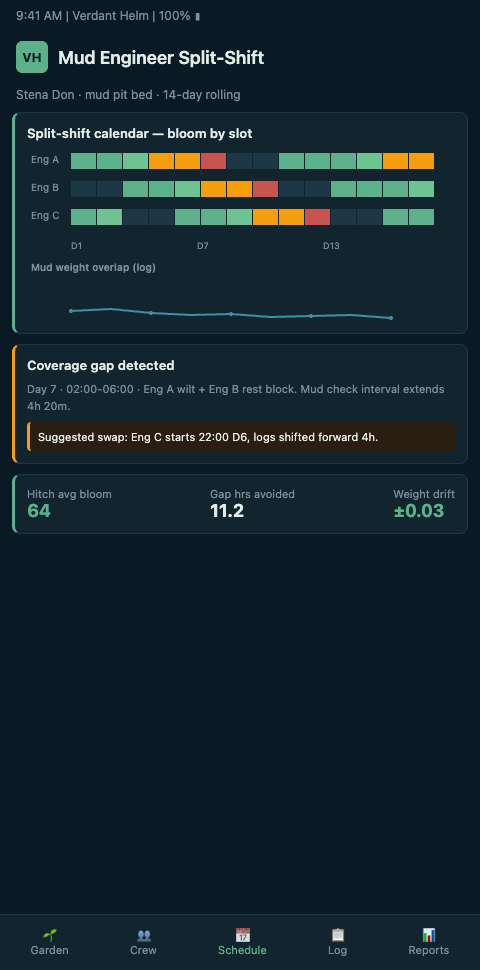
Verdant Helm treats the mud engineer as a specific perennial with a distinct bloom pattern. Unlike drill floor crew who work in pairs and have peer-check redundancy, the mud engineer often works alone or in a two-person split across the tour. The garden bed for this role has fewer plants and thinner margins. When the perennial wilts, there is no second plant in the bed picking up the slack. The split-shift garden design protects this role with explicit structural choices rather than relying on the engineer to self-manage. Self-management works when the engineer is at full bloom; it fails predictably in the late-hitch, late-tour windows that matter most.
The framework rests on four design moves. First, the split-shift boundary is the diagnostic window. The mud engineer's state at the end of their 12-hour tour is a better predictor of the next-tour signal-detection than the start state, and the garden captures both. A wilt score at end-of-tour above a threshold triggers a structured handover to the incoming engineer, not just a form exchange. The structured handover walks through active chloride trends, recent pit-volume anomalies, and any formation signals flagged in the previous 8 hours, with the outgoing engineer explicitly narrating what she is not sure about.
Second, rheology-sweep scheduling. The sweeps are time-flexible within wider bounds; the garden view moves the demanding sweeps into the engineer's bloom windows where possible and leaves the routine pit checks for the wilt windows. Third, chloride-trend cross-check. When the engineer's state sits in a wilt and a chloride or flow signal appears, the system routes the observation to the mud logger or senior drilling engineer for a second look, reducing the cost of a late flag. IPIECA's companion guidance on managing fatigue in the workplace gives the IOGP-linked framework that includes technical specialists in fatigue-risk management, not only rotating crew (Ipieca Managing Fatigue in the Workplace).
Fourth, the split-shift roster itself. Some rigs run the mud engineer as a 24-hour on-call; others split 12/12. The garden data surfaces which pattern produces the most stable detection performance for a given rig and crew, and the toolpusher can experiment across hitches to find the configuration that matches the rig's operational profile.
Existing crew-management tools for offshore oil and gas handle rotation scheduling, compliance, and replacement workflows at the contract layer (Ascertra Propeople Crew Management Software). The garden layer adds the cognitive-state view that connects the roster to the outcome — chloride detection speed, rheology-sweep quality, pit-volume anomaly catch rate. These are not abstract metrics; they are the specific detection functions that separate a clean bit run from a well-control event, and they track the mud engineer's cognitive state more closely than they track training hours or years of experience.
Advanced Tactics for Split-Shift Rotations
Three tactics sharpen the practice. The first is the peer-pairing schedule. If the rig runs two mud engineers in a split pattern, the garden helps sequence their overlap so that the handover window sits at the highest combined state, not the lowest.
A handover at 19:00 between a day-wilted engineer and a night-recovering engineer is a worse transfer than a handover at 07:00 after a sleep cycle. The derrick team scheduling before the next trip uses the same handover-state logic; the mud engineer pattern is simply a thinner bed.
The pairing also considers skill mix — a more experienced engineer paired with a junior on opposite tours creates asymmetric coverage that the garden can balance across a hitch.
The second tactic is the pre-influx protocol. The mud engineer is one of the first lines of influx detection, and the cost of a late flag is well-understood in the industry. When the garden shows a wilt window arriving during a section of elevated kick risk (new formation top, narrow margin, cement job recovery), the OIM considers a temporary second-person presence or a senior engineer call-in. This is not a doubled roster for the whole hitch; it is a targeted reinforcement for the window where the bed is thinnest. The parallel practice on offshore wind — rotating blade teams with garden transfer — shows how the same targeted-reinforcement pattern applies to thin specialist rosters.
The third tactic is handover-signal capture. The handover safety signal leak analysis applies directly; the mud engineer handover is one of the highest-leverage moments in the whole hitch for catching chloride-trend or rheology-drift signals. The garden view lengthens the handover structurally when both engineers are wilted, and shortens it when both are bloomed. The handover also cross-references the mud logger's data stream, which provides an independent observation against the mud engineer's own narrative.
A fourth tactic is workload visualization for the drilling supervisor. The mud engineer's workload over a hitch is often invisible to the drilling supervisor, who focuses on the drill floor tempo. The garden surfaces the engineer's workload alongside the floor tempo so the supervisor can see when his production schedule is stacking demands on a wilted mud engineer. The supervisor's decisions then account for the thin bed rather than assuming flat-line availability.
Common mistakes include running the mud engineer as a single-point-of-knowledge role with no peer cross-check (which amplifies fatigue-driven misses), scheduling rheology sweeps on a fixed clock rather than a garden-aware clock, and treating the mud engineer fatigue as a logistics problem rather than a detection-speed problem. A subtle trap: the engineer who has worked the same well for three hitches develops pattern-assumption that speeds pattern-recognition when fresh and misses novel signals when wilted. The garden surfaces this dependency. Another trap is underestimating the cognitive load of shared data streams — an engineer who is also maintaining the mud-log display, fielding shore-office queries, and running sampling schedules is carrying three workloads, each of which decays differently under fatigue.
Map the Next Hitch
If you run a toolpusher or OIM role and the mud engineer is on a split-shift pattern, pull the last hitch of pit-volume and chloride-detection logs, line them up against tour boundaries and hitch day, and see where the slow flags cluster. The pattern usually points to a single tour transition or a recurring late-night sweep that lands in a trough. Verdant Helm gives drilling supervisors the forward view to sequence rheology sweeps and cross-check protocols around the engineer's actual cognitive state. Send us one hitch of mud-engineering logs and we will return a garden overlay with three scheduling changes for the next hitch, each matched to a specific time window and role responsibility so the driller, the mud logger, and the mud engineer all know what the new rhythm looks like before day 1 of the next rotation starts.