How OIMs Replace Daily Stand-Downs With Energy Maps
The Script Nobody Reads, The Meeting Nobody Attends
06:00 on a semi-sub. 40 crew gather in the mess for the morning safety stand-down. The OIM reads a three-minute script from a laminated card — weather, operations summary, one safety topic of the day, the obligatory "any questions." Three hands go up. Two are about shift change logistics. One is about the espresso machine. The OIM dismisses the crew and everyone goes to the doghouse, the mud pit, the drill floor. The single document that would have actually changed the day's risk exposure — a honest picture of which crew members were running on three hours of sleep, which departments were carrying workload beyond ALARP threshold — never came up. It was never on the card.
IADC's own position on safety meetings acknowledges the problem by implication — the industry publishes hundreds of topics because rigs burn through the catalog and still struggle to make the meeting meaningful. Meanwhile, a Maersk Training piece on the OIM role describes the weight of daily communications on crew performance and the isolation of the OIM role when briefings become routine. Research on the OIM function published in ScienceDirect confirms daily briefings and decision points drive installation safety trajectory — but only when the briefing carries real information. When the script becomes ritual, the safety trajectory does not benefit.
An Energy Map Is a Garden the Crew Can See Together
What replaces the laminated card is not another document. It is a display — an energy map of the rig, projected on the mess screen, visible to every crew member at 06:00, showing the rig as a garden with named beds and colored plantings. The drill floor bed. The mud pit bed. The deck team. The galley. The marine team. Each plot shows a color gradient — green, amber, red — that represents the aggregated fatigue and load state of that department based on the last 24 hours of self-logged pulse, medic round observations, and operational workload. The OIM does not read a script. The OIM walks the crew through the map.
The shift from script-reading to map-reading changes the meeting's content. Instead of a topic chosen last week, the conversation is driven by which beds are showing wilt that morning. A drill floor team with two amber plantings and one red gets the first three minutes. A galley showing all green gets a check-in of 30 seconds. The permitting conversation that used to happen in a separate room at 07:30 happens in front of the whole crew at 06:10, anchored in the data everyone can see. Step Change in Safety's OIM guidance on offshore rotas and rest periods describes how the OIM translates fatigue and rota data into leadership action — the energy map is the interface that makes the translation visible.
The garden metaphor is what makes the map stick. Crews learn to read a garden faster than they learn to read a data table. A roustabout on day 12 can glance at the display and see that the deck bed is wilting in two spots, the galley is blooming, the drill floor has one perennial that needs pruning. The OIM does not have to explain what red means. The metaphor explains itself. That shared literacy is what the stand-down had been attempting and failing to build.
Verdant Helm designs the map with that literacy in mind. Each department tile carries the shape of the garden bed, with individual plantings rendered as small rosettes colored by the same five-parameter scoring a mud report uses — sleep debt, subjective sleepiness, handover quality, near-miss latency, workload exposure. Hover (or tap on the tablet version) and the parameter values appear. The crew member's identity is visible only to the OIM and toolpusher; for the crew, the display shows department-level aggregation. Privacy is preserved. The picture is not.
Drilling Contractor's coverage of offshore drilling's digital shift documents how rig-manager dashboards increasingly replace traditional briefings with live visualizations. Seadrill's data-driven performance approach shows the same shift on rig-wide performance displays that OIMs and toolpushers already read. The InfluxData case study of Seadrill's sensor-data dashboards goes further, describing the interface pattern Verdant Helm adapts for crew energy. The dashboards exist on the rig already. The gap has been crew state.
The Mess-Screen Energy Map
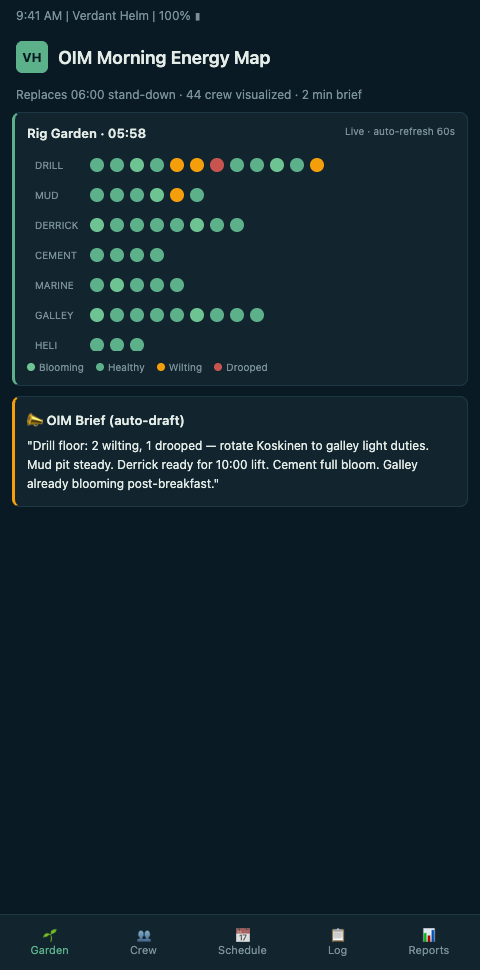
The mess-screen view the OIM walks through at 06:00 stays legible from any seat in the room. Seven or eight beds tiled to match the rig's organizational chart. A legend at the bottom-right. A trend strip along the bottom showing how each bed has shifted across the last seven days — so the OIM can point to a bed that has yellowed across three mornings and open a specific question. The meeting runs seven to nine minutes instead of three. Attendance, by visible measure, rises. The reason is simple: there is something on the screen worth reading.
The permit-to-work conversation becomes visibly connected to the map. The permit-to-work crew-energy integration post covers how the permit team uses the same garden state when a high-risk permit is being written later that morning. The tighter the coupling between the 06:00 meeting and the 07:30 permit review, the more the map becomes the rig's shared source of truth. The paper-logs-to-garden-display post covers the physical rollout — doghouse screen, mess screen, tablet access — that makes the map available everywhere it is needed.
Advanced Tactics: Making the Map Do Work
Three tactics keep the map from becoming the next laminated card. First, rotate the meeting lead. A map that only the OIM reads becomes the OIM's dashboard. A map that rotates through the OIM, the toolpusher, the rig medic, and the senior drilling supervisor becomes the rig's dashboard. Each lead brings different expertise to reading the garden. The rig medic will surface clinical signals the OIM misses. The toolpusher will surface operational load patterns the medic misses. Rotate the reading and the map becomes richer.
Second, tie the map to a specific decision each morning. The rule Verdant Helm suggests is that every morning meeting ends with one named change to the day's plan driven by the map — a handover extension, a JSA pair added, a permit deferred, a break repositioned. If the map does not change the plan, it is decorative. Crews read the rig by whether changes follow the map. Three mornings of no-change and the crew reads the map as theater.
Third, learn from hospitality crews who have solved the same meeting-replacement problem. Cruise-ship hotel directors face the same morning-briefing fatigue on a different cadence, and the hotel director toolkit for preempting complaints describes the garden-map pattern applied to hospitality crew state. The cross-industry parallel is worth reading because hospitality crews have been pattern-matching guest complaints to crew state longer than rigs have been pattern-matching incidents to crew state. The discipline transfers.
The common mistake is to install the map and continue to read the old script on top of it. The map then becomes background. The way the map earns its place is by being the meeting, not the visual aid to the meeting. That takes OIM discipline. Verdant Helm can produce the map. The OIM has to let the map run the room.
A fourth tactic is to connect the morning map to the evening handover. The map read at 06:00 sets the day's intention. The handover at 18:00 closes the loop — what the day actually did to the garden, which beds moved, which crew members crossed a threshold. When the morning OIM and the evening toolpusher read the same map at both ends of the day, the garden state propagates cleanly from shift to shift. That propagation is what makes the map a rig-level memory rather than a morning artifact.
A fifth tactic is to publish the map's weekly summary to the drilling contractor's onshore operations team. A weekly one-pager distilled from the garden display — which beds trended, what interventions were tried, what outcomes followed — turns the map into a fleet-level learning instrument. Onshore operations teams that receive those summaries start pattern-matching across rigs. A wilt trend showing up on three rigs in the same fleet in the same month is a fleet-level signal, not a rig-level anomaly. The map makes that signal visible. Without the summary, each rig solves the problem in isolation. With it, the fleet learns.
CTA: For OIMs Ready to Retire the Laminated Card
For an OIM running a rig where the 06:00 stand-down has become a ritual nobody believes, the practical next step is a two-hitch trial of the map-first meeting. Verdant Helm will build the garden state from one week of retrospective IADC daily reports and the last two weeks of fatigue logs you already have — no wearables required to start. Run the map-first meeting for two hitches, poll the crew on whether the 06:00 time is better spent, and compare near-miss reporting latency against the prior two hitches. The numbers will tell you whether the garden is worth keeping.
The trial's setup cost is lower than most OIMs expect. The mess-screen hardware is usually the display the rig already uses for weather and operations summaries. Verdant Helm feeds the garden state into that display as an additional page during the 06:00 window. The IADC daily reports and fatigue logs are sent once at trial start and then updated daily through the existing reporting flow. No new forms. No new interfaces for the crew to learn in the trial period.
The only behavioral change is what the OIM does with the seven minutes between 06:00 and 06:07. OIMs who have run the two-hitch trial describe the transition as surprisingly quiet — the crew stops noticing the script is gone by day four, and by day 10 the morning conversation is already anchored in the map. The honest comparison at hitch end is what decides the next move: keep the garden, return to the card, or tune both and run another hitch. Book a 30-minute call with an OIM who has kept it.