Reading Rig Crew Energy Like a Drilling Fluid Report
Why Crews Trust the Mud Report But Not the Fatigue Log
A mud engineer drops a daily report at the toolpusher's door on a drillship in the Gulf. It is a single page. Viscosity, pH, yield point, gel strength at 10 seconds and 10 minutes, plastic viscosity, solids percentage, chloride content, and two or three trend columns that show the shift in each parameter across the last seven days. The toolpusher reads it in 90 seconds, asks one clarifying question, and signs. On the same rig, the HSE coordinator hands over a binder of fatigue self-assessment forms. The toolpusher thanks them, stacks it on the filing cabinet, and never reads it. Both documents claim to describe the rig's safety state. Only one gets acted on.
The gap is not about the truth of the data. It is about how the data is presented. A SLB Defining Series reference on mud logging describes mud reports as the industry's clearest example of real-time telemetry — every parameter chosen because it changes predictively with hole condition, every trend read because experience has taught operators what matters. A Pegasus Vertex guide to daily mud reports goes further, documenting the visual conventions and parameter-watching logic that lets a driller spot trouble in a glance. Fatigue logs have never been given the same design discipline. Crews fill them in because they have to, toolpushers file them because they must, and neither side trusts the output. The signal is there. The reading practice is not.
Crew Energy as a Perennial Garden You Can Report On
The shift that Verdant Helm is built around is simple: treat crew energy as telemetry with the same rigour a mud engineer brings to a daily fluid report. Every crew member becomes a perennial in the garden — a planting with known seasonality, known water needs, known signs of wilt. The report is not a form crew fill in once a week. It is a living display the toolpusher reads every shift, the OIM reads every morning, and the HSE coordinator can reference any time the audit lands.
IOGP Report 626, the industry FRMS framework, already treats fatigue as a monitored signal rather than a soft topic. The gap between 626 and most rig implementations is that the signal is collected but not displayed in a way operators read. A mud report has five or six parameters on page one and a trend chart. A fatigue report should have the same. Sleep debt, subjective sleepiness, handover-note quality, near-miss latency, and workload exposure — five parameters with trend arrows. That is the daily crew-energy report Verdant Helm produces.
The garden framing is not decorative. A Shipowners Club piece on wearables for marine fatigue documents a pilot where wearables and mobile apps turned fatigue into a measured, reportable vital. The operators running that pilot treated it exactly like mud density — a parameter you watch every shift. The wearable produced the number. The interface made it readable. A PMC paper on biomathematical fatigue modeling shows how sleep and work inputs convert into operator-readable telemetry, the same way dial-in readings convert into mud parameters. Fatigue Science's technology overview describes biomathematical scoring that mirrors how drillers track fluid parameters in real time. The science is settled. The design discipline is the bottleneck.
Verdant Helm closes that bottleneck by building the crew-energy display with the same conventions as a mud report — parameter, current reading, trend arrow, comparable reference, action threshold. When a crew member's sleep debt rises three nights in a row, the row lights up the way a rising chloride reading lights up a mud log. When a department's handover-note quality drops below rolling average, the bed is flagged as wilting. The toolpusher does not have to learn a new language. The format already matches the discipline they practice twelve times a day.
A BSEE research report on real-time monitoring of offshore well construction makes the regulatory case: continuous telemetry is the direction of drilling monitoring, and the same principle applies to crew monitoring. A Drilling Contractor market report on offshore drilling's digital turn documents how operators are standardizing live rig reports as decision surfaces. Crew energy has to be on that surface, or the decisions will keep being made from a stale binder.
The Daily Energy Report
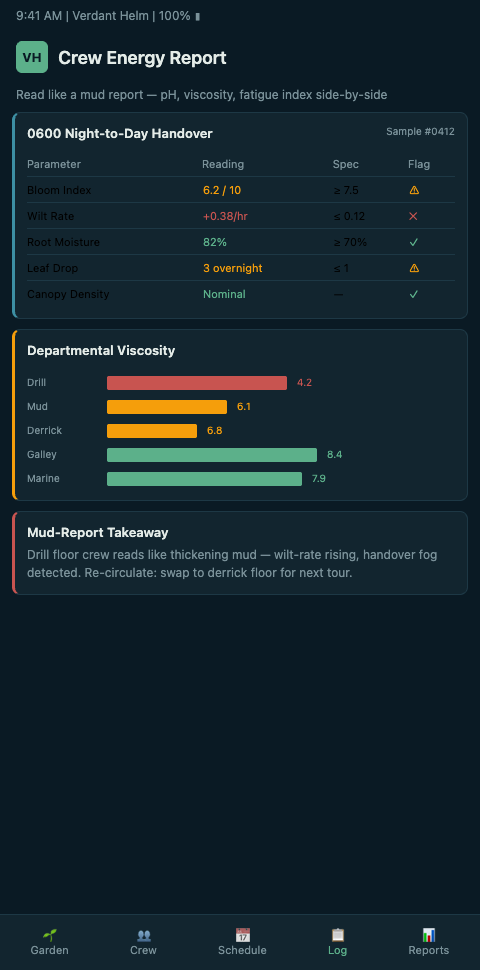
The daily energy report the toolpusher reads at 06:00 looks deliberately like the mud report they read at 06:05. Five core parameters run down the left edge: department sleep debt, subjective sleepiness score, handover-note quality index, near-miss report latency, and cumulative workload exposure. Each has a current value, a seven-day trend arrow, and an action threshold with a colored indicator when crossed. The bottom third of the report carries the same kind of free-text note a mud engineer writes — "derrickhand team showing sleep debt accumulation; recommend reschedule of tomorrow's trip." The toolpusher dashboard onboarding post covers how that reading habit gets established in week one.
The visual convention matters because rigs already have a rig-wide garden display for other telemetry. The rig-wide energy garden display post describes how the crew-energy view replaces paper logs and becomes a shared reading surface in the doghouse, the mud logger's office, and the OIM's room. Crew look at it the way they look at the weather board. That is the telemetry literacy Verdant Helm develops.
Advanced Tactics: Reading the Energy Report in Real Operations
Three tactics convert the report from a document into a decision tool. First, teach the telemetry literacy to the crew directly. A roustabout who understands that their sleep debt appears as a reading — not a judgment — will be honest in the self-log. Crews trust the mud report because they understand what each parameter measures. The same transparency has to apply to the energy report. Print the parameter definitions in the mess, post them in the mud-logger office, and let any crew member ask what their row says. The deep-sea cargo post on OOW alertness reading covers how navigation watchkeepers are learning the same reading discipline for ECDIS-adjacent alertness data.
Second, calibrate the thresholds to the rig. A generic dashboard with generic alert levels will flag too often or too rarely, and either failure mode erodes trust. The Verdant Helm approach is to seed thresholds from IOGP 626 reference values and then let the OIM and toolpusher tune over the first three hitches. That tuning is the same work a mud engineer does adjusting alarm limits to well conditions. It is not a one-time config.
Third, read across parameters, not each in isolation. Rising sleep debt by itself is manageable. Rising sleep debt and dropping handover quality and increasing near-miss latency together are a pattern that predicts an incident. The report has to show parameter correlation visually — the same way a mud engineer reads rising viscosity against falling weight as a flag for a different problem than either alone. Verdant Helm's correlation view is the advanced reading surface. It is what separates a rig that uses the report as compliance from one that uses it as operations.
The common mistake is to bolt telemetry onto a rig without teaching the reading. A dashboard that sits in the OIM's office and never appears in the morning stand-down, the handover, or the JSA conversation is a dashboard that will be ignored. The mud report works because every driller and toolpusher reads it. The energy report has to earn the same daily habit, which means getting it into the meetings, the handovers, and the permits — not the monthly HSE review alone.
A fourth tactic is to close the loop from report to intervention. A mud report that flagged rising chlorides without triggering a treatment adjustment would lose credibility within a week. The same loop applies to the energy report. When the report flags rising sleep debt on the deck team, an intervention has to follow — a shift swap, a rescheduled task, an extended handover. The intervention must be logged on the report so the following day's reading shows the response. That loop is what makes the telemetry operational rather than decorative. Verdant Helm builds the intervention log into the report itself, which keeps the loop tight.
A fifth tactic is to let the report surface patterns that cross parameters. A single parameter rising is a note. Three parameters rising together is a pattern. Four parameters rising with a parallel rise in medic-round observations is a prediction. The report's correlation view is what separates a rig that reads one metric at a time from one that reads the garden as a system. Advanced readers on rigs that have run the platform for six or more hitches learn to read the correlation view first and then drill into individual parameters. That reading order — system to parameter, not parameter to system — is the sign of a mature crew-energy literacy.
CTA: For Toolpushers and Drilling Supervisors Ready to Read Crew Telemetry
For toolpushers or drilling supervisors who read a mud report every shift without thinking, the next test is to read a crew-energy report the same way for two hitches and see what changes. Verdant Helm will produce the five-parameter report for your rig starting from the logs you already keep. The mud engineer's discipline is already on the rig — the platform extends it to the crew. Spend a hitch reading both reports side by side and the telemetry literacy will transfer naturally.
Start the side-by-side reading at the 06:00 handover. Pin both reports to the doghouse wall. The mud engineer walks through the fluid parameters first, as they always do. The toolpusher then walks through the five crew-energy parameters in the same order and cadence. On day three the habit feels awkward. By day seven the crew starts asking about the amber row before the toolpusher does, which is the literacy taking hold. By day 14 the handover note quality is visibly higher because the outgoing toolpusher has been reading the parameter that measures it.
The shift that matters is not the software — it is the reading minute added to an existing ritual. Book a scoping call with a drilling supervisor on a comparable jackup or semi-sub who has run the two-hitch trial. The operational language they have built around the report is worth more than any printed datasheet, and they can walk through the specific parameter thresholds that worked for their rig versus the industry defaults Verdant Helm ships with.