Translating Rig Medic Rounds Into Garden-Based Signals
The Data Already Sitting in the Sick Bay
A rig medic on a North Sea semi-sub keeps a paper logbook in the clinic. In one recent 21-day hitch the book showed 42 walk-ins. 18 for minor musculoskeletal complaints. 11 for headaches. 7 for sleep aids or requests for something "to help with the night shift." 4 for GI complaints. 2 for minor lacerations. At the end of the hitch, the medic submitted the hitch summary to the onshore medical department — a one-page document listing totals and any serious case — and the paper logbook went back in the drawer. Nobody on the operational side saw the distribution. The OIM knew there had been no serious incidents. The toolpusher did not know that the deck team had generated six sleep-aid requests in the last seven days, clustered between days 10 and 14.
The gap is known at the industry level. A Drilling Contractor piece on offshore medics' expanding role describes how medic responsibilities have grown to include mental-health and fatigue observation, but the data flow from medic to operations remains mostly paper. Remote Medical International's industry article describes medic rounds as early-warning signals for crew health — a framing the industry endorses but few rigs operationalize. A practitioner account of a typical day as an offshore rig medic documents the walk-in patterns (musculoskeletal, minor complaints, sleep) that form the early signals — the same pattern the North Sea medic's paper log shows. The signals are there. The translation is not.
A Gardener's Eye for the Sick-Bay Signals
The Verdant Helm approach treats the rig medic's round and walk-in log as the gardener's morning walk through the garden — the most practiced, most observant, most honest reading of the crew state the rig has. The translation problem is getting that reading into the shared garden display without compromising medical confidentiality or adding paperwork to the medic's already-heavy day. The answer is a structured observation flow that captures categorical data, not individual records.
Each morning, the medic completes a tablet flow at the end of the round that takes about two minutes. Department by department, the flow records: aggregated walk-in count (no names), presenting category (musculoskeletal, sleep, headache, GI, skin, other), observation of crew behavior in the galley or corridor (alert, quiet, agitated, mixed), and any pattern the medic wants to flag for the OIM. The individual patient record stays in the clinic under the medic's sole control. The category data feeds the garden display.
That separation is what the medical-ethics and occupational-health literature supports. An Oxford Academic review of medical emergency response in offshore oil and gas provides a peer-reviewed overview of the offshore clinic role, sick-bay visits, and medic observational data — making clear that aggregated patterns can inform operations without violating individual confidentiality when the flow is designed correctly. A PMC systematic review of mental health and psychological wellbeing of maritime personnel reviews how maritime medics observe psychological signals and how those observations can inform dashboard translation without clinical over-reach. The ethics framework is workable. The design discipline is where Verdant Helm lives.
The garden metaphor helps crews understand why their sick-bay visit is being aggregated. Nobody wants the OIM to know they asked for ibuprofen. Nobody objects if the deck team's bed on the shared garden display is showing amber because the musculoskeletal walk-ins have doubled in four days. The individual is protected. The department's wilt is visible. The medic's gardener-eye reading becomes rig-level intelligence.
IOGP Report 626-1's Fatigue Information Sheets provide the Fatigue Impairment Checklist that maps physical and behavioral observations — exactly what medics already gather. The Verdant Helm flow adopts the same categorical structure so the data is comparable across rigs and auditable against industry standards. United Safety's review of vital-signs wearables for worker health monitoring covers adjacent telemetry that can corroborate medic observations — wearable-derived sleep and activity data joining medic-round observational data to strengthen the signal.
The translation produces one more output the paper logbook cannot: the crossover with self-logged fatigue pulses from the crew. When the deck team's aggregate self-log shows three days of yellowed pulses and the medic's round count shows four extra sleep-aid requests in the same window, the two signals confirm each other. When they diverge — self-log green but medic count climbing — the divergence itself is a signal worth reviewing. That correlation is the value. The medic has always known it. The garden display makes it legible to the OIM and toolpusher.
The Medic-to-Garden Signal Flow
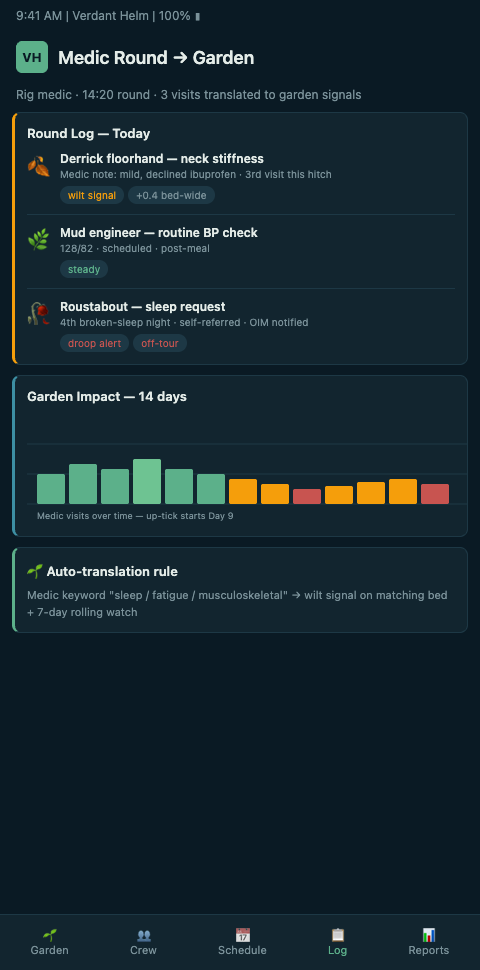
The flow the medic completes on the tablet at the end of morning rounds produces a department-level observation layer on the shared garden display. The individual walk-in records never leave the clinic. The aggregated categories update three beds on the display — the medic's observation view, the correlation view (medic vs self-log), and the trend view (medic observations across the hitch). The OIM reads the garden with an additional layer of ground truth. The medic retains clinical authority over every individual patient interaction. Both parties see each other's work without stepping on each other's toes.
The signal flow is deliberately asymmetric. The medic sees the full garden including the self-log data, because clinical reasoning benefits from context. The OIM sees only aggregated medic observations, because operational reasoning only needs the category-level trend. That asymmetry is what makes the flow work on rigs with strong medical-confidentiality cultures — the rig medic's clinical authority is never diluted, and the OIM never sees individual patient information regardless of operational pressure. Verdant Helm enforces the asymmetry at the data layer rather than through policy reminders.
A seasoned medic who has run the flow through two or three hitches describes the pattern as a gardener comparing their own morning notebook against the rig's shared weather board. The two sources speak the same language. The individual plants stay in the medic's notebook. The bed-level wilt shows up on the shared board. Both parties read the same garden without either party losing their professional boundary. That design is what turns the medic-round observation from a paper logbook into a rig-level capability.
Advanced Tactics: The Medic as Rig Gardener
Three tactics put the medic's observational expertise at the center of the rig's crew-state practice. First, pair the medic-round data with the roustabout fatigue log. The roustabout field guide on logging fatigue covers the self-log design that produces one side of the correlation.
When the two data sources converge, the garden state is high-confidence. When they diverge, the divergence itself is a specific signal that either the self-log design has drifted or an external stressor is affecting the crew. Either finding is actionable.
Second, tie medic observations to dropped-object precursor analysis. The dropped-object precursors energy dips post documents how the small signals that precede dropped-object incidents often show up in medic-round data earlier than in any operational metric. A musculoskeletal spike on the deck team is an operational precursor, not just a medical one. Tying the two data sources into the same garden view lets the toolpusher read dropped-object risk from medic-round patterns without waiting for a near-miss.
Third, cross-reference with adjacent-industry practice. Cruise-ship medical departments face the same translation problem on a different scale. The cruise director huddles garden actions post documents how cruise operators have started feeding medical department observations into daily operational briefings while preserving passenger and crew confidentiality. The discipline is transferable. Offshore rigs can benefit from the interface patterns cruise fleets have tested.
The common mistake is to overload the medic with administrative burden in pursuit of better data. A medic spending 20 minutes a day on a flow that does not produce visible operational change will abandon it within two hitches. The two-minute tablet flow has to be the only ask, and the OIM has to visibly read the output. When that loop closes, the medic becomes the rig's most valuable gardener, and the garden becomes a shared reading surface grounded in clinical reality.
A fourth tactic is to use medic-round observations to flag systemic ergonomic problems, not only individual fatigue. When the aggregate walk-in data shows musculoskeletal complaints clustering in one department or one task pattern, the signal points to equipment, layout, or procedure rather than individual crew state. A spike in wrist complaints on the mud pit that appears across multiple hitches is telling the rig something about pump handling ergonomics, not about roustabout sleep. The correlation view separates the two signals. Rigs that act on the ergonomic signal reduce the walk-in count at source.
A fifth tactic is to align the medic's observational flow with the rig medic's professional development plan. Offshore medics who contribute to a structured observational dataset build a portfolio of occupational-health analysis that transfers across contracts and employers. That portfolio is recognition the medic can take to any future role, and medics who see the career value of the work sustain the flow across years rather than hitches. The drilling contractor gains consistent data. The medic gains professional development. Both sides benefit from treating the observational flow as a contribution to the field, not rig-specific paperwork.
A sixth tactic is to use medic-round data to tune the self-logged fatigue pulse's thresholds over time. The medic's ground-truth observations act as a calibration signal for the self-log model — when the self-log is over-reporting relative to medic observations, the threshold logic gets tightened; when the self-log is under-reporting, the threshold logic loosens. That feedback loop keeps the garden display honest across hitches and crew changes. Rigs that run the loop for six months converge on a tuned model that reads their specific rig's dynamics rather than the generic industry baseline. The medic's gardener-eye becomes the model's calibrator, which closes the loop between observation and algorithm.
CTA: For OIMs and Rig Medics Building Shared Crew-State Visibility
For OIMs partnering with a rig medic on crew-state visibility, the right next step is a scoping conversation with the medic about what observations they already gather and what translation would preserve confidentiality while unlocking operational value. Verdant Helm's flow is designed with medic input from the pilot stage, not imposed on it. Book a 45-minute session with the medic and the toolpusher together — the interface discussions that come out of that room are worth more than any vendor demo.
Bring three artifacts to the scoping session. The medic's current paper logbook structure — the categories they already use when recording walk-ins. A summary of the last two hitches of walk-in counts by department. Any adverse-event or near-miss records from the same period where a medical factor was named in the root cause. Those three inputs let the Verdant Helm team map the rig's existing observational vocabulary into the garden flow, which means the medic does not learn a new taxonomy — the platform learns the medic's.
The toolpusher's role in the session is to surface the operational decisions they would make differently with department-level medic observations in hand. The OIM facilitates the conversation about confidentiality boundaries and confirms which aggregated signals reach line management. The scoping session ends with a named first-hitch rollout plan, a tablet placement location in the clinic, and a weekly review cadence for the medic and OIM to compare observed patterns against the self-log data. Rigs that run the scoping session before any software is installed have smoother rollouts and more trust-based use of the data than rigs where the technology lands before the conversation.