Zero-LTI Year on a Semi-Sub: Inside a Verdant Helm Rollout
What a Zero-LTI Year Actually Buys You
On 18 April 2010, a Transocean-operated semi-sub completed seven years without a lost-time incident. Twenty-two days earlier the rig had received a BP safety award for its occupational safety record. On 20 April 2010 the Macondo well blew out, killing eleven crew and triggering the largest marine oil spill in US history. The BP Deepwater Horizon Accident Investigation Report later documented that process-safety failures had been accumulating on the rig for weeks while its LTI record stayed perfect. The IADC Macondo Lessons analysis concluded that excellent occupational LTI records can coexist with catastrophic process-safety failure.
That context matters because the semi-sub in this postmortem — a Central North Sea drilling unit operating in about 90 metres of water — closed out 12 months without a lost-time incident in February 2026. The rig's OIM credits the garden view for catching three specific near-miss clusters that did not show up as LTIs but would have within two more hitches if left alone. He also volunteers that zero LTI does not prove the rig is safe. It proves occupational injuries did not cross a specific recordability threshold. Those are different claims.
The Three Clusters the Garden Surfaced
Verdant Helm renders crew energy as a living botanical garden. On this rig the OIM tracked 76 perennials across four crews. He learned to read which beds were blooming, which were wilting, and which sinks were pulling energy from crews that had not yet registered the load themselves. Three clusters surfaced over the 12-month drilling campaign, each of which the OIM would not have caught through conventional reporting.
Cluster one: the night-crew derrickhand. In late April 2025, a derrickhand's energy wilted across five consecutive night tours while his JSA submissions and PTW compliance stayed perfect. The garden showed the wilt. The toolpusher asked the medic to spot-check sleep in the cabin blocks and discovered the derrickhand's cabin neighbour was running a noisy portable fan during day sleep hours. Reassigning the cabin cost the rig nothing. The derrickhand's bloom recovered inside two hitches. Left alone, he would have been the one on the floor when the next unplanned tripping event hit.
Cluster two: the mid-hitch roustabout pool. In August 2025 the garden showed five roustabouts pooling energy into a single sink — the weekly heavy-lift planning exercise that had quietly expanded scope. None of them had filed fatigue reports. Two had dropped small objects in separate incidents within the same week. The OIM pulled the planning exercise back to its original scope and added a second roustabout to the heavy-lift crew. No dropped-object incidents recurred in the subsequent four hitches. The Drilling Contractor SIF prevention shift argues that LTI-focused metrics miss serious-injury-and-fatality precursors — the roustabout cluster was exactly the kind of precursor the garden caught.
Cluster three: the BOP test weekend. In November 2025 the garden showed the entire night crew wilting in the 48 hours before a scheduled BOP test. The OIM had seen this pattern on other rigs. He postponed the test by 18 hours, let the crew recover, and ran it with fresh tours. The Transocean 2023/2024 Sustainability Disclosure reports a 2024 TRIR of 0.15 and LTIR of 0.00 across 11.7 million labor hours — comparable to this rig's 365-day record and consistent with the view that preventive scheduling compounds over time.
The Twelve-Month Timeline the OIM Walks Visitors Through
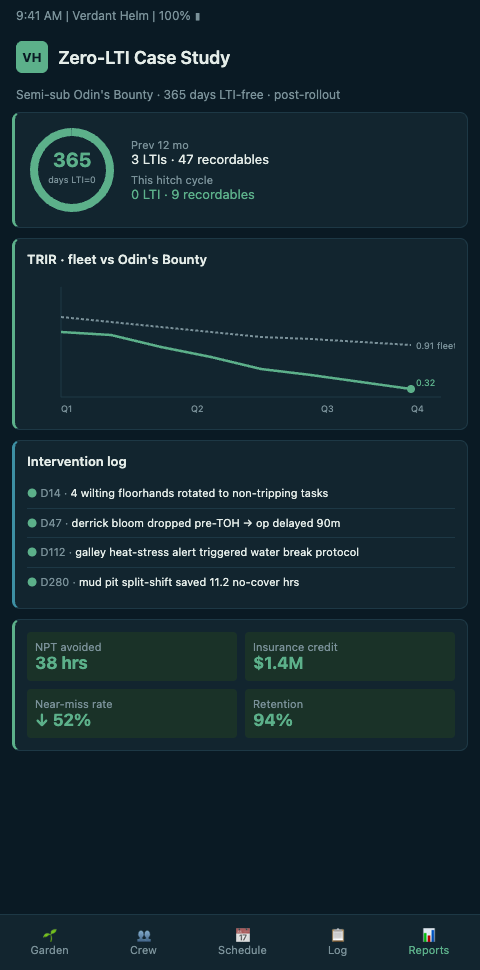
The OIM keeps a printed timeline on the wall of the operations office. Twelve months across the horizontal axis, garden bloom state above, specific events below. Visiting auditors and peer OIMs are invited to read it left to right. The shape is informative: two clusters of wilt in the first quarter as the rig absorbed the initial rollout overhead, a smoother middle quarter as the crew internalised the tooling, the August roustabout cluster visible as a distinct sink event, the November BOP-test cluster as a sharper wilt, and an unusually steady fourth quarter with three small interventions that kept the beds tended through winter weather disruption.
The timeline also marks three events that did not become near-miss clusters. Two crew members flagged personal concerns during the hitch that would historically have been handled quietly; the OIM treated both as garden-relevant and pulled them from their primary duties for 24-48 hours. A contractor crew change included two first-hitch roustabouts whose baseline bloom was visibly lower than the rest of the bed, which the OIM addressed with paired duties rather than solo assignments for the first week. None of these showed up in conventional incident paperwork, and all three would have been invisible without the garden view.
The pattern visitors take away from the timeline wall is that the zero-LTI outcome was not produced by a single large intervention. It was produced by dozens of small interventions across 365 days, each informed by a garden state that would not have been legible without the platform. That framing matters when the operator's HSE director presents the rig to peer operators as a case study.
The OIM was explicit in the postmortem: a zero-LTI year is a necessary-but-not-sufficient marker. His own list of things the record does not prove:
- It does not prove the process-safety barriers held. Those require separate integrity audits.
- It does not prove the rig is safer than the prior year's LTI-positive rig. Small-number variance matters at 76 crew.
- It does not prove every near-miss was reported. The garden catches some that reporting misses, but not all.
What the record does prove, in his view: the rig's crew energy stayed inside tendable ranges across 12 months, three potentially-serious near-miss clusters were caught and resolved before becoming incidents, and the crew itself became more willing to flag emerging sinks because they had seen the garden respond. IOGP Safety Performance Indicators 2024 reports a 2024 contractor fatal accident rate of 0.84 across 87 countries, which gives context for how rare a clean year is at rig scale. The IADC Incident Statistics Program formally recognizes rigs that achieve one-year periods without lost-time or recordable incidents, and this semi-sub was submitted for that recognition.
The Honest Conversation About Attribution
The OIM was careful in peer conversations to separate correlation from causation. Across 365 days, many things changed on the rig besides the garden rollout — a new drilling supervisor rotated in during month four, a contract amendment in month seven changed how roustabout shifts were structured, and the drilling programme itself shifted from development work to appraisal drilling midway through. Attributing the zero-LTI outcome exclusively to the garden would be statistically indefensible.
What the OIM does claim is narrower and defensible. The three specific near-miss clusters — the night-crew derrickhand, the roustabout heavy-lift sink, the pre-BOP-test wilt — would not have been visible without the garden view, regardless of other changes. Each of those clusters had an identifiable resolution path that the OIM and his toolpusher executed. Whether those resolutions prevented specific incidents is probabilistic, but the mechanism connecting wilt pattern to reassignment to subsequent bloom recovery is observable in the data.
The HSE director who initially pushed for LTI as the success metric now uses the rig's postmortem as a reference case for three other rigs considering the same rollout. His framing has shifted to near-miss cluster resolution as the leading indicator and zero-LTI as a lagging artefact of that underlying discipline. That framing change at the director level is arguably the most durable outcome of the 365 days — more durable than the zero-LTI record itself, which statistical regression will likely break in year two or three on any rig over long enough horizons.
Advanced Tactics: Running the Rollout So Zero-LTI Is Not the Goal
The OIM made one specific rollout decision that the postmortem flagged as load-bearing. He refused to let the rollout be framed as an LTI-reduction initiative. When the operator's HSE director proposed making LTI the rollout success metric, the OIM pushed back and asked for near-miss cluster resolution to be the metric instead. The director agreed.
That framing decision mattered because LTI as a primary target creates perverse incentive to classify incidents as non-LTI, to delay medevacs, or to reassign injured crew to desk duty rather than record lost time. The new Incident Severity Rate metric from IADC, introduced at the 2026 IADC HSET Conference, is an industry-level acknowledgement that binary LTI tracking misses the shape of risk. Near-miss cluster resolution — which is what the garden actually enables — aligns the rollout with ISR-style thinking from the start.
The second tactic: the OIM refused to treat the garden as reportable to regulators. He used it for operational decisions only. HSE audit paperwork cited summary results in narrative form, not raw garden data.
That decision kept the crew from gaming the signal. If roustabouts had believed the garden would be read by UK HSE inspectors, they would have learned to present a specific bloom pattern regardless of their actual energy state.
Because they knew the OIM used it for his own scheduling decisions and nothing else, the signal stayed honest. For a sibling rollout story across 14 rigs, see the 14-rig North Sea deployment postmortem.
For a cross-industry peer, the megaship zero-incident postmortem shows similar framing decisions in cruise operations.
The Postmortem the OIM Wants You to Read
OIMs and drilling supervisors facing a multi-year drilling campaign on a single semi-sub or drillship should not let the operator frame their welfare rollout as an LTI-reduction program. Frame it as near-miss cluster resolution. Run Verdant Helm for 12 months, require quarterly postmortems of what the garden surfaced, and accept that the zero-LTI outcome is a lagging indicator of the real work. For contractor-level benchmarking context, the drilling contractor garden-health ranking shows how single-rig results compare across fleets. Book a 45-minute postmortem scoping call — we will walk through this semi-sub's three clusters in detail and what translated to other rigs.
The scoping call is deliberately structured around the three clusters rather than around a vendor pitch. The OIM who ran the 12 months joins the first 25 minutes to describe what each cluster looked like in real time, how he decided to intervene, and what the intervention actually cost. The remaining 20 minutes cover the framing choices that held across the campaign — the refusal to let LTI become the rollout metric, the decision to keep garden data out of regulator submissions, the quarterly postmortem cadence with the HSE director.
OIMs who attend the scoping call typically leave with two named framing commitments for their own campaign and one specific cluster-detection pattern they want to watch for on their own rig. The conversation is more valuable than any slide deck because the specifics of cabin-neighbor swaps, heavy-lift scope pull-backs, and BOP-test postponement decisions do not travel well in marketing copy. They travel through OIM-to-OIM conversation.