Sequencing Blade Inspections Around Team Fatigue Cycles
The Problem: Sequencing Wins, Handovers Lose
Blade inspection campaigns follow the weather. A leading-edge erosion (LEP) sweep across a 174-turbine North Sea field gets slotted into whatever window the metocean opens, and the rope access pair gets told which turbine to climb via a list that was built on Friday and partly rewritten on Tuesday. The drone crew feeds high-resolution imagery into an MDPI-reviewed workflow that combines LiDAR, thermal, and ultrasonic overlays; the rope team works off whichever version of the list reached the CTV that morning.
The Hornsea campaign ran 11 consecutive workable days in August across a Siemens Gamesa SG 7.0-154 fleet. Drone imagery flagged turbine H-47 with a 340mm LEP crack on the pressure side of blade B, requiring filler and overlam. The rope pair dispatched to the same sector climbed H-74, which had a 180mm erosion mark on the low-priority schedule. The repair tickets did not reconcile until the end-of-day debrief because the handover on day 11 had been a voice call between a drone operator finishing his 14/14 and a rope lead 19 hours into a shift that should have ended at hour 12.
The Ineaconsulting case literature already documents how salt-load accelerates LEP on offshore blades — particularly on blades running tip speeds above 85 m/s — and forces inspection cadence up; the quieter problem is that it also forces the human decision cadence up, and the decision layer is where the campaign breaks.
The gap is not drone accuracy or rope skill. Both are high. The gap is that the inspection sequence gets written against the weather envelope and then gets delivered through a team whose fatigue envelope is on a different clock. DOE's O&M roadmap puts each weather-limited blade visit at over $20K; the Springer opportunistic-maintenance work argues for batching blade repairs to amortize that cost. Batching works for the weather. It exhausts the humans.
The Solution: A Bloom Calendar for the Rope Team
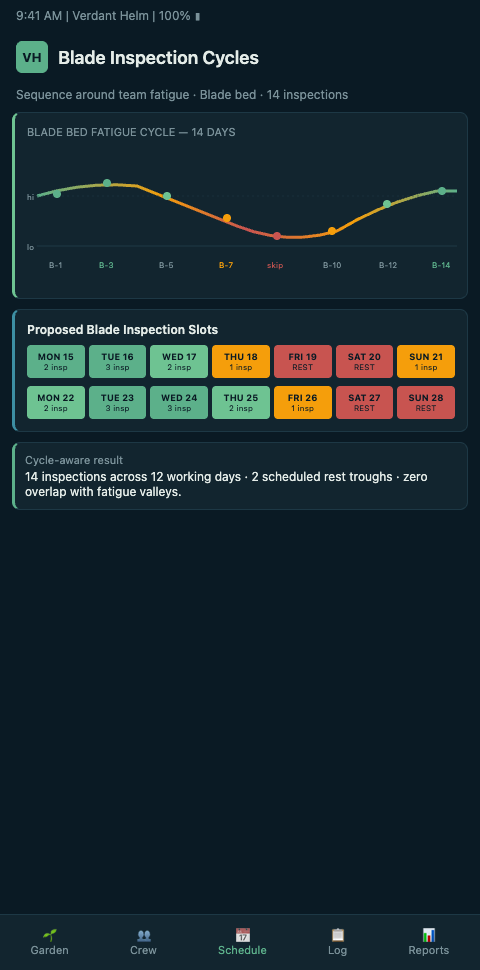
Verdant Helm treats the blade team as a garden bed with its own bloom cycle. Rope access pairs — whether IRATA ICOP or SPRAT certified — carry a bloom curve shaped by sleep, climb load, muscle recovery, and the micro-concussions of gangway transfers off a walk-to-work SOV or a 27m CTV bow fender. The dashboard reads that bloom curve and builds the inspection sequence against it, not against the raw weather envelope.
The bloom calendar has four signals. The first is rest-state entry — how each tech arrived on the SOV or shore base after the previous day. A pair that slept under 6 hours enters the day at amber bloom, regardless of the forecast. The second is repair-load history — how many rope hours, how many overlam applications, how many hub-entries in the trailing 72 hours. The third is weather-stress debt — how many transfer attempts the pair has absorbed, including the aborts that count as motion exposure without productive work. The fourth is the skill-match lens — some blade defects the drone flagged need ultrasonic interpretation that sits with one specific tech on the vessel, and that tech's garden state gates the whole sequence.
From those signals, Verdant Helm builds a sequence that looks nothing like the raw priority list. The drone's H-47 ticket is the right repair; the question is whether the pair in full bloom this morning matches H-47's ultrasonic-interpretation requirement. If not, the schedule pulls an adjacent lower-priority ticket that the bloomed pair can consume and holds H-47 for the afternoon pair or the next morning's crew. The garden analogy holds: a head gardener does not prune every rose on Monday; they prune the beds whose perennials are ready.
The sequencing also protects the handover layer. The 19-hour awake shift that sent the Hornsea rope team to the wrong rotor happened because nobody was watching the garden crossing at the handover itself. Verdant Helm treats the handover as its own perennial — it blooms when both teams are in compatible bloom states, and it wilts when one side is reading a ticket list through bloodshot eyes. The DNV blade-inspection standard already frames campaigns as drone-plus-rope-plus-monitoring workflows; the bloom calendar adds the human-state layer that makes the workflow survivable over a 14-day window.
The ScienceDirect comparative analysis of offshore blade maintenance strategies benchmarks classical versus reinforcement-learning schedules for blade fatigue risk reduction, and the pattern that wins is the one that treats both the component's fatigue and the technician's fatigue as coupled state variables. That is what the garden does on the dispatcher's screen — it shows them as one plot, not two.
Operators running blade campaigns alongside hub and nacelle work find that the same sequencing logic generalizes. The blade repair tech's log template gives the tech-side view of the same problem, and the rotating blade teams with garden-state transfer rules extends the bloom calendar across multiple rope crews at once.
Advanced Tactics
Four operator-grade patterns extend the bloom calendar. The first is the drone-to-rope latency window. Drone imagery arrives faster than rope capacity; the garden calendar sets a maximum defect-to-repair window for each severity class and sequences rope pairs to hit that window without running anyone past their bloom ceiling. A 340mm LEP crack has a 10-day repair ceiling in most Op manuals; a debonded trailing-edge panel on a Siemens Gamesa B75 blade has a 72-hour ceiling. The sequencer works backward from each ceiling and fits the rope pair whose bloom curve clears the work, rather than the pair who happens to be free.
The second is the paired-task amortization. When a rope pair already has IRATA certifications and GWO BST refreshed, they can batch adjacent turbines on a single lift — H-45, H-47, H-49 — but only if their bloom holds across four hours of rope work in the hub-plus-blade-root envelope without a full recovery. Verdant Helm runs a projection against each pair's bloom decay rate; batching only clears when the decay stays inside the envelope. Aggressive batching without the bloom check is what creates the handover-error pattern that cost the Hornsea campaign its day-11 miss.
The third is the LEP-season pre-seeding. Leading-edge erosion accelerates in winter months for North Sea fields — particularly October through February when the monthly mean Hs climbs above 2.2m and rain impact velocities rise. The inspection sequencer reads the Met Office LEP-season curve and pre-seats the rope pairs who carry the heaviest bloom into the heaviest weeks, so that the campaign peak aligns with the strongest gardens rather than the ones that happen to be on rotation. This is not rocket science; it is the missing step that offshore wind currently skips because nobody has the overlay.
The fourth is the interpretation handshake. Some defects require drone imagery to be interpreted alongside rope-side ultrasonic data before the filler decision is made. Verdant Helm builds the handshake into the bloom calendar — the drone interpreter and the ultrasonic rope tech must both be in green bloom at the moment of interpretation, or the ticket holds for the next window. The Springer opportunistic-maintenance methodology assumes this kind of decision coupling; in practice, it rarely gets enforced because the fatigue data is not on the same screen. Floating-wind campaigns on Hywind Tampen, where blade inspection doubles as a floater-motion audit, compound the handshake requirement — the interpreter also has to reconcile rotor motion signatures with the drone imagery, and both calls degrade fast when the interpreter is on their tenth rotation hour.
A fifth extension, which operators tend to add once the bloom calendar has run for a season, is the defect-mode to rope-skill matrix. Not every LEP defect needs the same hands. A pressure-side erosion mark on the outer third of a 75m Siemens Gamesa B75 blade needs the leading-edge protection (LEP) filler-and-overlam pair; a trailing-edge panel debond on the same blade needs the bonding-paste pair and takes an extra hour; a lightning-receptor continuity failure needs the electrical-certified tech on the pair. The matrix makes the skill-match visible alongside the bloom-match, so the sequencer does not send a bonded-rope-qualified pair to an LEP ticket just because their bloom reads green.
For teams running adjacent muster and training cycles on the same vessel, the muster drill energy collapse work describes a compatible pattern from the hospitality fleet side — the underlying idea that formal drills should never drag down the live garden applies identically to blade campaigns.
Get the Rope Calendar on the Dispatch Wall
Blade campaigns that still run off a static priority list will keep losing days to handover errors during the next LEP season. The Verdant Helm team runs a 45-minute campaign audit — pull a recent blade window from your field, overlay the rope team bloom curves we reconstruct from your shift logs, and show you exactly which sequence would have prevented the wrong-rotor miss. Offshore Wind O&M leads running IRATA or SPRAT rope teams on North Sea, Baltic, or Taiwan Strait fields use the same audit format. Most leads walk out with a revised sequencing rule they can test in their next rope dispatch.
Citations:
- MDPI: Review of Drone-Based Technologies for Wind Turbine Blade Inspection
- IRATA International: Renewable Energy
- DNV: Wind Turbine Inspections
- Springer: Optimizing Maintenance Strategy for Offshore Wind Turbines Blades Using Opportunistic Preventive Maintenance
- ScienceDirect: Comparative Analysis of Offshore Wind Blade Maintenance — RL vs Classical Strategies
- Ineaconsulting: Drones to Support Blade Inspection for Leading Edge Erosion
- DOE: Operations and Maintenance Roadmap for U.S. Offshore Wind
Book a campaign audit with the Verdant Helm team to re-sequence your next blade window.