Fatigue-Weighted SLAs in Offshore Wind O&M Contracts
The Clause That Punishes the Wrong Party
An opco's legal team signs a 15-year O&M service agreement with an OEM. The availability warranty reads 94% in year one, stepping to 97% by year five. Clifford Chance's briefing on offshore wind O&M agreements walks through the standard architecture — availability warranties, SLAs, carveouts, liquidated-damages caps — and their follow-up guidance on O&M agreement issues for wind turbines confirms the typical 94-96% year-one availability stepping to 97-98% later. The clause does not distinguish between a gearbox that fails at 3am and a gearbox climb that doesn't happen because the only qualified tech on the SOV is carrying three days of sleep debt. Both drop availability. The LDs fire.
The asymmetry is bigger than it looks. When a gearbox fails, the OEM is contractually and operationally responsible, and the incentives align. When a climb is missed for fatigue reasons, the opco pays the LD while the crew-management choices driving the miss were owned by the opco itself. PEAK Wind's service agreement key items guide treats this as a practitioner issue with no clean contractual answer. The SLA was built for a hardware era and has not caught up with a labour-constrained one.
A parallel problem sits on the OEM side. OEMs under flat availability warranties have no direct mechanism to reward opcos that maintain healthy crew states, so an opco's crew-management investment does not show up in the service agreement's pricing structure. This is a dead weight — the opco bears the full cost of the telemetry rollout, and the commercial benefit to the OEM (fewer emergency call-outs, less reactive dispatch, smoother parts planning) goes uncaptured. A structural clause redesign rebalances this: opcos that run fatigue-weighted programmes get preferential contract terms, OEMs get better planning data, and the industry's overall O&M efficiency improves.
Growing a Fatigue-Weighted SLA
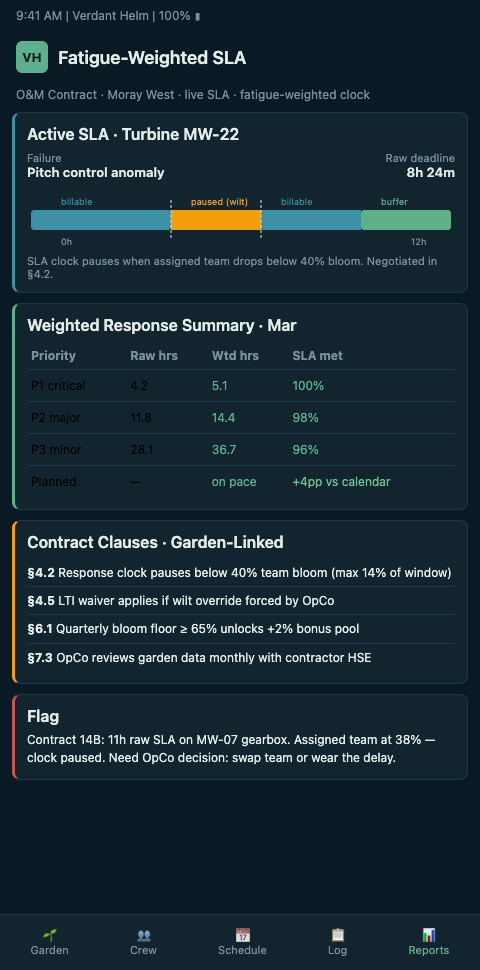
Treat the service agreement as a contract over a living garden, not a fixed asset. The OEM and opco agree up front that availability is measured against a fatigue-adjusted baseline: a climb not executed because the tech's bloom state reads red under a pre-agreed schema does not count as downtime against the availability warranty, provided the garden-state evidence is there. Verdant Helm's continuous stream becomes the evidentiary substrate — bloom-state history, recovery-ledger balance, and wilt-event timestamps for the relevant tech across the relevant window, exportable as a contract-grade report.
The structure has three moving parts. First, the opco and OEM agree on a shared bloom-state schema at contract signing, using the same standardised colour definitions the opco uses internally. Second, a fatigue-carveout clause defines the conditions under which a downtime event is excluded from availability calculation — typically, a tech in documented pruned state plus a forecast-weighted intensity score above a pre-agreed threshold. Third, the carveout is capped, so the clause cannot swallow the whole warranty; a typical cap might be 40 basis points of annual availability, enough to cover a hard hot-window season without gutting the contract's commercial logic.
A worked example clarifies the mechanics. Suppose an opco's 200-turbine fleet has a 96% availability warranty in year three, with liquidated damages of £8,000 per 0.1% of availability missed below the threshold. Without the fatigue-weighted clause, a season that ends at 95.3% triggers £56,000 of LDs. With a 40-basis-point fatigue carveout, the opco documents 38 basis points of downtime attributable to documented pruned-state events during high-intensity windows and presents the evidence archive through the agreed verification process. The revised availability calculation lands at 95.68%, and the LDs fire on the 0.32% that actually reflects hardware or logistics downtime. The $8,000 per 0.1% continues to matter; the clause just puts the LDs on the events the OEM can actually influence.
The $12 billion O&M market makes this the right moment. Wood Mackenzie forecasts offshore wind O&M to grow 16% annually to $12 billion by 2029, and their opinion piece on how O&M will adapt to offshore wind's rise flags SLA innovation as a central theme as subsidies wane and operators need more nuanced contract terms. DNV's O&M strategy writeup for offshore wind describes their OMCAM model projecting 30-year opex including availability performance, and DNV's wind turbine warranty and verification work across 800+ turbines is the independent-verifier layer that makes a fatigue-weighted SLA bilaterally auditable.
Insurance pricing is the quieter force pushing the same direction. Underwriters pricing offshore wind operational policies are beginning to ask questions about workforce fatigue management and its evidence base, and opcos with a documented continuous-telemetry programme find themselves on the better side of the underwriting conversation. A fatigue-weighted SLA backed by an auditable bloom-state archive is not just an O&M instrument; it is also an insurance instrument, because the same evidence that carves out availability liability demonstrates active risk management in the loss-prevention file. Opcos that understand the dual-use value of the evidence archive extract more commercial leverage per unit of telemetry investment than those who treat it only as an O&M artifact.
For the OEM, the clause is not pure giveaway. In exchange for accepting fatigue carveouts, the OEM gets access to bloom-state data that materially informs predictive maintenance — knowing which climbs were deferred because the crew was wilting tightens the OEM's own intensity planning and reduces emergency dispatch costs. The contract becomes a two-way data exchange rather than a one-way penalty structure.
Precedent exists in adjacent sectors. Aviation lease agreements have long included fatigue-adjusted utilisation clauses, and offshore oil has carried fatigue-risk carveouts in select jack-up rig contracts for more than a decade. Wind is late to this evolution partly because the SLA templates were imported from onshore wind, where crew-state issues were structurally smaller. The $12 billion market's growth forces the alignment. Opcos that bring the fatigue-weighted clause to the negotiating table now, with Verdant Helm's bloom-state evidence behind them, shift the negotiation's starting position for every subsequent contract they sign — and, once two or three major opcos carry the clause, the OEM service playbook will standardise around it.
Advanced Tactics
Three negotiating moves separate a fatigue-weighted SLA that holds from one that unravels at year three.
First, specify the bloom-state schema as a contract annex, not a side letter. If the colour definitions live in a referenced document that either party can update, the carveout becomes contentious the first time it fires. Nail the schema in the contract itself: the four bloom colours, the specific input signals, the weighting, and the audit procedure. Any future change requires a formal amendment. This is friction, deliberately — friction keeps the clause honest.
Second, pre-agree the verifier. DNV, a comparable independent body, or a pre-defined third-party data escrow validates the bloom-state history that underpins any carveout claim. Without a named verifier, every carveout becomes a dispute. With one, disputes become exceptions rather than the default mode of the clause.
Third, tier the carveout by event type. A fatigue-driven climb deferral during a routine maintenance window is a different contractual event from a fatigue-driven deferral during a post-storm emergency response. Different caps, different verification requirements, different LD implications. A single flat carveout clause tries to cover too much ground and produces loopholes either way. Three or four tiered clauses, each narrowly defined, survive longer and produce cleaner incentives on both sides.
Fourth, negotiate the data-rights terms in parallel with the carveout terms. The bloom-state data is valuable to the OEM too, and a contract that lets the opco claim fatigue carveouts without granting the OEM access to the underlying evidence is not the contract that closes. The right terms give the OEM access to carveout-event bloom-state history for the purpose of verification and predictive maintenance calibration, with clear restrictions on use beyond those purposes. Getting the data-rights language right is often more contentious than the carveout cap itself.
Fifth, write the clause with a sunset-and-review mechanism. The first generation of fatigue-weighted SLAs will get some terms wrong — cap levels too tight, verification too burdensome, event tiers too coarse. A three-year review clause with mutual amendment rights lets both parties adjust based on real operational data rather than locking in first-draft mistakes for fifteen years. This is basic contract hygiene; the novelty of fatigue-weighting makes it essential to flag.
The SLA shift is part of a broader governance stack. Upstream, G+ safety dashboards fed by energy telemetry builds the sector-wide benchmark that makes contract schemas negotiable. Downstream, calendar rotations are dead is the crewing-policy reform that makes fatigue-carveout evidence rigorous enough to stand up in contract review. And for the sibling cargo sector, circadian energy gates in cargo ship SMS maps the same evidentiary shift onto deep-sea safety management systems, where the contractual parallel is the P&I club's loss-prevention expectations.
Bring Fatigue Weighting to the Next Contract Review
Offshore Wind Ops commercial leads with an O&M contract renewal in the next 24 months should draft a fatigue-carveout annex now. Verdant Helm's contract-export view generates the bloom-state evidence schema in a format ready for legal review, and running three months of continuous stream data through the proposed carveout logic before renewal gives the negotiation a data backbone the OEM cannot dismiss. That is what shifts a standard availability warranty into a fatigue-weighted one — and what rebalances a $12 billion market toward contracts that reflect how offshore wind actually operates.
Bring the insurance underwriter into the same conversation. The evidence archive that supports the OEM carveout is the same archive the underwriter wants to see during the next operational policy renewal, and running the two negotiations in parallel lets the commercial lead extract value from a single telemetry investment in two places. Opcos that treat the O&M SLA and the insurance policy as separate commercial surfaces typically pay for the telemetry rollout twice — once by absorbing the rollout cost without an offsetting SLA benefit, and a second time by paying premiums that do not yet reflect the operator's active fatigue-management programme.
Name the three signatories who will co-own the fatigue-carveout annex before drafting begins. The commercial lead who negotiates the contract terms. The HSE lead who owns the bloom-state schema and the evidence archive. The operations director who owns the operational discipline that makes the carveout defensible. Fatigue-weighted SLAs fail at year three almost always because one of those three roles changes hands without a handover document, and the incoming replacement lacks the context to defend the carveout during a disputed event. A signed three-way ownership document, filed with the contract itself, is the cheapest insurance against that drift. Contract hygiene is unglamorous; it is what keeps a first-generation fatigue-weighted SLA functional long enough to produce the data that informs the second-generation design, which is the real sector-level shift the $12 billion market needs.