Nacelle Safety Playbook for Borderline-Energy Days
The Problem: Checklists Do Not See Borderline Days
Nacelle work sits at the intersection of working-at-height, confined-space, and solo-pair protocols. GWO's BST standard covers the rescue and fire-awareness baseline, OSHA classifies the hub as a non-permit confined space (upgradable to permit-required during hot work), and RelyOn Nutec's practitioner guidance sets the pre-entry air-quality and rescue-readiness bar. All of it is well documented. All of it assumes the tech executing the checklist is in full bloom.
The Energy Institute toolbox bulletin on the hand-caught-between-hatch-and-nacelle-floor incident is the case the playbook designers keep staring at. The UK tech had climbed the 95m tower on a Vestas V164-8.0, worked inside the nacelle on a yaw-drive inspection, and descended the ladder at the end of a ten-hour day. The hatch closed on his right hand. He could not free himself. The rescue took 40 minutes. The public incident review covers the mechanics — hatch tolerance, ladder geometry, PPE — and lands on behavioral causation, which the ScienceDirect offshore wind H&S review backs up with data: 60% of working-at-height incidents in offshore wind track to behavioral failures tied to fatigue.
The playbook gap is not the checklist content. It is the assumption that the tech reading the checklist is at the same energy state as the tech who wrote it. A borderline-energy day — one where the tech is in amber bloom, slept poorly, or carries residual micro-fatigue from a week of climbs — reads the checklist the same way as a green-bloom day but does not execute it the same way. The Tandfonline scoping review on human factors in onshore and offshore wind identifies 13 factors shaping O&M safety, and the team/crew and task/environmental themes dominate; the ASSP Foundation working-in-pairs analysis adds climb-fatigue mitigation as a stand-alone axis. None of that shows up on the standard nacelle job pack.
The Solution: A Garden-Gated Nacelle Entry
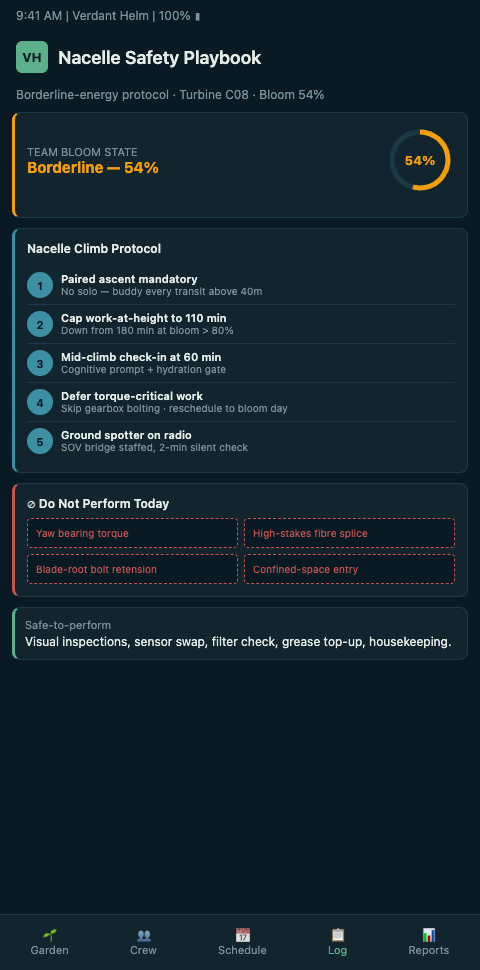
Verdant Helm treats the nacelle entry as a gated handoff inside the garden. Each technician's bloom state is a continuous reading; the hub and nacelle are the garden beds that only accept perennials above a specific bloom threshold. The playbook stops being a binary go/no-go and becomes a graded entry with three tiers.
Tier one is green bloom. The tech has slept 7+ hours, climbed fewer than two turbines in the prior 24, and scored clean on the morning HRV check if the vessel runs wearables. They enter the nacelle under the standard checklist, with the partner running the watch role from the hub. Full toolkit, full task scope, standard hot-work rules.
Tier two is amber bloom. The tech is inside the envelope but carrying a trough signal — one bad night, one long climb the day before, or an HRV reading that sits below their seasonal baseline. The playbook narrows the scope. No hot-work tasks. Ladder descent only with hatch-held discipline by the partner. Hub entry allowed only with confined-space air-quality pre-check logged in Verdant Helm and signed by the partner as well as the tech. Every transition point — ladder, hatch, platform — is an explicit verbal handshake, not an implicit trust.
Tier three is red bloom. No nacelle entry. The tech stays on the CTV or SOV, or works at the tower base on torque, cable, or inspection tasks that do not require climbing into the hub. The G+ Offshore Wind Physical Fitness Standard already sets a physical-fitness floor; tier three adds the state-of-day floor, which the fitness test does not measure.
The botanical framing matters because it gives the pair a shared vocabulary on the radio. "I'm at amber today" is a sentence that lands in a way "I'm tired" does not. The garden says the tech is not broken — they are a perennial at a particular point in their bloom cycle, and the rest of the garden adjusts. The partner shifts into a supervisory role, the supervisor on shore shifts the ticket, and the nacelle keeps its safety margin.
The playbook also restructures the hot-work decision. OSHA's classification of the hub as non-permit confined space that upgrades to permit-required during hot work creates a decision moment in the middle of the day. Verdant Helm pulls the bloom reading at that decision moment. An amber tech does not upgrade the hub to permit-required work. That is the sentence the Energy Institute incident review should have been able to cite two hours before the hatch closed.
Teams integrating this playbook into their near-miss program find that the incident pattern changes within a season. The same garden logic carries into near-miss reports mapped to fatigue troughs and into dashboard-led energy briefs that replace toolbox talks. For deep-sea bridge teams working a compatible problem, COLREGS drill timing under fatigued watchkeepers provides a parallel case.
Advanced Tactics
Four operator-grade extensions live on top of the tiered playbook. The first is the descent-decision micro-gate. The ladder descent is the phase the toolbox bulletin keeps flagging, and it is the phase that gets the least explicit protocol attention. Verdant Helm runs a descent readiness check in the last 15 minutes of the nacelle task — the partner reads the tech's current bloom against the descent baseline, and if the tech has drifted, the descent holds until a rest-and-hydrate pause clears the drift. On a Siemens Gamesa SG 14-222 DD, that descent is 138m on a service lift plus the final ladder section; on an older 3.6MW Vestas V112, it is a 95m ladder-only descent with intermediate rest platforms every 25m. The hatch-closing-on-hand incident is exactly the transition this micro-gate catches on the ladder-only profile.
The second is the work-in-pairs pairing rule. The ASSP Foundation working-in-pairs guidance is already doctrinal; the extension is that the pair must be bloom-compatible. Two amber techs cannot be paired for hub entry, even if the checklist clears both of them individually. The dashboard shows the pair's combined garden state, and an amber-amber pair gets split or down-scoped automatically. This rule is the one most operators resist at rollout and the one that produces the cleanest LTI reduction in the first quarter.
The third is the thermal-stress overlay. The MDPI and sciencedirect reviews on H&S factors both call out heat as a state multiplier — a summer nacelle in full sun runs 10-15°C above ambient, and the tech's bloom decays faster than on a cool day. On a GE Haliade-X nacelle during a Taiwan Strait July window, interior temperatures regularly exceed 42°C even with the nacelle vents open. Verdant Helm reads the nacelle interior temperature from the SCADA feed and adjusts the bloom threshold for the hub entry. A tech who would clear tier one at 15°C ambient may drop to tier two at 30°C; the playbook reflects that without the tech having to argue it on the radio.
The fourth is the rescue-readiness coupling. GWO BST's rescue-from-nacelle standard assumes a partner in full bloom. If the working pair is bloom-compatible but the designated rescue pair on the CTV has drifted below tier one, the supervisor gets a flag and reseats the rescue pair before the climb begins. The rescue pair's garden state is a live reading, not a planning assumption. On floating-wind sites like Kincardine or Hywind Tampen, the rescue pair often sits on the SOV rather than a CTV, and the deployment time from SOV davit launch to nacelle base is longer — making rescue-pair bloom state even more load-bearing than on fixed-bottom fields.
The fifth pattern, which operators tend to add after the first incident avoided by the tier gates, is the failure-mode-to-tier mapping. Some nacelle failure modes tolerate amber-tier work; others do not. A yaw-brake caliper inspection on a SG 14-222 DD is a tier-two-compatible task — torque readings, visual check, no hot work. A generator-bearing replacement on the same platform involves hub-entry, hot-work-adjacent handling, and a 6-hour task envelope; that sits at tier-one only. A Vestas V174 pitch-bearing alignment check is tier-one-only because the bolt-torque sequence requires interpretation under load. The dashboard maps each standard O&M task to its tier requirement, so the dispatcher does not have to make the call on the fly when the gardens shift mid-morning.
Upgrade the Playbook Before the Next Hot Window
A nacelle playbook that still treats the hatch-close incident as a behavioral outlier is one windy summer away from logging its own version. The Verdant Helm team will run a 45-minute playbook review — pull your current job pack, overlay the last 90 days of crew fatigue patterns we reconstruct from your shift and transfer logs, and mark the decision moments where the garden tiers would have changed the task scope. Offshore Wind O&M leads running GWO BST programs, G+ member operators, and tier-one IOCs entering floating-wind campaigns use the same format. Most leads walk out with three or four playbook edits they can roll into next week's shore brief.
Citations:
- GWO Basic Safety Training Standard
- OSHA Green Jobs: Wind Energy Confined Spaces
- Energy Institute Toolbox — Hand Caught Between Hatch and Nacelle Floor
- ScienceDirect: Offshore Wind H&S Review and Analysis
- Tandfonline: Human Factors in Onshore and Offshore Wind Scoping Review
- RelyOn Nutec: Enhancing Confined Space Safety in Wind Turbines
- ASSP Foundation: Wind Turbine Safety
Book a playbook review with the Verdant Helm team ahead of your next nacelle campaign.