How SOV Masters Plan Transit Cycles From Garden Curves
The Problem: The SOV Bridge Runs on Transit Logic, Not Garden Logic
Service Operation Vessels — SOVs — are the dominant crew-platform for offshore wind fields beyond roughly 30 km from shore. The Offshore Magazine reference on SOV deployment and the MarineLink coverage of demand drivers both fix the offshore cycle at two-to-four weeks with DP-assisted walk-to-work transfers. Ampelmann's write-up of motion-compensated gangways explains why the SOV-plus-gangway combination extends the transfer window relative to boat-landing CTVs. The Guide to an Offshore Wind Farm's service-vessel entry sets the crew-change cadence and on-board accommodation rules. Ulstein's OEM analysis makes the case that SOVs should be the default beyond that distance threshold.
The SOV master running the German Bight cycle was on the third week of an 18-day offshore rotation. His transit calendar was tight — daily field rounds, DP station-keeping by morning, walk-to-work transfers onto designated turbine clusters, vessel repositioning for the afternoon coverage, and evening recovery for the crew on board. That calendar got built in the scheduling office 30 days prior, with daily field coverage requirements per turbine and per role. The calendar was clean at the logistics layer.
What the calendar did not show was the tech-level bloom state by day. Day 14 produced a crossover the master could not have seen without it — a blade rope pair who had been green through days 3-10, amber through days 11-13, and crossed into deep amber on day 14. The day-14 ticket list required both blade pairs. The master had only one pair at green. The crew change was four days away at day 18. For four days, the field ran a day short of blade coverage — not because the SOV was missing a tech, but because the bench on board had no fresh blade pair to rotate.
The Carbon Trust Offshore Wind Accelerator logistics and O&M programme and the MDPI machine-learning metocean forecasting work both frame SOV planning as an information-integration problem. The information that does not integrate is the live garden state of the crew. The SOV master has SCADA, metocean, AIS, and crew-change logistics on his bridge. He does not have a garden curve. The day-14 crossover was in the data; the bridge did not see it.
The Solution: The Garden Curve on the Bridge
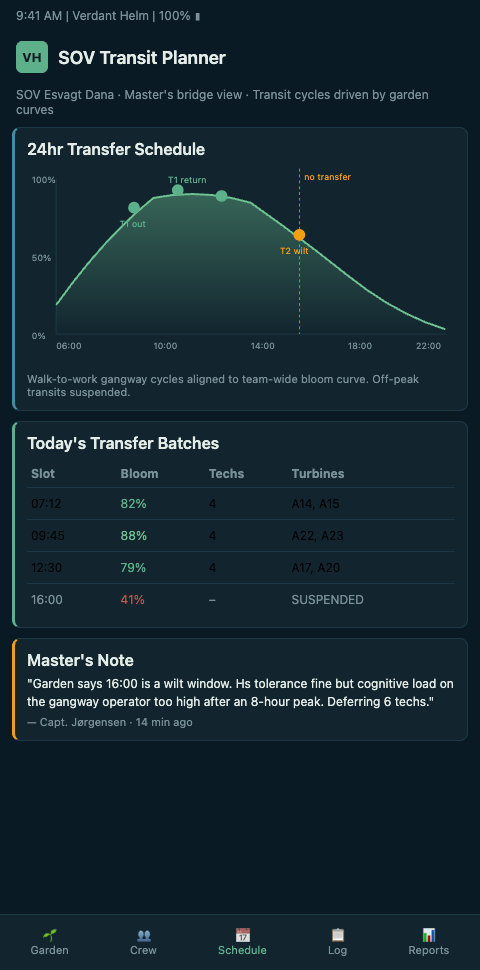
Verdant Helm pushes the live garden curve onto the SOV bridge. The master sees each perennial on the vessel — every tech, every rope pair, every specialist — as a bloom curve across the remaining days of the offshore cycle. The bed layout matches the field layout: rope access pairs in one bed, gearbox specialists in another, cable-work teams in a third. The sinks — the slow corners where energy pools low — are visible by color; the beds in full bloom are visible by color; the crossover dates are visible by mark.
The SOV master's core decision is how to spend the vessel-hours against the garden. A vessel-hour spent transferring a pair that will cross into amber tomorrow produces less field coverage than a vessel-hour spent transferring a fresh pair that has a six-day bloom ahead. The bridge display shows the projected bloom curve for each pair across the remaining cycle, and the master can re-sequence the transit and transfer order to stretch coverage.
The botanical framing matters on the bridge specifically because the master is making decisions in parallel with the DP and the transfer crew. The garden is a shared visual anchor — the bridge officer, the transfer supervisor, and the master can all see the same bed-and-bloom view, and they can name the day-14 crossover in plain language. "The blade bed crosses on day 14" is a sentence that lands faster than "our rope access availability drops below one full pair by Thursday morning." Both sentences mean the same thing. The first one lets the master do something about it on day 11.
The Ampelmann walk-to-work analysis gives the transfer-window extension; the garden adds the crew-window alignment. Together, they produce a vessel-day that consumes more workable hours without exhausting the bench. A SOV that lands 8 transfers a day through a 12-day peak window without the garden overlay arrives at day 13 with a bench that cannot hold the last five days. The garden-aware SOV paces the transfers — maybe 7 transfers on day 6, 8 on day 7, 6 on day 10 with a recovery allocation for the bloom curve — and arrives at day 13 with coverage intact.
The MDPI ML-metocean forecasting work feeds the upstream layer. Verdant Helm reads the forecast and projects the weather-window compression across the cycle, then re-plans the garden consumption accordingly. The SOV master sees not just today's garden but the garden across the next 10 days against the forecast, which is the view the scheduling office built the original calendar against — just with the crew state the office never had.
Planting an energy garden on your walk-to-work SOV gives the per-vessel rollout view, and jack-up campaign calendars driven by predictive energy is the adjacent WTIV version of the same planning frame. For cruise fleet teams carrying a compatible emotional-labor load, casino hosts and emotional labor debt gardens explores the same debt-accumulation pattern in a hospitality context.
Advanced Tactics
Four patterns sharpen the bridge display over a season. The first is the gangway-transfer load accounting. A walk-to-work transfer is lower stress than a boat-landing jump, but motion-compensated does not mean motion-free. The Ampelmann analysis notes the sea state envelope but not the micro-fatigue accumulation across 30 or 40 transfers in a cycle. Verdant Helm tracks transfer count and transfer sea-state per pair, and the bloom curve reflects the cumulative load. The SOV master sees which pairs have been carrying the high-transfer load and can reseat their field assignments.
The second is the cross-cycle bench depth planning. The Guide to an Offshore Wind Farm notes the two-to-four-week offshore cycle; the bench depth required to survive it depends on the field's turbine count and the predicted weather window across the cycle. Verdant Helm runs a bench-depth projection at the start of every cycle and compares it to the bench the crewing office actually seated. When the projection says the bench is light for the predicted window, the tool escalates to the shore crewing team before the vessel sails — not on day 14 after the crossover.
The third is the shared-SOV coordination. Some operators run two fields from one SOV, and the garden has to span both fields. The dashboard extends naturally — each field is a cluster of beds within the garden, and the master balances transit and transfer decisions across fields. The Carbon Trust OWA logistics work touches this coordination; the garden puts the crew-state constraint alongside the vessel-logistics constraint on the same screen.
The fourth is the crew-change handover note. The Ulstein SOV analysis and the Guide's crew-change cadence both treat the crew change as a data-poor handover. Verdant Helm generates a per-cycle garden handover — the outgoing crew's final bloom state, the carry-forward debt for the ones continuing, and the seating recommendation for the incoming rotation — that the master and the shore crewing office both read before the handover day. The next cycle starts with a calibrated bench instead of a clean-slate assumption.
Get the Garden on Your SOV Bridge
If your SOV is still running the cycle off a scheduling-office calendar with no live garden on the bridge, the day-14 crossover is a recurring feature of your season. The Verdant Helm team will run a per-vessel pilot — reconstruct the bloom curves from your last two offshore cycles, install the bridge display on the SOV, and train the master and bridge officers on the garden vocabulary across one cycle. SOV masters running German Bight, Dogger Bank, East Anglia, and US East Coast fields have used this format. Most masters flag two transfer re-sequences in the first week and one bench-depth adjustment before the next cycle dispatches.
Citations:
- Offshore Magazine: What Is an SOV? (Spinergie)
- Ampelmann: Walk-to-Work New Standard for Safe and Efficient Offshore Access
- Guide to an Offshore Wind Farm: Service Operation Vessels (O.1.3.2)
- MarineLink: SOVs — Analyzing Current, Future Demand Drivers
- The Carbon Trust: Logistics and O&M (Offshore Wind Accelerator)
- Ulstein: Why Service Operation Vessels Should Be the Standard at Offshore Wind Farms
- MDPI: Machine Learning-Based Forecasting of Metocean Data for Offshore Engineering
Book the per-vessel pilot with the Verdant Helm team before the next SOV cycle begins.