Tech Exhaustion Curves Inside a 10-Day Weather Window
Day One Looks Like a Gift
An ECMWF extended-range chart drops on a Friday showing ten days of Hs under 1.5m from the following Monday. The publicly accessible ECMWF 30-42 day extended-range charts give offshore planners a lead time that did not exist a decade ago, and HR Wallingford's forecaster tooling ties those charts to 10-day access windows with usable confidence. The dispatch reflex is predictable: stack six or seven climbs a day, push the full roster across the ten, and write the year against that single window.
The problem is not the window. The problem is day six. A probabilistic weather-window prediction methodology in the Journal of Marine Science and Engineering models the access probability, not the crew-load compounding that follows a stacked deployment. A 2025 Frontiers in Public Health scoping review of seafarer fatigue names consecutive work hours and watch systems as primary drivers of exhaustion, and a peer-reviewed PubMed study of offshore fatigue risk factors links cumulative shift hours to the curve's inflection. The 10-day window does not deliver a flat load. It delivers a compounding one.
The dispatcher's incentive to treat it as flat is real, too. The charterer has booked the CTV day rate. The operator is chasing a quarterly availability KPI. The SOV is stationed on-field and the transit-time budget says a returned rotation costs two productive days. The curve's bend on day six is therefore not an accident of physiology; it is the predictable outcome of every commercial and logistical pressure pointing in the same direction. A dispatcher who understands the curve still has to argue for it against a charterer's day-rate logic, and that argument is more defensible when the curve is backed by bloom-state evidence rather than a general appeal to fatigue.
Mapping the Curve Across Ten Days
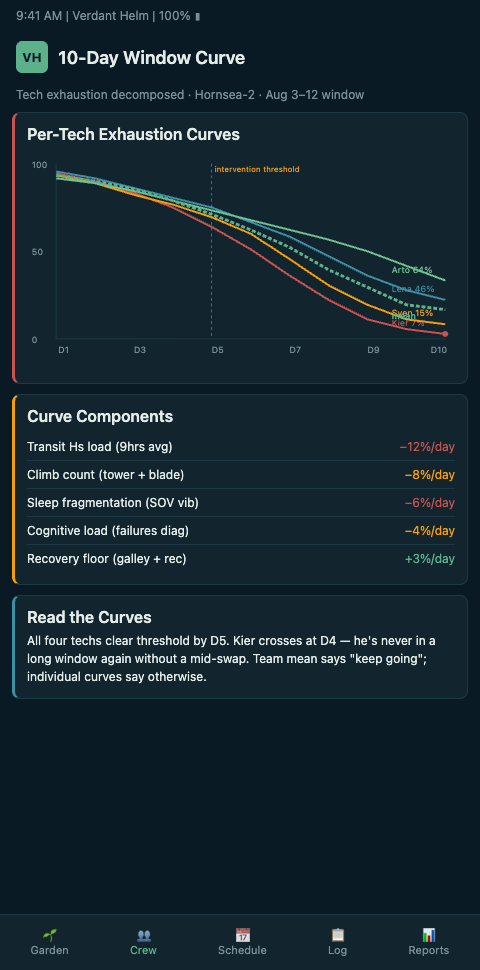
Read the roster as a garden of perennials with staggered bloom durations and the 10-day window as a single long hot spell. Days one and two are bright bloom: sleep debt near zero, physical readiness high, focus on climb mechanics sharp. Days three through five are the productive heart: the garden absorbs stacked climbs, recovery between shifts still works, logged transfer attempts trend clean. Day six is the first visible wilt — chronic sleep loss begins to surface, grip strength measurements on climb-assist devices drop measurably, and the near-miss register ticks up. Verdant Helm's curve view shows this as a color gradient sweeping across the 10-day timeline, with each tech's bed tracked individually.
The Applied Ergonomics paper on offshore day-shift fatigue over two weeks found post-shift fatigue scores rose with successive days-on-shift, with chronic sleep loss accumulating from roughly day five. That matches what the garden shows in practice. Days seven and eight are where the wilt spreads — a single tech's fatigue pattern becomes social, because shared mess hall fatigue norms move faster than individual recovery. Days nine and ten, if the window is actually worked at its full planned intensity, are where the reporting framework breaks: near-misses that would have been logged on day two go unreported, and the dispatcher's view of the roster decouples from its actual state.
The social contagion dynamic deserves its own attention in the curve model. When one experienced tech skips breakfast on day six, the behavioural cue propagates faster than individual recovery does — two techs skip breakfast on day seven, four on day eight. The garden view picks up the contagion because the meal-attendance signal tracks across the entire SOV cohort, not just individual beds. A contagion alert fires when three or more techs cross a recovery-marker threshold within 48 hours of each other, and the alert is treated as a cohort-level prune signal rather than individual prunes stacked. This matters because cohort wilts drive the cascade failures that individual prunes would not have prevented.
Physical load data confirms the shape. A 2022 Applied Ergonomics study of 27 wind techs over 110 workdays found higher objectively measured physical work demands on offshore versus onshore days — the offshore days themselves are heavier, before any stacked-window effect layers on. In garden terms: each offshore day draws more water from the bed than an onshore day. Stack ten of them and the soil runs dry.
Day-level specifics matter. Day three in a 10-day window is often the peak productive day — sleep from the SOV's first nights has normalised, the roster has found its rhythm, and the dispatcher is confident enough to push higher-intensity climbs. Day five is the first watch-out: sleep debt starts showing in wearable HRV trends about 36 hours before it shows in self-reported readiness ticks. Day seven is where CTV pair dynamics change — an experienced tech paired with a junior tech starts compensating for the junior's fatigue by taking a disproportionate share of the climb load, and the garden view catches this because both beds' bloom state moves in the same direction on the same days. Day nine is where the dispatcher faces a real choice: push the roster through or swap in shore-side reinforcement, and the 10-day curve's shape dictates which decision ages better.
Verdant Helm maps the curve with three inputs per tech per day: sleep duration (self-reported or wearable), climb count and intensity, and a forecast-weighted pressure score. The curve plots each tech's personal wilt trajectory across the ten days and fires a prune alert when the projected bloom state on day N would fall below the minimum safe threshold for a gearbox climb or a blade repair. The dispatcher sees not just today's state but the projected state three days forward, which is the lead time needed to reshape the deployment before the curve bends.
The curve's lead time matters operationally. A wilt event visible on day six is actionable if it was projected on day three — the opco can fly in reinforcement, shift non-critical climbs to the back half of the window, or swap a tech off the SOV during the next CTV return. A wilt event visible only on day six is not actionable at all; by the time the dispatcher sees it, the damage is in the ledger. The three-day projection is the minimum lead for logistics, and hitting that lead requires the continuous stream running through the first three days of the window, which is the architectural requirement that validates all the upstream investment.
Advanced Tactics
Three patterns bend the curve back inside a 10-day window rather than fighting it.
First, rotate the bed composition at day five, not day ten. The reflex pattern is to push the same roster the full window because each tech is "still technically fit." Garden logic says you swap a third of the roster at the inflection regardless — a tech who started day one in high bloom is a different resource on day six than on day one, and the fresh-planted beds flown out from shore carry the second half of the window. This costs one extra SOV rotation and one extra set of CTV transits. It is measurably cheaper than losing days seven through ten to spreading wilt.
Second, use the intensity tier, not the climb count, as the dispatch lever. Two gearbox climbs on day seven carry more load than five routine blade inspections on day three, and the garden view weights them accordingly. The temptation is to flatten dispatch to "four climbs per tech per day" as a shorthand rule. A 10-day window rewards teams that dispatch by bloom-weighted intensity instead, keeping high-intensity work inside the bright bloom days and pushing routine work to the wilt-edge days.
Third, build the day-eleven recovery plan before the window starts. Techs who work days one through ten under stacked load need an extended recovery cycle, and the ledger debit should be planned into the following rotation before the window opens. Verdant Helm generates a recovery-commitment view alongside the window deployment plan — the output is a two-document artifact, not a single dispatch sheet. Crewing managers who read only the dispatch half lose the next window because the ledger debt compounds into the next rotation.
Fourth, separate the "workable weather" decision from the "workable roster" decision. The ECMWF chart answers the first; the garden answers the second. Conflating the two produces the reflex that fills every workable hour with a climb. A proper dispatch cadence treats the weather window as the outer envelope and the bloom-state forecast as the inner envelope, and the actual deployment sits inside whichever is tighter. On many 10-day windows, the tighter envelope is the roster, not the sea state — and the crewing discipline is knowing when to hold back climbs the weather would permit.
Fifth, document the day-by-day curve from every 10-day window as a corpus. Each worked 10-day window adds a row to the opco's curve library, and the library drives the next window's forecast calibration. An opco with three seasons of stored curves has a calibration set nobody else in the sector has — it becomes a commercial asset in its own right. Verdant Helm archives the curves as structured datasets so the calibration survives staff turnover and platform upgrades without rebuild effort.
The curve is part of a larger intensity picture. A dataset of the 50,000 transfer-attempt dataset that 10-day windows compound in condensed form. The 14/14 rotation's own weakness — the 14/14 hot-weather rotation crack — is effectively a slower-motion version of the 10-day curve, and reading the two together clarifies where the rotation reform actually needs to land. For cargo-crew parallels, the eight-day warning for cognitive debt at sea traces an analogous inflection on deep-sea watchkeepers, and the modelling transfers directly back to offshore wind curves.
Read Your Next Window's Curve
Offshore Wind Ops dispatchers with a 10-day window on the long-range chart can book a walkthrough and build the curve view this week. Pull the last three 10-day windows the team worked, plot the incident log and tech-reported fatigue against them day by day, and overlay the bloom projection Verdant Helm generates against the same roster. The dispatch decisions the garden disagrees with on day six of a historical window are the ones to study most carefully before the next forecast drops. That is where the curve bends.
Use the retrospective curve as the training artifact for the next window's planning meeting. The crewing manager, the SOV master, and the CTV pair leads each bring a different lens to the same ten days — the manager remembers the pressure, the master remembers the roster's mood, and the pair leads remember which techs quietly absorbed the compounding load. Reading the three perspectives against the plotted curve usually converges on two or three specific decisions the next window should handle differently, and those two or three become the calibration rules the dispatcher carries into the live ECMWF chart.
Commit one specific tactic from the retrospective into the next window before the forecast drops. A written note that says "day-five partial rotation of two techs" is worth more than a general commitment to "read the curve closely" because it converts the retrospective into a scheduling constraint the dispatcher cannot silently walk back under charterer pressure. Crewing managers who write a single tactic per retrospective — and who defend it against the commercial pull when the forecast looks clean — build a scheduling discipline that compounds across three or four seasons into the opco's actual operational memory. That memory is what separates an opco whose 10-day windows keep bending the curve from one whose windows keep breaking on day six.