Capturing and Retrieving Industry Intelligence Quickly and Accurately
The Speed-Accuracy Tradeoff
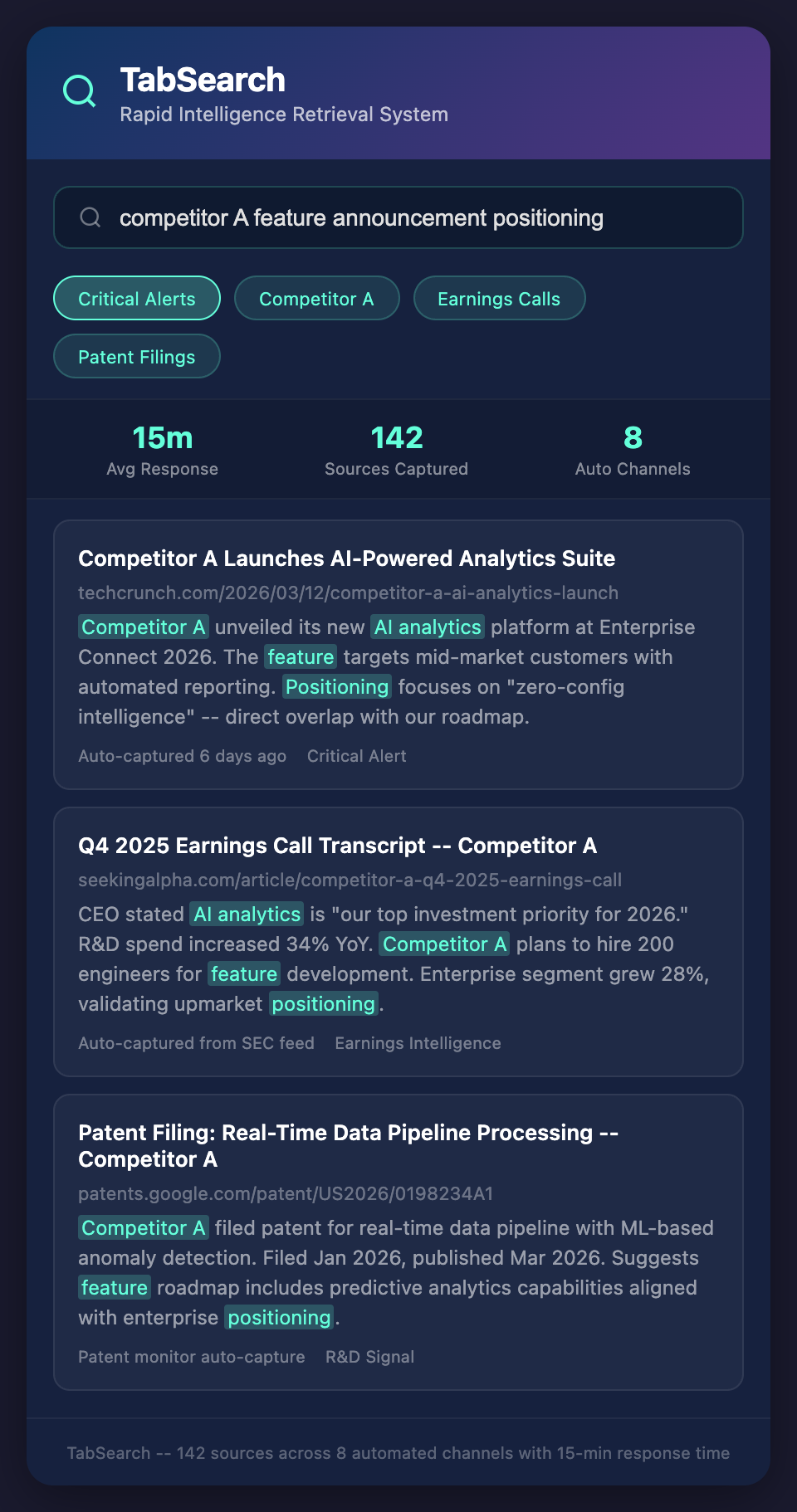
When Competitor A announces a major feature, your sales team needs to know immediately. Is this a threat? How do we position against it? What should messaging be?
Typical response:
-
Sales leader learns about announcement through customer call or email
-
They search for prior analysis of Competitor A's roadmap
-
They find related articles but not a comprehensive strategic assessment
-
They spend two hours re-reading past competitive analysis
-
They send guidance to sales team
-
Sales team has already been in customer meetings for an hour without this guidance
Total delay: 2-3 hours.
Fast, accurate intelligence systems cut this to 15 minutes:
-
System automatically detects Competitor A announcement
-
Surfaces all historical intelligence about them
-
Highlights most relevant previous analysis
-
Provides pre-drafted positioning guidance
-
Notifies leadership and sales simultaneously
The difference is systematization. The companies reacting fastest aren't the ones with better research—they're the ones with systems that capture and retrieve intelligence at speed.
The Capture Problem
Capture Fragmentation
Industry intelligence arrives through multiple channels:
-
News alerts go to email
-
Customer mentions are scattered through sales calls and emails
-
Earnings calls are announced via email, must be found and listened to
-
Analyst reports arrive via email or must be accessed through subscriptions
-
Social media requires active monitoring
-
Patent filings require database monitoring
-
Job postings must be actively monitored
-
Investor communications require visiting multiple websites
Without consolidation, capturing intelligence requires checking eight different sources daily. This quickly becomes unsustainable.
Capture Inconsistency
When multiple team members capture intelligence, it's captured inconsistently:
-
Some people save articles with notes; others save just the link
-
Some remember to add publication date; others don't
-
Some tag with competitor name; others leave it untagged
-
Some include direct quotes; others provide summary only
Inconsistency degrades searchability and usability.
Capture Burden
If capturing intelligence requires effort, it won't happen consistently. Users will bookmark articles but not save them to the intelligence system. They'll mention competitive moves in Slack but not log them. The intelligence system will fall behind reality.
A System for Rapid Capture and Retrieval
Automated Capture Infrastructure
News monitoring:
-
Set up alerts for your direct competitors (automatic capture to intelligence system)
-
Subscribe to industry news sources covering your market (RSS feeds to aggregator, tagged automatically)
-
Use a news monitoring service (Feedly, Google News, industry-specific services) that feeds content to your system
Earnings call and earnings report monitoring:
-
Subscribe to SEC filing emails for public competitors
-
Set up alerts for earnings call announcements
-
Automatically save earnings call transcripts when available
-
Automatically extract and tag competitor mentions
Job posting monitoring:
-
Use job board APIs to monitor competitor job postings
-
Tag by company and role type automatically
-
Flag new postings in competitive verticals or customer segments
Patent filing monitoring:
-
Monitor patent databases for filings from competitors
-
Automatically extract technology focus from patent titles and claims
-
Tag by innovation area (AI, analytics, integrations, etc.)
Social media and executive monitoring:
-
Use a social listening service (Brandwatch, Sprout Social, Hootsuite) to capture company mentions
-
Alerts for executives joining/leaving competitors
-
Alerts for competitor announcements on LinkedIn/Twitter
The goal: Intelligence should arrive in your system automatically, with minimal manual intervention.
Human-Powered Capture Infrastructure
Automated capture gets 80% of what you need. For the remaining 20%, enable easy human capture:
Browser extension:
-
One-click save of current article to intelligence system
-
Extension auto-fills competitor name, topic, and date from content
-
User just needs to add brief note and click save
-
Capture takes 15 seconds vs. 5 minutes if done manually
Email forwarding:
-
Intelligence team members can forward articles directly to a special email address
-
Email is automatically added to intelligence system with metadata from email headers
-
Extracting articles goes from "add to system manually" to "forward email"
Slack integration:
-
When articles are shared in intelligence channels, bot automatically captures them
-
Bot extracts URL, creates intelligence entry, asks for competitor and topic tags
-
Capture happens automatically; user just needs to tag
Mobile capture:
-
Mobile app lets field teams (sales, customer success) quickly capture customer intelligence
-
"Competitor mentioned" → one tap, competitor name, quick note, submitted
-
Designed for 20-second capture while in customer meeting
CRM integration:
-
Customer conversation notes in CRM are automatically scanned for competitor mentions
-
Mentions are surfaced to intelligence team for validation and capture
-
No additional user action required; happens automatically
Metadata Standardization
Captured intelligence should include standard metadata automatically:
Automatically extracted:
-
Source URL
-
Publication date
-
Source type (news article, earnings call, job posting, etc.)
-
Company mentioned
Auto-categorized but verifiable:
-
Competitor (extracted from article, confirmed by user)
-
Topic (auto-categorized by AI, can be overridden)
-
Confidence (based on source credibility)
User-provided:
-
Why you captured this (2-3 sentences)
-
Urgency level (routine, important, critical)
-
Recommended audience (who should see this?)
Fast capture means less metadata is manually entered. But the automatically extracted metadata should be sufficient for effective search and retrieval.
Retrieval Systems for Speed
Real-Time Alerting for Critical Intelligence
Not all intelligence requires manual retrieval. The most critical intelligence should proactively alert:
Alert when:
-
Competitor announces major feature
-
Competitor changes pricing
-
Competitor enters market segment you own
-
Competitor hires for roles in a market you're expanding into
-
Competitor acquisition or funding
Alert structure:
-
Send to C-suite and relevant teams within 30 minutes of detection
-
Include: What happened, why it matters, preliminary competitive positioning, recommended next steps
Alert system should be smart:
-
Don't alert on every competitor mention; alert only on material moves
-
Don't create alert fatigue; if three separate intelligence items arrive within 2 hours with same implication, alert once with all three
Quick-Access Retrieval for Ongoing Questions
For questions that come up regularly, enable instant access:
Saved reports:
-
"Competitor A profile" (all intelligence about them, sorted by recency)
-
"Pricing comparison" (all pricing intelligence across competitors)
-
"Market segment status" (which competitors own which segments?)
-
"Capability comparison" (feature matrix across competitors)
These shouldn't require research each time they're needed; they should be automatically generated from your intelligence database weekly or daily.
Search for Ad-Hoc Questions
For questions that emerge unexpectedly, search should be fast and accurate:
Search query: "Competitor B moving upmarket"
Results:
-
[1] Earnings call from Q4 2025 explicitly mentioning upmarket focus
-
[2] 3 customer interviews mentioning Competitor B in upmarket segment
-
[3] Job posting for "Enterprise Sales Manager" posted Jan 2026
-
[4] News article about their $50M enterprise contract
Results appear within 10 seconds, sorted by relevance, with key excerpts visible.
Implementation Timeline
Week 1-2: Establish Automated Capture
Set up news alerts, earnings monitoring, job posting monitoring. Goal: 80% of intelligence arrives automatically.
Week 3: Human-Powered Capture
Deploy browser extension, Slack integration. Enable team to quickly add remaining 20%.
Week 4: Test Retrieval Systems
Run mock scenarios. When Competitor A announces something, can you get to critical intelligence within 15 minutes?
Week 5+: Optimize and Expand
Based on testing, add more automation. Expand to additional competitors or intelligence sources.
Measuring Capture and Retrieval Effectiveness
Capture metrics:
-
How many sources are you capturing monthly?
-
What % arrives automatically vs. manually?
-
How consistent is metadata across sources?
Retrieval metrics:
-
Average time from competitive announcement to intelligence summary ready
-
How many ad-hoc intelligence requests can be answered within 30 minutes?
-
User satisfaction with search results
Business metrics:
-
Sales response time to competitive threats
-
Win rate against specific competitors (where you have superior intelligence)
-
Speed of strategic response to market shifts
Track these quarterly. Use data to guide what to automate next.
Avoiding Common Pitfalls
Pitfall 1: Building before understanding needs
Don't implement a massive capture system before understanding what intelligence actually gets used. Start with what your organization actually needs, then automate.
Pitfall 2: Capturing without retrieving
A database of captured intelligence is useless if nobody can find anything. Retrieval systems matter as much as capture.
Pitfall 3: Over-automating
Perfect automation of capturing intelligence you don't need is time wasted. Focus on automating the intelligence that drives decisions.
Pitfall 4: Underestimating integration
Most delay in intelligence systems comes from information silos, not from capture or retrieval. The key is integrating information from multiple sources and surfacing the synthesis.
The Competitive Advantage
Companies with fast, accurate intelligence systems make strategic decisions 2-3x faster than competitors. In fast-moving markets, that's the difference between winning and losing.
The companies not drowning in intelligence noise are systematizing their capture and retrieval. Start this week.
Transform scattered industry intelligence into instantly actionable insights. Join our waitlist to see how to build capture and retrieval systems that keep you ahead of competitive threats.