Competitive Intelligence Data Collection Methods That Actually Work
Why Competitive Intelligence Collection Fails
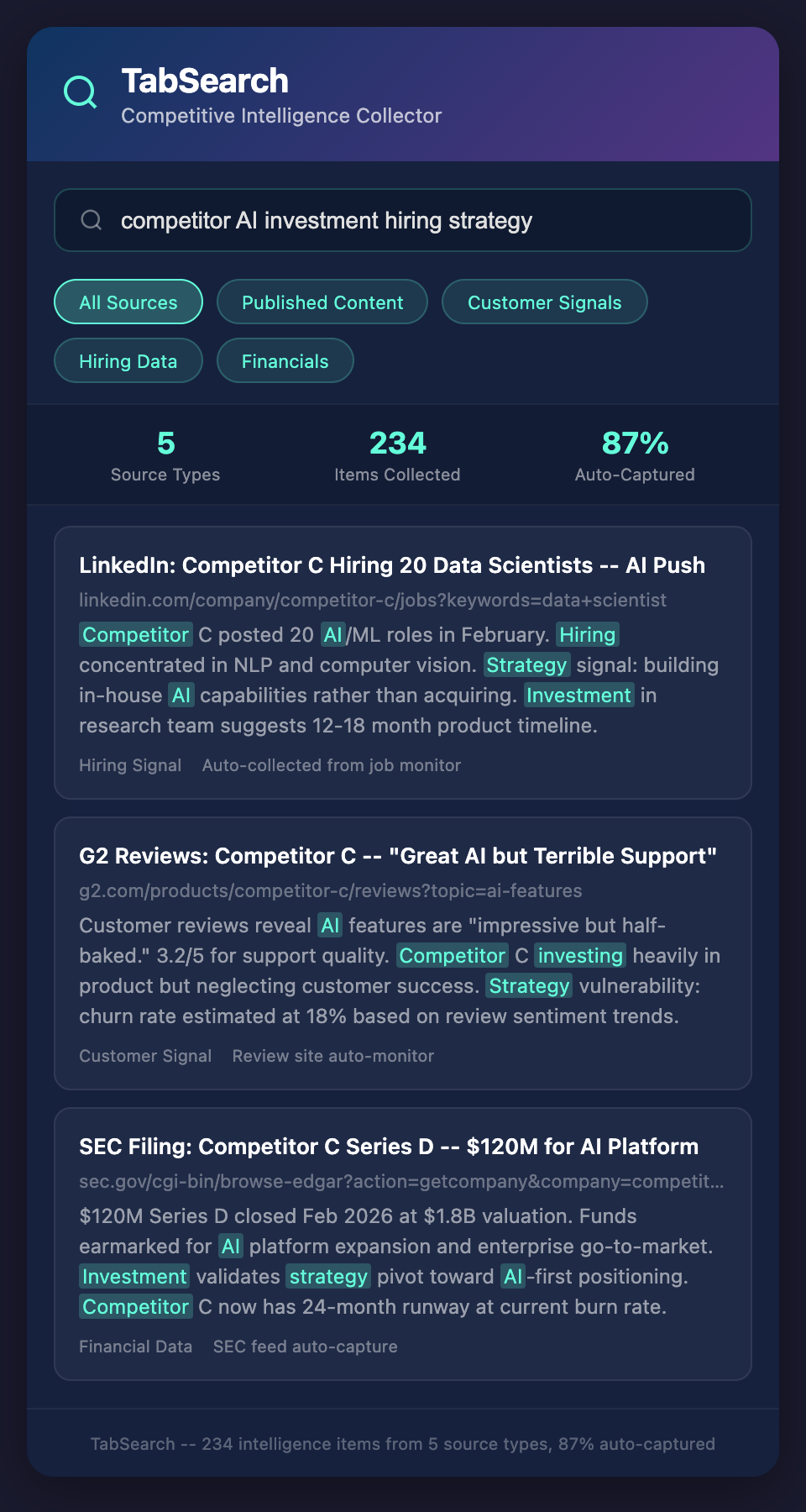
Most companies approach competitive intelligence haphazardly. A sales rep spots a competitor announcement. A product manager reads a tech article. An analyst attends a webinar. These insights exist in isolation—mentioned in Slack, forwarded in emails, filed in individual notebooks. Nothing connects them.
When the CEO asks "What are competitors doing in AI?" nobody can answer with confidence. The information exists somewhere. You just can't assemble it quickly enough to be useful.
The cost is real: You miss competitive moves until they're fully deployed. You make product decisions without complete market context. You price reactively instead of strategically.
Effective competitive intelligence requires systematic collection, not sporadic gathering.
The Data Collection Framework
Competitive intelligence falls into five categories, each requiring different collection methods:
1. Published Content
What it includes: News articles, press releases, blog posts, earnings calls, investor presentations, website content, social media announcements.
Why it matters: This is the earliest signal of major competitive moves. A competitor's blog post about new features often precedes the actual launch.
Collection method: Set up saved searches for competitor company names across news sites, industry publications, and tech blogs. Use RSS feeds from competitor blogs. Monitor their social accounts. Capture published content automatically—don't rely on manual checking.
2. Customer Signals
What it includes: Customer reviews, support tickets mentions, user feedback, social media complaints, analyst reviews, comparison websites.
Why it matters: Customers reveal competitor weaknesses and strengths through reviews. "Great product, terrible support" tells you about weak points. "Switched because of automation features" reveals competitive advantages.
Collection method: Monitor review sites in your category (G2, Capterra, Trustpilot, AppSumo). Set alerts for competitor mentions on social media. Monitor forums where your customers discuss solutions. Collect customer feedback systematically.
3. Hiring and Personnel Signals
What it includes: Job openings, LinkedIn profiles, hiring announcements, org changes, executive moves, departures.
Why it matters: Hiring patterns reveal strategic direction. A competitor hiring 20 data scientists signals AI investment. Departures of key talent reveal instability. Management changes forecast strategy shifts.
Collection method: Monitor competitor job boards. Set LinkedIn alerts for competitor company updates. Track executive changes through LinkedIn and industry news. Use LinkedIn to track team growth trajectories.
4. Financial and Legal Data
What it includes: Earnings reports, SEC filings, patent filings, acquisition announcements, funding rounds, litigation.
Why it matters: Financial data quantifies competitive strength and reveals investment priorities. Patent filings show R&D direction years in advance. Acquisitions signal capability building.
Collection method: Monitor SEC filings for competitors (10-K, 8-K filings). Set alerts for funding announcements. Track patent filings in your relevant categories. Monitor regulatory filings and litigation.
5. Industry and Ecosystem Intelligence
What it includes: Industry reports, analyst research, conference content, ecosystem announcements, partnership news, integration announcements.
Why it matters: You understand competitive positioning within broader market trends. Partnership announcements show strategic alliances. Integration announcements reveal product direction.
Collection method: Subscribe to relevant industry reports and analysts (Gartner, Forrester, etc.). Monitor conference speaker lineups and content. Track partnership announcements in your ecosystem.
Making Collection Systematic
Haphazard collection fails because it depends on people remembering to check sources. Systematic collection works because the sources come to you.
Establish collection workflows:
-
Automated feeds: Create RSS feeds and email alerts for each competitor across different source types. Get news, job openings, and social mentions delivered automatically.
-
Consolidated dashboard: All intelligence feeds arrive in one place. Sales team, product team, and executives can view them without searching multiple platforms.
-
Regular review cadence: Team reviews collected intelligence weekly. This isn't about reading everything—it's about noticing patterns that matter.
-
Tagging and organization: Tag intelligence by type (product move, pricing change, hiring, partnership) and category (serious, watch, minor). This enables pattern recognition.
-
Actionable synthesis: Monthly competitive briefings summarize what changed, what it means, and what action matters. Intelligence without synthesis remains noise.
The Data Capture Challenge
Most organizations collect competitive intelligence reactively. Someone sees something and mentions it. But by then, it's stale. By the time it's synthesized into a report, it's already two weeks old.
The solution is automated capture. Every relevant source is monitored continuously. Every mention of competitors is captured instantly. Data waits in your system for humans to synthesize it into insights.
This requires technology that can index and search across dozens of sources continuously. It's not realistic for humans to manually monitor all relevant sources daily.
Ethical Boundaries
Competitive intelligence collection must stay within ethical and legal bounds:
-
Public information only: Rely on publicly available sources—news, filings, public social media, published research.
-
No misrepresentation: Don't pose as customers or partners to extract information.
-
Respect IP: Don't access proprietary information or violate terms of service.
-
Privacy compliance: Respect individual privacy in personnel research. Focus on public professional information.
-
Legal boundaries: Never access confidential information, reverse engineer proprietary technology, or bypass security.
Ethical boundaries aren't limiting—they're the only sustainable approach. Building competitive intelligence from public data trains your organization to make decisions based on public market understanding, not on stolen secrets.
The Compound Advantage
Organizations that collect competitive intelligence systematically develop advantages that compound:
-
Spot trends months before others recognize them
-
Anticipate competitor moves before launch
-
Understand market context before it becomes obvious
-
Make strategic decisions with complete information
-
React faster because baseline context exists
The organization with the best competitive intelligence system doesn't necessarily know more—they just find and synthesize what they know faster.
Build Your Intelligence System
Competitive intelligence only works if it's systematic. Ad hoc research creates gaps. Automated collection with human synthesis creates advantage.
Join our waitlist to build a competitive intelligence system that automatically collects and indexes all your research sources. Stop relying on scattered knowledge. Start building systematic competitive advantage.