Knowledge Worker Browser Session Organization for Teams
The Knowledge Sharing Problem
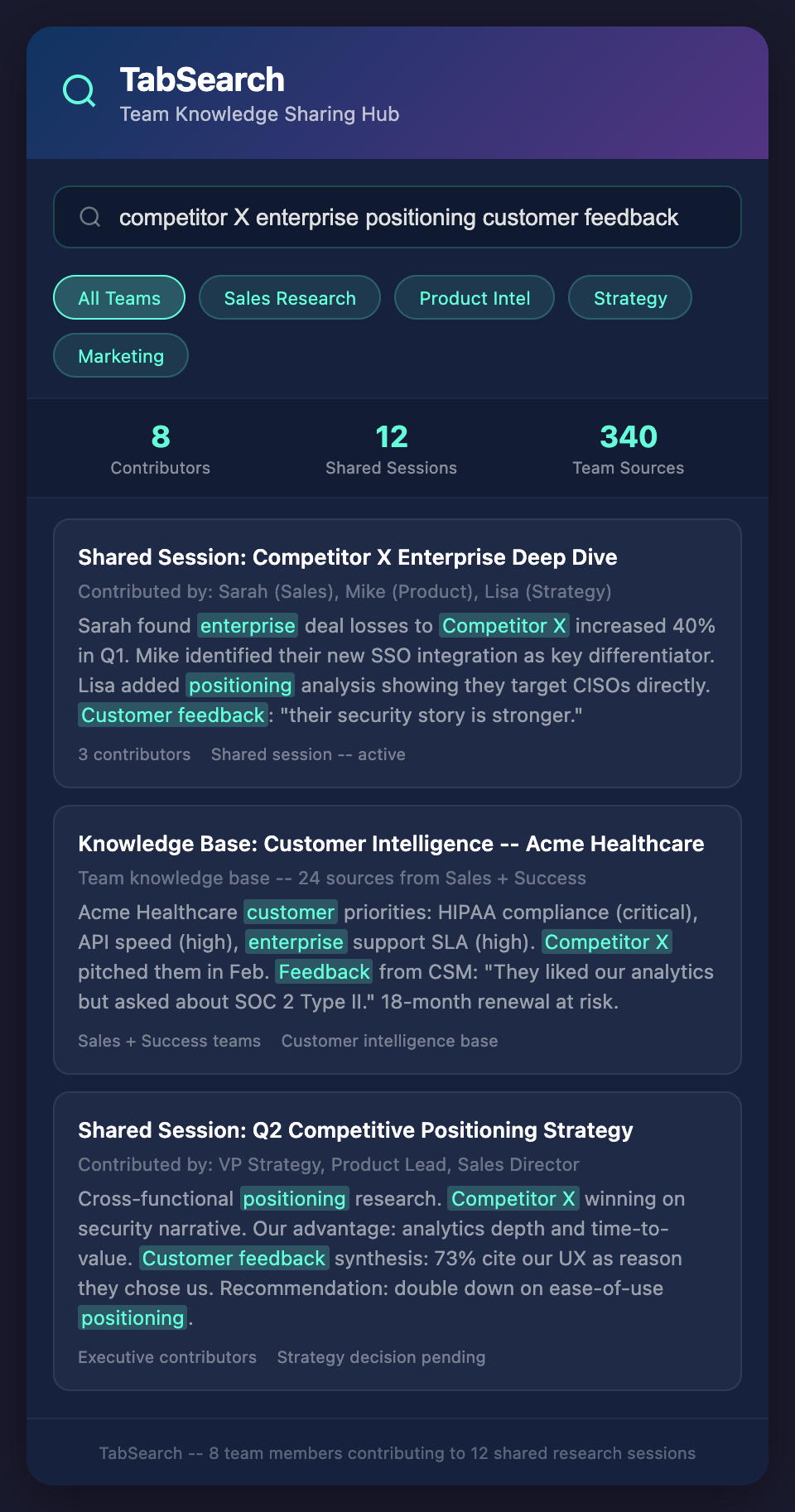
Individual productivity is important. Team productivity is critical. But most knowledge workers operate in information silos.
A sales rep researches a prospect and uncovers competitive intelligence. That intelligence stays in their personal notes and browser tabs. When another team member researches the same competitor, they start from scratch.
A product manager analyzes customer feedback across sources. They synthesize insights about feature priorities. But they're the only one with that complete picture. The engineering team has parts of it, the support team has other parts, and management is working with a surface-level summary.
A strategist gathers market research for quarterly planning. They build a synthesis. But the detailed research that drove conclusions isn't documented or accessible. When questions arise, they have to recreate analysis or rely on memory.
This is siloed knowledge. It's rampant in organizations. And it's catastrophically inefficient.
The Cost of Knowledge Silos
Knowledge silos create four problems:
1. Duplicated research: Multiple people research the same topics independently because they don't know previous research exists.
2. Slower decisions: Decisions are made without access to complete information. Leadership decides strategically without knowing the research behind why a decision was made.
3. Inconsistent understanding: Different departments build different mental models of the market, competitors, or customers. These models conflict, creating organizational confusion.
4. Lost knowledge: When people leave, their research knowledge leaves with them.
For a 100-person organization, knowledge silos probably cost 500-1000+ hours monthly in duplicated research, slower decisions, and redundant effort.
Transforming Individual Sessions Into Shared Knowledge
The solution starts with organizing individual browser research sessions, then evolving toward shared sessions and team knowledge bases.
Level 1: Personal Session Organization
Each knowledge worker organizes their own research:
-
When starting a research project, create a named session
-
Capture session context and goals
-
As research progresses, review and update session to maintain clarity
-
Archive complete sessions with conclusions captured
This level prevents personal knowledge loss. It also creates the foundation for sharing.
Level 2: Shared Sessions
For cross-functional projects, create shared sessions:
-
Sales and product collaborate on prospect research
-
Marketing and product coordinate on competitive intelligence
-
Executive leadership and strategy align on market research
Shared sessions mean multiple people see the same sources, the same research progression, and can contribute findings. They build shared understanding because they're literally looking at the same information.
Level 3: Persistent Knowledge Base
Beyond individual sessions, create permanent knowledge structures:
Competitive intelligence base: All competitive research across the organization—sales research, product competitive analysis, strategic competitive monitoring—lives in one searchable place. New employees can learn competitor landscape in hours instead of months. Sales can instantly answer "What do we know about competitor X?"
Market intelligence base: Customer feedback, market research, analyst reports, trend analysis—everything about how the market is evolving. When pricing decisions happen, everyone can reference complete customer and market context.
Customer intelligence base: Customer research, feedback, industry analysis for major accounts. Sales can instantly understand customer priorities. Product knows what features matter most. Success teams understand customer business. This alignment enables better service.
Implementing Shared Browser Sessions
Shared sessions require infrastructure, but the benefits justify it:
-
Central research platform: A place where team members can create sessions, invite collaborators, and contribute research together.
-
Shared access with permissions: Not all sessions are open to everyone, but teams can collaborate on relevant projects.
-
Research input: Multiple team members contribute sources, notes, and findings to shared sessions. The collective research is better than individual research.
-
Collaborative synthesis: Teams review shared research together. Sales and product align on what competitive intelligence means. Marketing and sales agree on customer insights. Alignment becomes natural because everyone sees the same data.
-
Persistent memory: Sessions don't disappear when projects close. They remain searchable, referenced, updated. Institutional knowledge accumulates.
Overcoming Sharing Resistance
Teams often resist sharing research. Common objections:
"My research is incomplete": Yes, and someone else's different view of the same data will make it better. Incomplete shared research beats complete siloed research because others fill gaps.
"I'm not done yet": Then you don't archive the session, but others can still see your in-progress work and contribute. This accelerates your completion because others help.
"This is proprietary": Distinguish between research that shouldn't be shared (customer secrets, personnel info) and research that should be (market analysis, competitor intelligence, customer feedback). Most research should be shared within the organization.
"It takes extra effort to document": Initially, yes. But the effort of other team members not redoing your research saves far more effort than documentation costs.
Building a Research Culture
Shared research requires culture shift:
-
Normalize sharing: Make default assumption that research is shared unless there's explicit reason not to share.
-
Reward contribution: Recognize people who share research, contribute to shared sessions, and help synthesize collective intelligence.
-
Make synthesis visible: When decisions are made, show the research that drove them. "We prioritized feature X because customer research showed strong demand" demonstrates research value.
-
Require research for decisions: Don't allow major decisions without referencing shared research. This incentivizes quality research contribution.
-
Invest in tools: Show that the organization is serious by investing in research platforms that make sharing easy.
The Organizational Learning Advantage
Organizations with strong shared research capabilities learn faster. They build on previous research instead of repeating it. They make decisions with full context. They adapt to market changes because they're collectively monitoring market evolution.
This isn't just productivity. It's organizational capability building.
Start With Your Team
Shared research doesn't require organizational mandate. Start with your team. Establish shared sessions for projects you work on together. Invite team members to contribute sources. Review research together. The benefits will become obvious.
As the practice spreads, more teams adopt it. Eventually it becomes organizational norm.
Build Shared Intelligence
Knowledge workers shouldn't work in isolation. They should work in information-rich environments where collective research is available, shared sessions are collaborative, and team learning compounds.
Join our waitlist to organize browser research sessions across your team. Stop hoarding intelligence. Start building organizational knowledge advantage.