Market Research Information Overload: Practical Solutions for Business Intelligence
The Information Overload Crisis
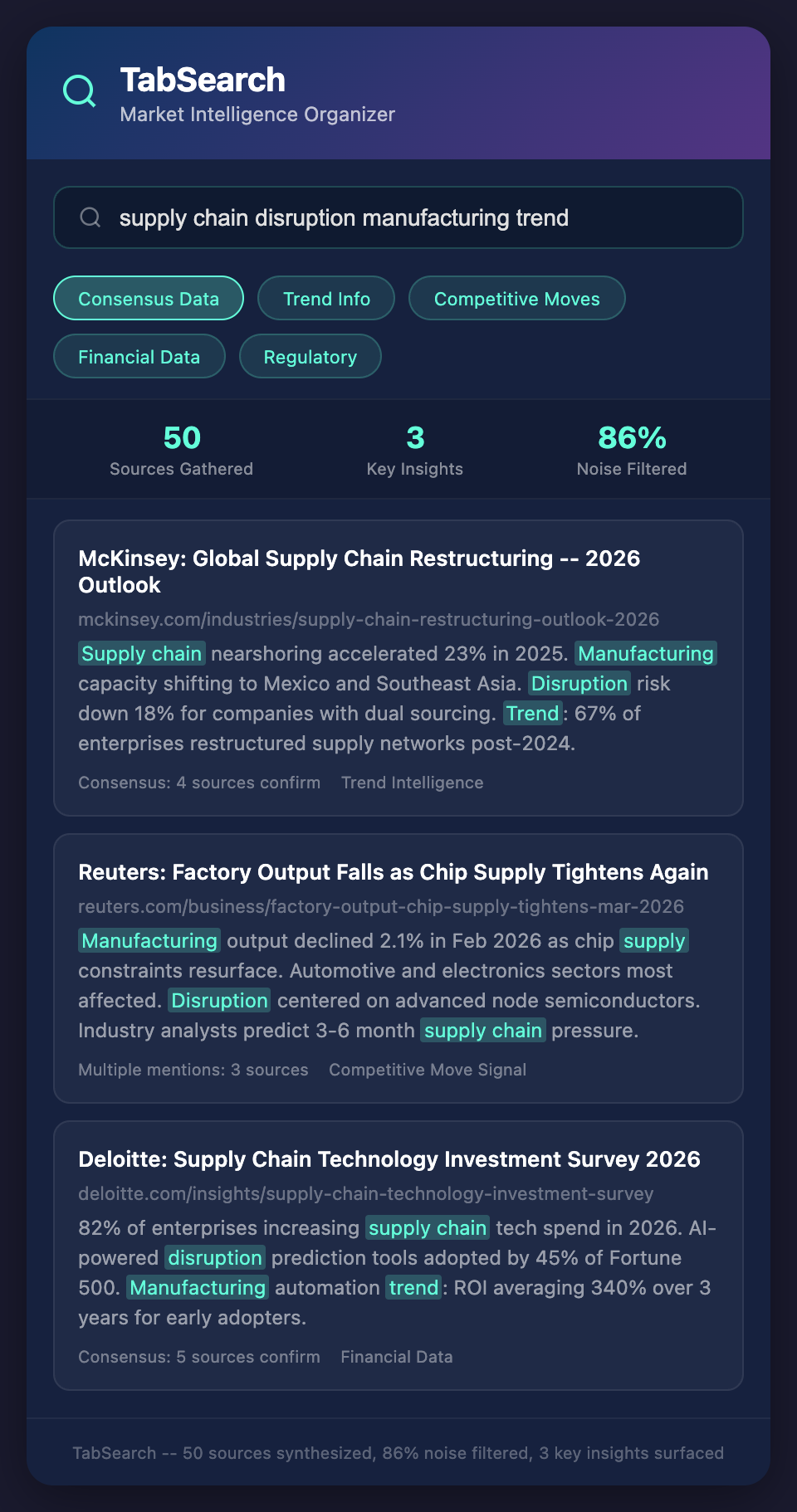
A market research project should take two weeks. You collect data, synthesize insights, write recommendations. Instead, it takes four weeks. Why? Because you're drowning in information.
You've gathered data from 50 sources. News articles, analyst reports, competitor websites, customer reviews, financial data, and regulatory filings. Somewhere in there are three key insights that matter. The rest is noise.
Finding those insights means reading through hundreds of pages. Some information contradicts other information. Recent data conflicts with older but more detailed sources. You're not sure which sources are reliable. You have quantities of data but absence of clarity.
This is information overload. Not information scarcity. Not information quality issues. Just too much information competing for your limited attention and analysis time.
The cost is real: Projects take longer. Decisions are delayed. By the time analysis is complete, market conditions have moved. The competitive advantage of knowledge-based decision making evaporates because knowledge takes too long to synthesize.
Why Traditional Approaches Fail
Google Docs and Spreadsheets: You manually compile information into a document. This works for small projects. For comprehensive research, you're copying data all day. Updates are manual and lag behind source changes by days or weeks.
Industry Reports: You pay for a comprehensive analyst report. It covers the market broadly but lacks specific details relevant to your business. You still need to supplement with primary research.
Enterprise BI Tools: These are built for quantitative data (sales numbers, customer metrics). They require data engineering to set up. For qualitative intelligence gathering, they're overkill.
Manual research workflows: You read each source deeply, take notes, extract key data. You synthesize weekly. This is thorough but crushingly slow.
Each approach has merit for specific purposes. None solve the core problem: Helping knowledge workers rapidly synthesize large amounts of diverse information into actionable insights.
Reframing Information Overload
Information overload is partly a problem of volume, but more fundamentally a problem of organization. If you have 200 disorganized data points, you're overloaded. If you have 2,000 well-organized, searchable data points with clear relevance rankings, you're not overloaded—you're equipped.
The solution isn't less information. It's better organization. Better searchability. Better synthesis.
The Market Intelligence Framework
Effective market research under information overload requires a three-layer approach:
Layer 1: Capture and Categorize
As you gather information, immediately categorize it:
-
Trend information: Data suggesting market direction
-
Competitive moves: Announcements about competitor actions
-
Customer signals: Customer feedback, reviews, churn indicators
-
Financial data: Revenue, funding, profitability information
-
Technology shifts: New technologies, adoption patterns
-
Regulatory changes: New rules affecting market
-
Partnership news: Alliances, integrations, ecosystem changes
This taxonomy lets you filter out irrelevant information. Research about regulatory changes is interesting, but if you're gathering trend information, regulatory data can be deprioritized mentally.
Layer 2: Cross-Reference and Validate
When the same insight appears across multiple sources, it gains credibility. When sources contradict, dig deeper. Information appearing only once might be outlier data or unreliable source.
Organize information by:
-
Single mention: Data mentioned in one source (treat cautiously)
-
Multiple mentions: Data confirmed by 2-3 sources (treat as high credibility)
-
Consensus: Data that appears across many independent sources (treat as fact)
This transform information overload into a credibility ranking system. You focus on consensus data first.
Layer 3: Synthesize Into Conclusions
With categorized, validated information, synthesis becomes faster. You're not reading 500 pages trying to find themes. You're looking at organized data points and drawing conclusions from patterns.
Ask specific questions:
-
"What's the trend indicated by this data?"
-
"What competitive moves are happening?"
-
"How is customer demand evolving?"
-
"What does financial data suggest about market health?"
Organized data makes pattern recognition much faster.
Tools That Enable This
Effective market research under overload requires tools that:
-
Capture diverse sources: News, reports, websites, emails, documents—everything lands in one place
-
Extract structured data: Key facts (company, date, metric, action) are identified automatically
-
Enable quick search: Find information by keyword, company, date range, or category
-
Support organization: Tag, mark priority, link related data points
-
Highlight consensus: Show when multiple sources mention the same fact
-
Generate summaries: Rapid synthesis of what data actually says
Without these capabilities, you're back to manual compilation and careful reading of everything.
The Real-Time Intelligence Advantage
Markets change constantly. The competitive advantage belongs to organizations that recognize and respond to changes fastest.
With traditional research (2-4 week turnaround), you're responding to month-old news. Competitors have already moved.
With organized, searchable market intelligence (daily synthesis), you're responding to this week's news. The competitive advantage is real.
Implementing Market Intelligence Systems
Rolling out effective market intelligence requires:
-
Identify core sources: What 20-30 sources matter most? Compete here, not everywhere.
-
Automated capture: Everything from these sources is captured continuously
-
Team access: All team members can search the intelligence base
-
Regular synthesis: Weekly or bi-weekly, highlight what changed and what it means
-
Action protocols: When specific signals appear, someone acts (pricing change alert → competitive response, hiring surge → strategy briefing)
This transforms information overload from a problem into a system.
From Data to Decisions
The goal of market research isn't data collection. It's decisions. The more quickly you transform data into decisions, the more you benefit.
Organizations with slow research cycles make decisions quarterly. Organizations with fast intelligence cycles make decisions monthly or weekly. That frequency difference compounds into competitive advantage.
Regain Your Research Capacity
Market intelligence should take 2-3 weeks. If it's taking 6-8 weeks, you're handling overload poorly. Reclaim that time through systematic organization and search.
Join our waitlist to organize market research and turn information overload into managed intelligence. Stop drowning in data. Start finding insights fast.