Creating Searchable Archives of Business Research and Competitive Data
The Archive Problem
A company has been conducting competitive intelligence for three years. They have:
-
200+ competitive analyses
-
500+ saved articles and research
-
1000+ customer conversation notes mentioning competitors
-
50+ win/loss analyses
-
100+ lost deal records
The collective intelligence in these archives is worth thousands of dollars. It represents literally hundreds of hours of analysis.
But when someone needs information, they don't search the archive. They re-research. Why? Because finding something in the archive takes longer than researching it from scratch.
The archive failed because it solved the wrong problem. It's easy to save things; it's hard to find them. Without searchability, archives become graveyards.
Why Archives Fail
Problem 1: Deteriorating Discoverability
Over time, organization schemes decay:
-
File naming conventions that made sense become inconsistent
-
Folder structures become unclear as content grows
-
Old tagging systems stop being used
-
Search within archives returns too many results
Someone looking for "Competitor A pricing strategy" might find:
-
15 articles mentioning their price changes
-
3 competitive analyses
-
10 sales objection handling documents
-
25 customer conversation notes mentioning pricing
-
40 internal discussion documents
That's 93 results to sort through manually.
Problem 2: Organizational Entropy
Archives organized at the start deteriorate without maintenance:
Original system: Folders by competitor, with subfolders by topic
After 2 years: New team members put files in different locations, naming conventions vary, old structure isn't maintained
The archive reflects how it was organized, not how anyone would logically search for information.
Problem 3: Context Collapse with Scale
An article is useful when captured with context:
-
Why this matters
-
What it suggests about competitive strategy
-
Supporting evidence
As archives grow, this context gets buried. A three-year-old article is just a title and link. The deeper context—why it mattered, what it implied—is lost.
Problem 4: Format Fragmentation
Archives contain multiple formats:
-
PDFs (industry reports)
-
Web archives (articles saved as HTML or images)
-
Spreadsheets (win/loss analyses, competitive comparisons)
-
Documents (competitive analyses)
-
Email threads (research and discussion)
-
Video (earnings call recordings)
Searching across mixed formats is difficult. Video and image content especially are invisible to text search.
Problem 5: Temporal Decay Without Refresh
An analysis from two years ago is either:
-
Still accurate (but you don't know which ones)
-
Outdated (but there's no clear indicator)
Archives don't distinguish between current and historical. Users don't know whether they're reading current strategy or ancient history.
Building Searchable, Maintainable Archives
Archive Architecture
Hot tier (current, actively used):
-
Research from the last 6 months
-
Actively maintained and updated
-
Immediately searchable
-
Used for current decisions
Warm tier (recent history):
-
Research from 6-12 months ago
-
Stable; not actively updated
-
Searchable, but with clear age indication
-
Used for understanding recent trends
Cold tier (historical reference):
-
Research older than 12 months
-
Archived; no longer updated
-
Searchable, but clearly marked as historical
-
Used for understanding evolution and context
This tiering prevents old data from being mistaken for current data.
Full-Text Indexing for Searchability
Every document in your archive must be searchable. This means:
For text documents (articles, analyses, emails):
-
Full-text indexed (every word searchable)
-
Metadata indexed (title, date, author, tags, source)
For PDFs:
-
Text extracted and indexed (requires OCR for images in PDFs)
-
Metadata indexed
For images:
-
Alt text and captions indexed
-
Consider AI-powered image recognition to extract content
For videos:
-
Transcribed and indexed
-
Timestamps linked back to video
For spreadsheets:
-
Content indexed
-
Both cell contents and surrounding context searchable
The goal: Whether information lives in a PDF, email, article, or spreadsheet, you find it the same way—through search.
Smart Categorization for Multiple Discovery Paths
Archive should be searchable multiple ways:
By competitor: "Show all archived intelligence about Competitor A"
By topic: "Show all pricing strategy research"
By time period: "Show all research from 2025"
By source type: "Show all earnings call analysis"
By author: "Show all research conducted by Jane Smith"
By confidence level: "Show only high-confidence analyses"
Implement through:
-
Tagging systems
-
Database queries
-
Faceted search
-
Saved searches
Evolution Tracking
Archives should show how intelligence evolved:
Competitor A strategy
-
2023: "Consolidating market position"
-
2024: "Moving upmarket"
-
2025: "Expanding enterprise"
This progression tells a story. Single snapshots don't.
Metadata Standards for Archive Longevity
Every archived item should have:
Core metadata:
-
What (title/subject)
-
When (publication date, archival date)
-
Who (author, researcher, source)
-
Where (URL, location)
-
Why (brief description of why this was archived)
Archive metadata:
-
Age category (hot/warm/cold)
-
Confidence level
-
Last reviewed date
-
Recommendation for update
-
Known changes since publication
Findability metadata:
-
Tags (competitor, topic, segment, geography)
-
Related items (links to correlated research)
-
Superseded by (if replaced by newer analysis)
This metadata ensures that even if original context is lost, archive entries provide sufficient context for evaluation.
Migration Strategy for Existing Archives
You likely have scattered research accumulated over years. Migrating to a searchable archive:
Phase 1: Stop the Bleeding (Month 1)
All new research goes into the searchable archive immediately. Use new system for all new capture. Don't attempt to retroactively import old research yet.
Phase 2: Selective Indexing (Months 2-3)
Identify high-value archives:
-
Competitive analyses (full import)
-
Most recent 500 articles (import with metadata)
-
Most recent 50 major reports (import)
Skip low-value historical content; focus on recent, valuable material.
Phase 3: Metadata Enhancement (Months 3-4)
As you import, add metadata:
-
Categorization (competitor, topic, time period)
-
Confidence assessment
-
Cross-linking to related research
This is labor-intensive but necessary for discoverability.
Phase 4: Ongoing Refinement (Ongoing)
As people use the archive, they'll identify:
-
What's missing
-
What's organized confusingly
-
What's outdated
Use this feedback to refine organization and search.
Practical Archive Search Examples
Search 1: "What has Competitor A announced in the past 90 days?"
Results:
-
Earnings call from Mar 2026 with 2 key announcements
-
Press release from Feb 2026 about partnership
-
Customer conversation notes mentioning their new product
-
Job posting for enterprise team
Total time: 30 seconds
Search 2: "What do we know about market consolidation?"
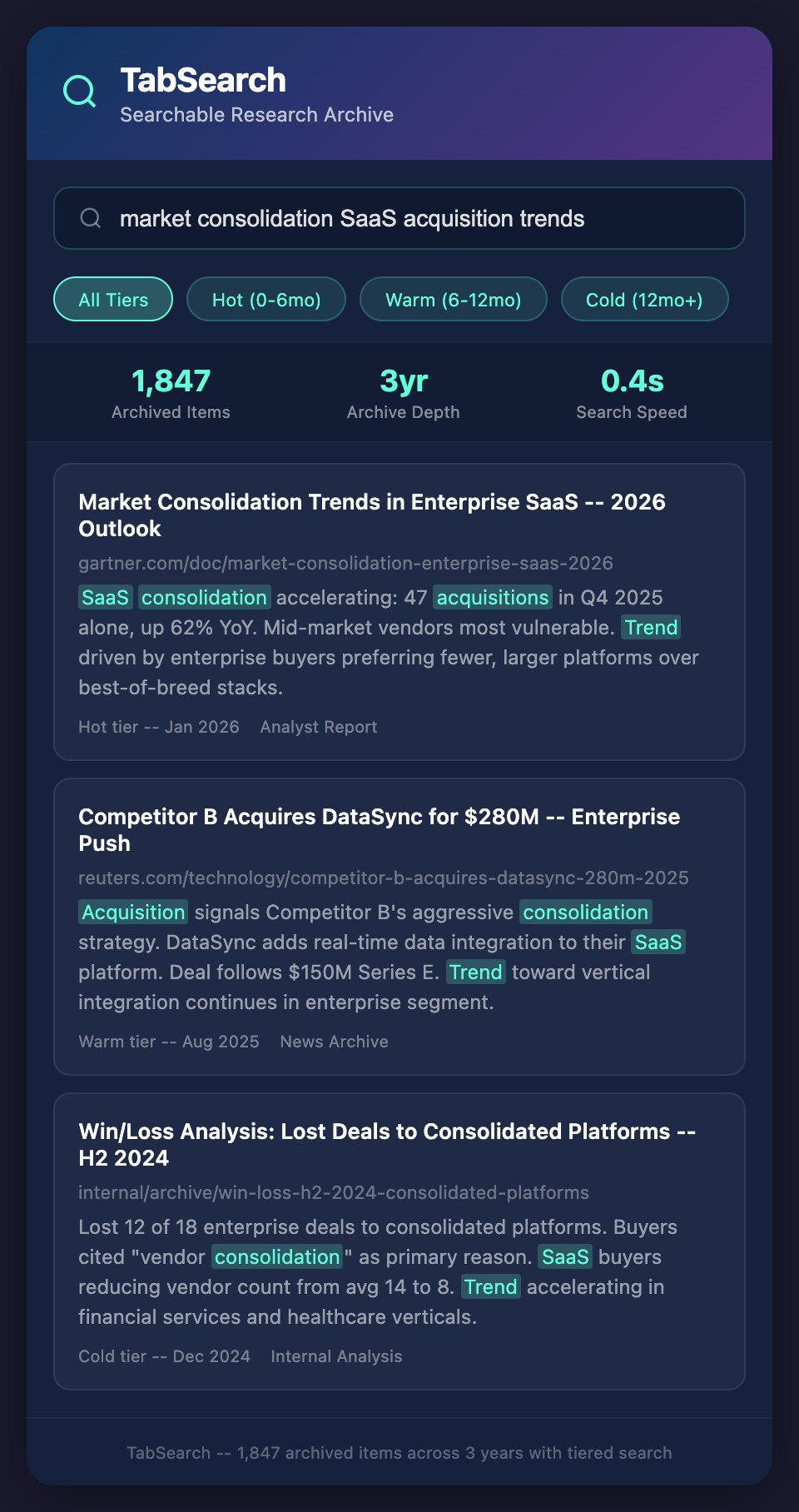
Results:
-
Analysis "Market Consolidation Trends in SaaS" from Jan 2026
-
5 corroborating articles mentioning consolidation
-
3 customer conversations discussing M&A activity
-
Analyst report on consolidation
Total time: 45 seconds
Search 3: "How has Competitor B's strategy evolved?"
Results (chronologically):
-
2023: "Focused on SMB market"
-
2024: "Expanding upmarket"
-
2024Q4: "Announced enterprise partnerships"
-
2025: "Launched enterprise product line"
-
2026: "Enterprise now >50% of revenue"
Total time: 1 minute
Archive Maintenance
Archives decay without maintenance:
Monthly:
-
Review new additions for proper metadata
-
Check that search is working effectively
-
Fix any broken links
Quarterly:
-
Remove duplicates
-
Consolidate related items
-
Update "superseded by" links when newer analyses replace old ones
-
Identify analyses that need refresh
Annually:
-
Full review of archive structure
-
Consolidate and reorganize as needed
-
Assess what types of research are most valuable
-
Identify research gaps
Ongoing:
-
Use search logs to identify what people are looking for
-
If people search for something repeatedly without finding it, improve tagging and categorization
The Compounding Value of Searchable Archives
In month one, building a searchable archive feels like setup overhead. By month six, your archive has prevented 20+ instances of duplicate research, saving your organization hundreds of hours. By month two, your archive has saved your organization from repeating analysis. By year two, your archive is a strategic asset—new employees can get up to speed on competitive landscape in days instead of weeks.
Companies with mature, searchable archives respond to market changes faster because they can draw on institutional knowledge instantly. This is the difference between acting reactively and acting strategically.
Stop letting valuable research disappear into unsearchable archives. Join our waitlist to see how to build searchable research archives that become more valuable over time.