Creating Searchable Business Knowledge Databases for Sales Teams
The Sales Knowledge Problem
A sales director receives a call from a frustrated account executive: "That customer is saying Competitor A can do X for half our price. I need to know if that's even possible. I need it now." The AE is on the phone with the prospect in five minutes.
Where does the sales director turn? Usually, to scattered emails, Slack conversations, past proposals, and product documentation—hoping someone has documented this objection before. If the company has handled a similar competitive objection, that knowledge exists somewhere. But finding it in the next four minutes? That's the real challenge.
Most sales organizations operate with fragmented knowledge. Competitive responses live in individual email inboxes. Deal strategy gets discussed in Slack and evaporates. Product capability documentation sits in a wiki nobody visits. The collective intelligence of the team—everything learned from hundreds of customer conversations—is inaccessible at the moment it matters most.
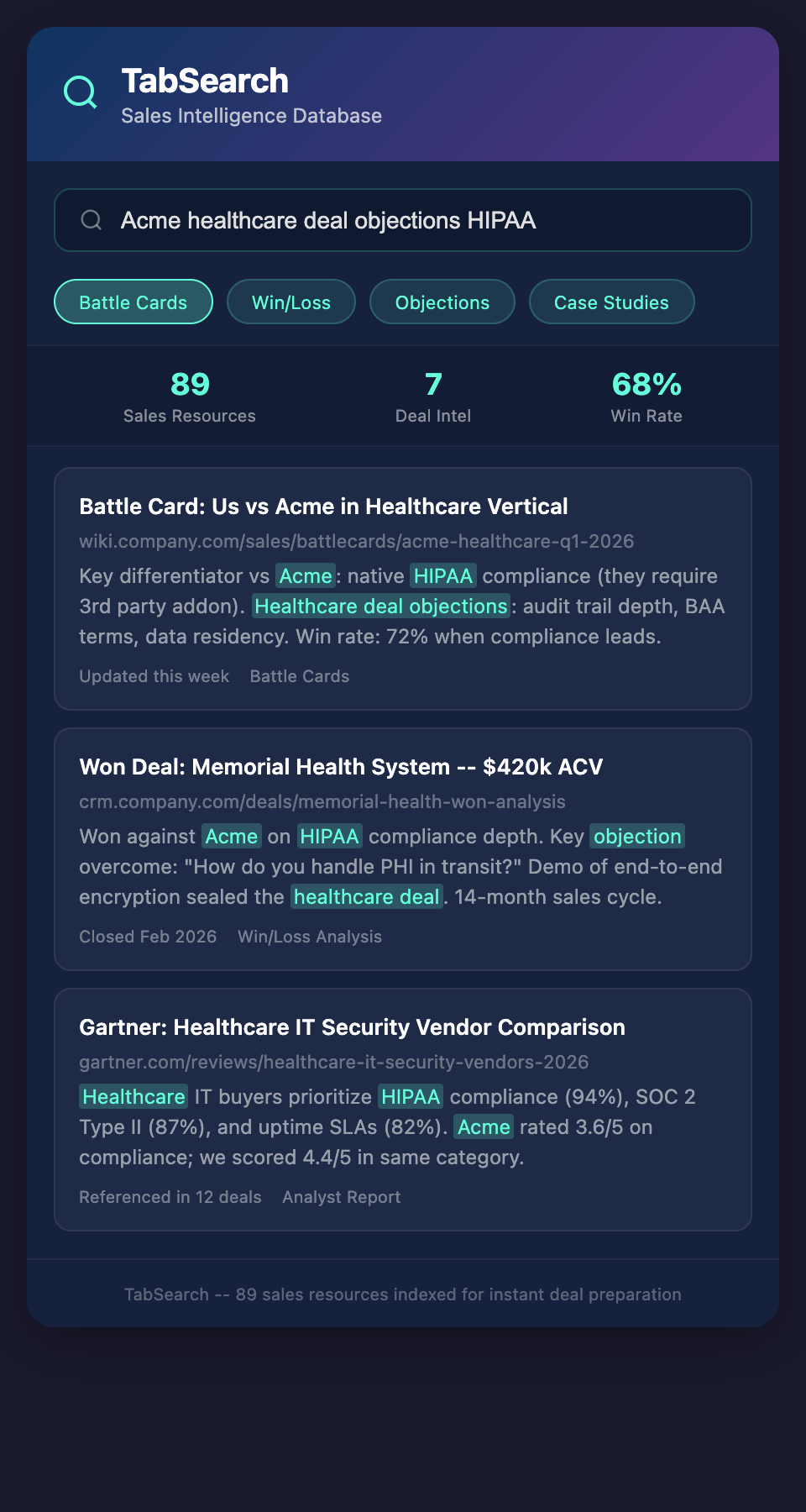
What Searchable Knowledge Databases Accomplish
When sales teams have instant access to searchable knowledge, everything changes:
Faster deal progression: AEs spend 20% less time searching for information and 20% more time selling
Consistent competitive messaging: When sales access the same curated competitive response, the entire company speaks with one voice
Reduced deal loss to "I need to check with engineering": Sales can confidently answer capability questions by searching documented product specifications
Accelerated ramp for new hires: A new AE can search "common objections in financial services" rather than spending a month shadowing other reps
Quantifiable competitive insights: Leaders can search for "lost deals to Competitor A" and identify systematic gaps in competitive positioning
The impact compounds: Every interaction a sales professional has is an opportunity to capture knowledge. Without a system to retain that knowledge, it's lost. With a system, each interaction strengthens the collective knowledge base.
Core Components of Sales Knowledge Databases
Competitive Battlecards
These should be instantly searchable, not buried in Salesforce or a dusty shared drive. The best competitive battlecards answer three questions immediately:
Position: How does the competitor position themselves? (e.g., "Emphasizes ease of use for non-technical teams")
Proof points: What evidence supports their positioning? (e.g., "150k+ SMB customers, 4.8 star Capterra rating, free tier available")
Our response: How do we counter this? (e.g., "We focus on compliance and security—90% of Fortune 500 use us. Lower total cost of ownership for enterprises due to reduced implementation time")
Make these one-page documents, keyword-searchable, and organized by competitor. A sales rep should find answers to objections in under 30 seconds.
Lost Deal Analysis
Every lost deal teaches something. Systematically capture:
-
Which competitor won (if known)
-
The primary reason for loss (price, feature, timing, company decision)
-
Supporting quotes from the customer
-
What we could have done differently
-
What product gaps this revealed
This analysis, indexed and searchable by reason for loss, becomes a living curriculum. When patterns emerge—"we've lost 12 deals this quarter to Competitor A's integration with Salesforce"—the company can respond strategically.
Customer Proof Points and Stories
Great salespeople use stories, not just feature lists. Capture them systematically:
-
Customer profile: Industry, company size, challenge they faced
-
The situation: What was the customer trying to accomplish? Why did it matter?
-
Our solution: How did we help? What was the measurable outcome?
-
The quote: What did the customer say about the value they received?
-
Searchable categories: Problem solved, industry vertical, measurable outcome (e.g., "reduced support costs by 40%")
When an AE is talking to a prospect in financial services about compliance challenges, they should find three relevant customer stories in 10 seconds.
Frequently Encountered Objections
Sales teams encounter objections repeatedly. Systematically document the best responses:
Objection: "Your product is too expensive."
Root cause: Usually price sensitivity or unclear ROI understanding
Our best response: "Many customers told us the same thing initially. What they found was that we reduce customer support costs by an average of 35%—that recouped the investment within four months. Have you calculated your current support costs?"
Success rate: 60% of opportunities that use this response advance to next stage
Related resources: Link to ROI calculator, customer case studies demonstrating savings
Product Capability Documentation
Sales teams need clear, searchable answers to product questions without reading technical documentation:
-
Capability: Integration with Slack
-
Implementation time: 30 minutes for basic setup, 2-4 hours for advanced configuration
-
Supported use cases: Team notifications, automated alerts, custom workflows
-
Limitations: Requires Slack workspace admin access; some enterprise SSO configurations require engineering support
-
Alternative for customers wanting feature X: These other integrations achieve similar outcomes
-
Customer success stories: Links to customers using this capability
Proposal and Contract Templates
Sales shouldn't write proposals from scratch. Maintain searchable templates for:
-
Common deal structures (annual, multi-year, usage-based)
-
Service level agreements (SLAs)
-
Data security and compliance clauses
-
Customer-specific terms and what requires legal review vs. what's negotiable
Building the System
Week 1: Audit existing knowledge
Have sales team members identify where they currently search for information. You'll probably find it lives in 6-8 different locations.
Week 2: Start capturing new knowledge
Don't rebuild everything retroactively. Focus on new lost deals, objections, and customer interactions going forward.
Week 3: Implement retrieval
Set up full-text search across all captured knowledge. Sales should find answers within 30 seconds.
Week 4: Establish governance
Assign ownership for keeping competitive data current, adding new customer stories monthly, and removing outdated information.
The Compound Effect
In month one, the knowledge database feels like extra work—sales reps must document interactions they previously didn't document. By month two, the system saves reps 30 minutes per week in search time. By month three, new hires ramp 40% faster. By month four, the company closes deals more consistently against specific competitors.
The companies winning in competitive markets aren't the ones with better products—they're the ones whose entire sales team operates with superior knowledge, consistently available, at the moment of truth.
Stop losing deals because critical knowledge is trapped in individual email inboxes. Join our waitlist to see how companies are building searchable knowledge systems that transform sales productivity and consistency.