Create a Searchable Database from Web Content in Minutes
The Manual Data Entry Trap
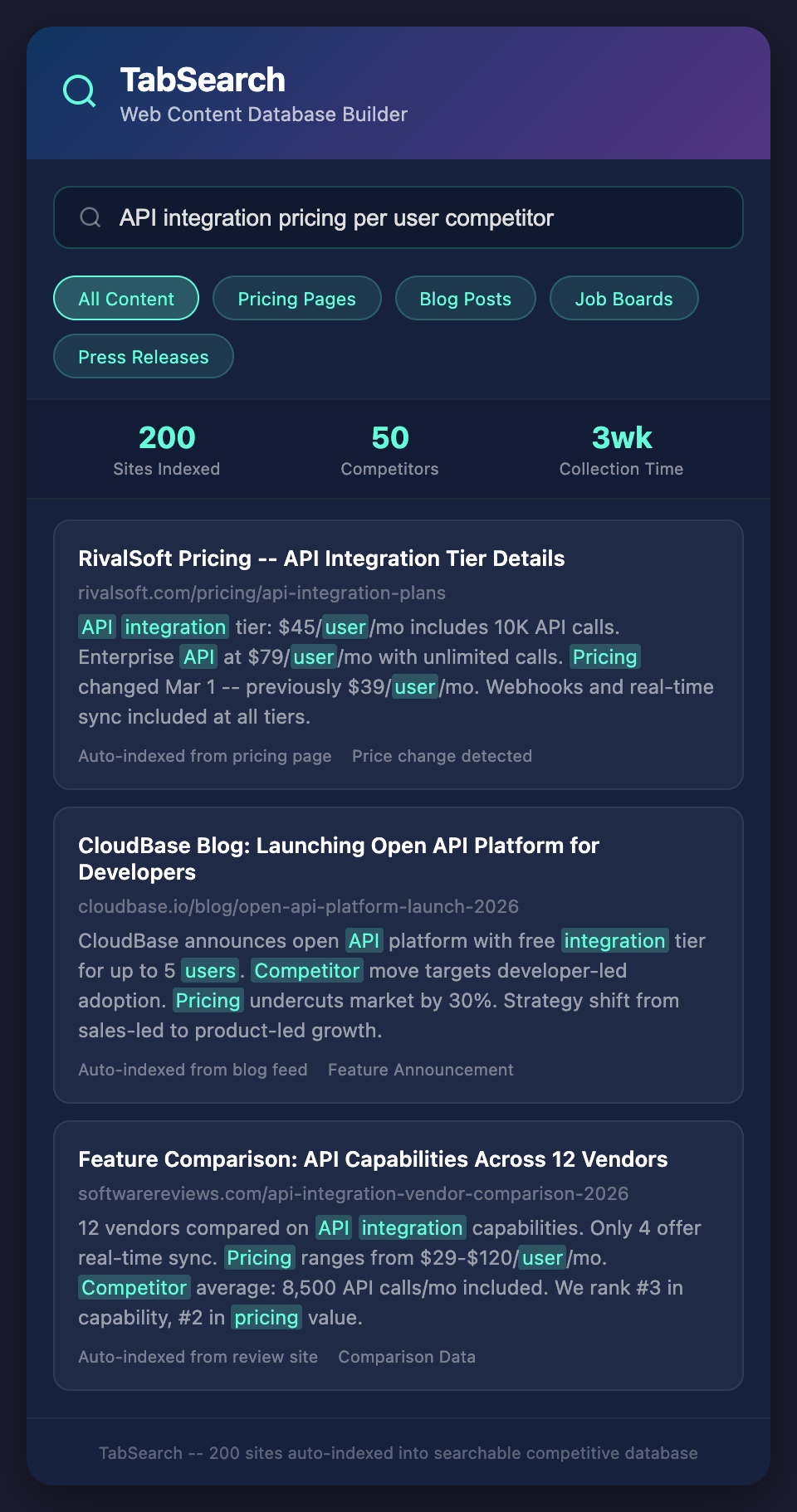
You've been researching a market for three weeks. You've visited 200 websites. You've collected data on 50 competitors. Now you need to synthesize this into a database for your team.
The traditional approach: Create a spreadsheet. Manually enter competitor data from your research. Set up tabs for different data types. Hope nobody updates it inconsistently.
By the time you finish, the data is half-stale. It took 40 hours of manual work. Updating it next week will take another 20 hours. Real-time market intelligence is impossible.
This is why most companies resort to expensive enterprise tools or outdated manual processes. They haven't discovered that creating a searchable database from web content can be nearly instant.
Why This Matters
A searchable database of web content transforms how knowledge workers operate:
Speed: Find specific data points instantly. "Which competitors offer API integration?" Search for "API integration" across your entire database. Get answers in seconds instead of minutes.
Recall: Eliminate forgotten research. If you've read it and it was important enough to capture, you can find it. Your knowledge doesn't leak away.
Synthesis: Combine insights from multiple sources. Search across 200 competitor websites for specific features, pricing, or positioning. You see patterns that individual research missed.
Sharing: Your database becomes team knowledge. Research becomes asset. Instead of hoarding competitive intelligence in individual notebooks, it becomes organizational capital.
Tracking change: Monitor the same content monthly. Has competitor pricing changed? Search the database historically. Did market positions shift? Comparison becomes instant.
The Modern Approach: Automatic Indexing
Instead of manual data entry, automatically capture and index web content as you research:
Step 1: Identify Your Research Sources
What websites matter for your business? Competitors, industry analysts, vendor sites, news sources, customer review sites, regulatory databases, financial data providers. List the core sources.
Step 2: Automatic Content Capture
As you visit these sources, capture the full content. Not just the title or URL—the actual article, data table, pricing page, or analysis. This happens automatically without manual work.
Step 3: Structured Indexing
The captured content is automatically indexed by:
-
Keywords: Extract key terms so searches work
-
Metadata: Date published, source, author, category
-
Structure: Identify lists, tables, prices, quotes
-
Relationships: Link mentions of competitors to data about them
-
Temporal data: Track how information changes over time
Step 4: Instant Searching
Query your database like you'd query Google, but for your proprietary research:
-
"How many competitors offer white-label solutions?"
-
"What's the highest pricing tier mentioned?"
-
"Which sources mention supply chain issues?"
-
"Did anyone announce hiring in Q1?"
Results appear with context, source, and date.
Real-World Database Examples
Competitive Intelligence Database
You research 30 competitors daily. Automatically capture:
-
Pricing page content (track when prices change)
-
Blog posts (monitor feature announcements)
-
Job postings (track hiring in specific roles)
-
Press releases (log major announcements)
-
News mentions (archive third-party coverage)
Query this database to answer:
-
"Has anyone changed pricing in the last 30 days?"
-
"What features are competitors announcing this quarter?"
-
"Who's hiring engineers? How many positions?"
-
"Is there a pattern in announcements from company X?"
Market Research Database
Capture analyst reports, industry data, and market research:
-
Industry reports (track market size and projections)
-
Analyst research (maintain comprehensive coverage)
-
News articles (monitor trends)
-
Customer reviews (understand market sentiment)
-
Regulatory filings (stay compliant)
Query to answer:
-
"What is the projected market growth in our category?"
-
"Which analysts cover our space?"
-
"What are the most mentioned customer complaints?"
-
"Has regulatory landscape changed?"
Due Diligence Database
During acquisition or partnership evaluation, capture all research:
-
Company financials (SEC filings, reports)
-
News coverage (monitor sentiment)
-
Customer reviews (assess product fit)
-
Team information (LinkedIn research)
-
Technology analysis (understand capabilities)
Query to answer:
-
"What's this company's financial trajectory?"
-
"Is there negative news I missed?"
-
"What do customers actually think?"
-
"Did key people leave recently?"
Why This Beats Manual Spreadsheets
Spreadsheets require human discipline: consistent column naming, accurate data entry, regular updates, no duplicates. As databases grow, spreadsheets become unreliable and slow.
Automatic indexing:
-
Prevents data loss: Nothing is forgotten. If you captured it, you can find it.
-
Eliminates formatting inconsistency: The system normalizes all data automatically.
-
Updates continuously: Changes happen in real-time. Pricing changes are detected automatically.
-
Scales infinitely: Add 10 sources or 1,000—the system maintains performance.
-
Enables discovery: Search capabilities let you find patterns you didn't know to look for.
Implementing Your Own Database
Building a searchable database from web content doesn't require engineering expertise. The process:
-
Identify your sources: List websites and content types that matter to your business.
-
Set up automatic capture: Configure the system to capture content as you visit these sources.
-
Define your schema: What data do you care about? Features, pricing, dates, contacts, technologies? Define what to extract.
-
Start searching: Query your database like a search engine. Refine queries as you learn what's there.
-
Maintain and expand: Add new sources. Archive old data. Let the database grow as your research deepens.
The difference is dramatic. In week one, you have a database of your research. In month one, you have a corpus of market intelligence that would take a team days to manually compile. In quarter one, you have organizational knowledge that most competitors don't possess.
Competitive Knowledge Is Competitive Advantage
Markets move fast. Companies that know competitive landscape instantly move faster. Companies waiting for quarterly reports move too slowly.
A searchable database of web research gives you real-time competitive knowledge. Not perfect knowledge, but immediate knowledge. That speed translates to better decisions, faster pivots, and smarter strategy.
Start Building Your Database Today
Stop manually transcribing research into spreadsheets. Let automatic indexing build your knowledge database while you focus on analysis.
Join our waitlist to automatically capture and index every piece of research you gather. Transform weeks of manual database building into instant searchable intelligence. Start leveraging competitive knowledge instead of hoarding it.