Best Practices for Documenting Sources During Writing
The Citation Debt Problem
You're writing and your flow is good. You make an assertion: "Remote workers report higher engagement than office workers." You're confident this is true based on research you did, but you're not certain which source it came from. Do you stop writing to hunt for the source? Do you write [CITATION NEEDED] and plan to find it later? Or do you just keep writing and hope you remember during editing?
Most writers accumulate citation debt. You make assertions throughout a draft without recording their sources. Later, during editing, you spend hours trying to find the sources you referenced. Sometimes you can't find them at all, requiring you to either delete the assertion or rewrite without the specific supporting evidence.
This is wasteful and creates inaccurate content. Better to document sources as you write, building citations into your draft from the beginning.
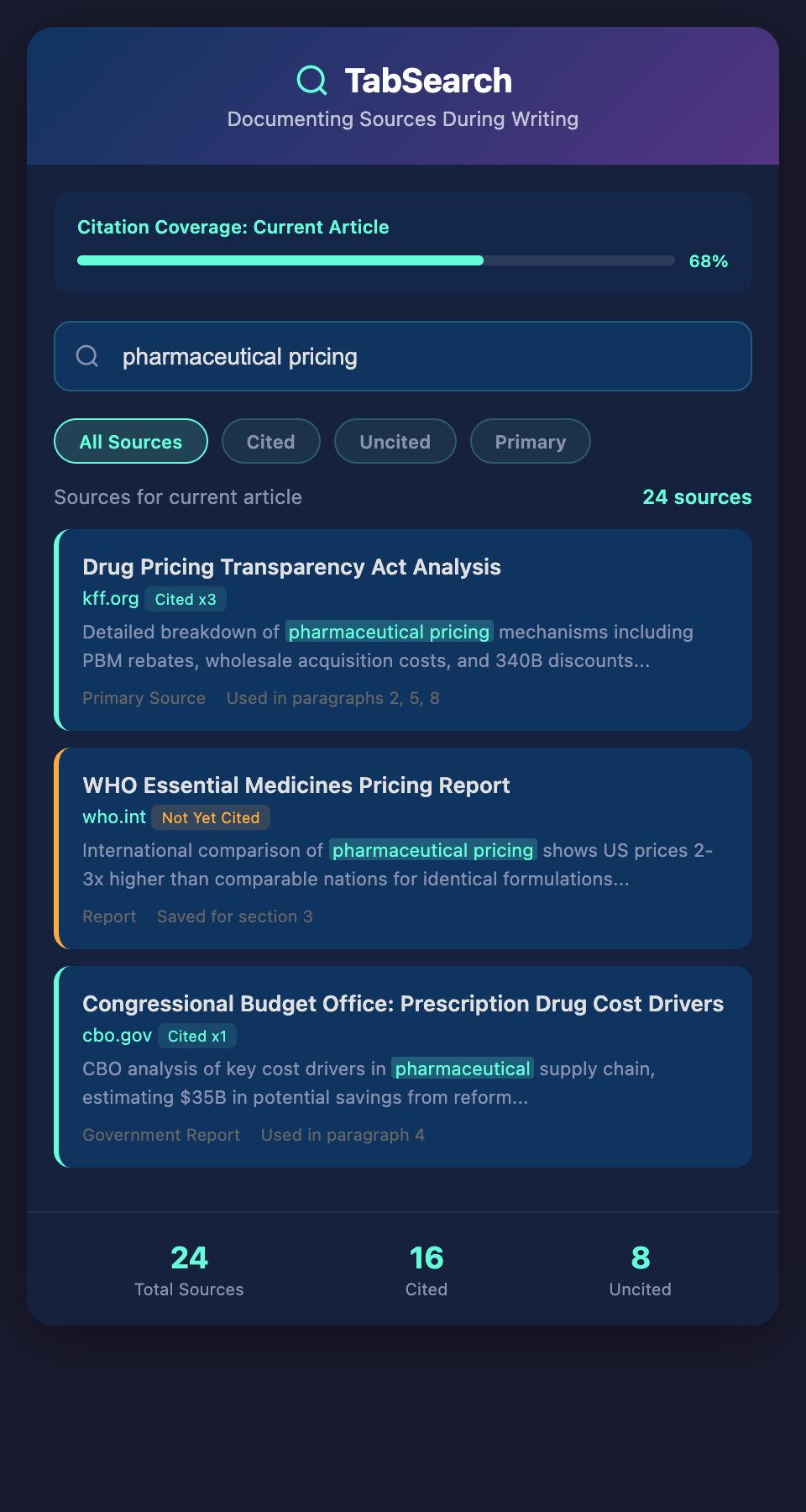
Source Documentation as You Research
The foundation of easy documentation is capturing sources properly during research. Every source you'll cite should already exist in your research system with complete metadata:
-
Full URL. So you can verify it and create accurate links.
-
Author and publication. So you can write proper citations.
-
Publication date. Essential for many citation formats.
-
Full page content. So you can find and verify exact quotes.
Without this infrastructure, documenting sources during writing becomes painful. You're trying to reconstruct information that wasn't captured properly during research.
Inline Documentation System
As you draft, develop a consistent system for marking sources within your document:
Simple Placeholder System
Some writers use inline placeholders: [source: remote-workers-engagement]. This placeholder references a source in your research system by a simple identifier. When editing, you'll convert this to a proper citation.
The advantage is that it's fast—you note which source supports a claim without interrupting flow. The disadvantage is that you still need to convert placeholders to citations later.
Parenthetical References
Other writers use parenthetical references as they write: (remote-workers-engagement, 2024). This is more formal and closer to a final citation, making the editing pass faster. It's slightly slower than a placeholder but requires less rework later.
Detailed Inline References
Some writers go further: (Smith et al., 2024, "Remote Work Engagement Study"). This captures author, year, and title inline. This is slowest during drafting but leaves the least work for editing. Only use this approach if you're an experienced writer comfortable with faster typing speed.
Citation Format Consistency
Choose your citation format before you start writing. Common academic styles include MLA, APA, Chicago, and Harvard. Many online publications use a simpler format: author name and publication. Decide upfront so your inline citations are consistent.
Verification During Drafting
As you write, you can verify sources as you go:
-
Make an assertion. "The average knowledge worker has 37 open browser tabs."
-
Search your research system. Find the source supporting this claim.
-
Verify the exact statistic. Is it 37 or 38? Is this from a 2023 or 2024 study?
-
Note the source inline. (Example: [source: browser-tabs-study-2024])
-
Continue writing.
This takes 15 seconds per assertion but saves hours during editing. You're building citations into your draft as you write, not retroactively hunting for sources.
Managing Quotes and Paraphrasing
Distinguish between direct quotes and paraphrased information, as they have different sourcing requirements.
Direct Quotes
When you use exact language from a source, mark it as a quote. Include quotation marks and the source inline.
Example in draft: Smith argues that "remote work increases employee autonomy" (Smith, 2024).
Later, during editing, you'll verify the exact quote, add page numbers if applicable, and ensure it's properly formatted according to your citation style.
Paraphrased Information
When you summarize a source in your own words, you still need to cite it, but it's not a quote.
Example in draft: Research by Smith indicates that workplace flexibility correlates with employee retention (Smith, 2024).
Again, you'll verify during editing that you've accurately represented the source.
General Knowledge
Some information doesn't require citations: "The Earth orbits the sun" is general knowledge. But if you're unsure whether something is general knowledge or specific findings, cite it. Over-citing is better than under-citing.
Using Notes and Annotations
Some writers maintain a separate notes document alongside their draft, listing all sources used in each section.
Example:
-
Introduction (no specific sources, general overview)
-
Section 1: Smith 2024, Johnson 2023
-
Section 2: Conference presentation by Williams 2024, Smith 2024
This provides a quick reference and ensures you don't forget to cite a source you used.
The Editing Pass: From Drafts to Final Citations
Once you've drafted with inline source references, the editing pass becomes straightforward:
-
Go through each inline reference.
-
Verify it in your research system (check exact quotes, confirm publication details).
-
Format according to your citation style.
-
For linked content, verify URLs are accurate and active.
If you've documented sources carefully during drafting, this pass takes an hour or two for a 3,000-word article. If you didn't document, it can take a full day or require deleting unsourced claims.
Building a Sourcing Habit
Good source documentation becomes habitual. After a few projects, you'll document sources automatically without thinking about it. The key is starting with consistent systems: same placeholder format, same citation style, same verification approach.
Document Your Sources Confidently
Ready to write with confidence that all your claims are sourced and verifiable? Join our waitlist to get early access to a writing system that integrates source documentation seamlessly into your drafting workflow.