Why Browser History Fails Content Creators
The Illusion of Browser Organization
Open your browser history. Try to find something you researched two weeks ago. Can't remember the exact URL? Can't recall the domain? Welcome to the biggest problem in research: browser history was never designed for research management.
Your browser's history feature is designed to help you get back to a site you recently visited. That's it. It's not designed to help you find information within that site, compare multiple sources, or build a searchable knowledge base. Yet this is exactly what writers and content creators try to use it for.
The gap between what writers need and what browser features provide is where chaos lives.
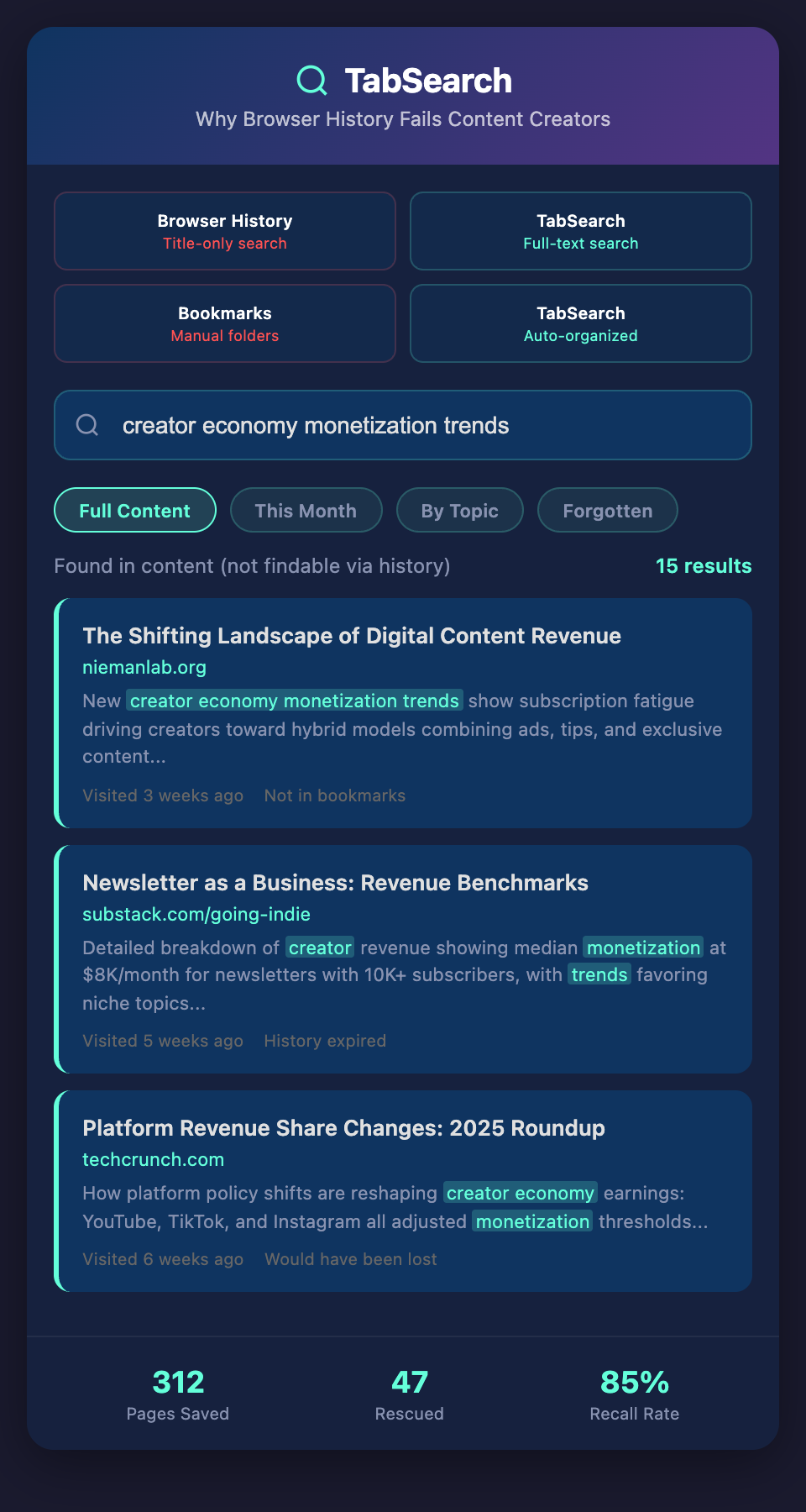
The Three Failures of Browser Tools
Failure 1: Discoverability is Terrible
Browser history shows you websites you've visited, listed mostly by recency. But you don't think in URLs. You think in concepts. "I remember reading something about email engagement metrics" or "There was a tool that did real-time collaboration."
With browser history, you're stuck with:
-
Scrolling through dozens of pages hoping to recognize something
-
Remembering the domain and searching for it
-
Using your browser's Find function on the history itself (which is slow and awkward)
You're solving a URL problem, not an information problem. Browser history fails because it doesn't let you search for information by topic, concept, or content.
Failure 2: Content Becomes Inaccessible
Save a research page to bookmarks. Six months later, you want to reference it. You click the bookmark and get a 404. The page has moved. The site shut down. The article was deleted or behind a paywall now.
Without full-text indexing of page content, you've only saved a link, not the information. When the link dies, the information is gone.
Writers who've been burned by this start having to make difficult choices:
-
Do I spend time manually archiving pages I might need?
-
Do I copy-paste content into documents (terrible for organization)?
-
Do I just accept that research becomes inaccessible after time?
Browser bookmarks are fragile references, not reliable sources.
Failure 3: Knowledge Doesn't Build
Using browser history and bookmarks for research creates a recency-based system. You research for Project A, bookmark things. You finish Project A, move on to Project B. When you need to reference ideas from Project A months later, you scroll through your bookmarks trying to remember which folder you put them in.
Meanwhile, you might not realize that you have extensive research on a related topic. You have sources covering both "email marketing psychology" and "behavioral economics," but because these are in different folders or search results, you miss the connection that would enhance your current article.
Browser tools don't help you see patterns in your own knowledge. They don't surface connections. They don't help your thinking evolve.
Why This Matters for Writers
For a writer or content creator, ineffective research systems have direct financial consequences:
Time waste: Research scattered across browser tabs, bookmarks, and documents means you spend 2-3 hours per article searching for sources you already have. That's 10-15% of your writing time lost.
Lower quality output: You cite fewer sources. You make weaker claims because you can't easily verify them. You miss important nuance because you can't quickly scan related sources.
Repeated work: Without a system that preserves and makes accessible what you've learned, you end up re-researching the same topics. Your sixth article on email marketing requires as much research as your first one.
Missed opportunities: Connection and pattern-spotting across sources leads to better ideas. Browser tools don't help you spot these patterns.
What an Effective Research System Looks Like
It Captures Full Content, Not Just Links
Save pages with their full text, not just URLs. When you need the information, it's immediately accessible. No dead links, no paywalls blocking your reference.
It's Fully Searchable
Every word of every source should be indexed and searchable. You should find that statistic about engagement rates with a simple search phrase, even if you can't remember where you read it.
It's Organized by Your Thinking, Not by Websites
Tag sources by topic, project, content type, or however you actually think about them. Don't force yourself into hierarchical folder structures. Use flexible tagging so sources can belong to multiple categories.
It Integrates with Your Writing
When you're writing, you need your research immediately accessible. You shouldn't have to break flow to search through bookmarks or history. The best systems let you reference sources directly from your writing interface.
It Grows with You
Every article you write, every source you collect becomes more valuable as your database grows. Old research becomes new context. Patterns emerge. You build a compound advantage.
The Real Cost of Browser Tools
Using browser bookmarks and history for serious research is like using a spreadsheet for your business database. It technically works for tiny amounts of data, but it:
-
Creates inefficiencies at scale
-
Breaks down when you need flexibility
-
Fails when data becomes inaccessible
-
Doesn't help you understand your own data
For writers averaging 2-4 articles per month, this inefficiency adds up. That's 24-48 hours per year lost to searching for research you already have.
Building Your Better System Today
If you're using browser history and bookmarks as your primary research system, it's time for an upgrade. You don't need something complex—just something that:
-
Makes capture fast
-
Makes search reliable
-
Indexes full content
-
Grows over time
The good news: such systems exist, and more are coming to market specifically for content creators.
Don't let browser limitations hold back your writing. Join our waitlist to access a research tool built for writers—one that captures content once and makes it searchable forever.